Huzzah! The more people who read those books, the better.
Category: Uncategorized
The recent rockslide at Magheramorne Quarry got me thinking something. Aren’t Night’s Watch castles located in a dangerous area? Large chunks of ice would come crashing down regularly with the change of seasons.
The Wall protects its own.
What advise would you give Mance Rayder?
Build a fleet of ships to ferry people around the Wall instead.

I can’t stop laughing at this panel what’s wrong with me
As someone who writes about politics and comics, and thinks Punisher is a Reaganite asshat/Bernie Goetz analogue this is everything.
Paging @racefortheironthrone.
Also I gotta get on that Daredevil essay…
That is perfect. Let’s be honest. Present day punisher would absolutely be one of those sovereign citizen/survivalist types, but one of the more antisocial ones who don’t get invited to join militias.
Chapter-by-Chapter Analysis: Jon VIII, ACOK
Chapter-by-Chapter Analysis: Jon VIII, ACOK

They glimpsed the eagle twice more the day after, and heard the hunting horn behind them echoing against the mountains. Each time it seemed a little louder, a little closer. Synopsis: a grizzled veteran and a rookie agent are on the run from enemy military forces and hit the end of the road. The rookie agent is ordered by his superior to defect to the enemy. SPOILER WARNING: This chapter…
If King’s Landing does go up in flames as you predict, what do you think will happen to the Sparrow movement? The centre of the Faith will be in Oldtown, but the Reach populace hasn’t experienced the same wartime depredations that radicalised the Sparrows. Similarly, what do you think is currently happening in the Starry Sept vis a vis the new-found power of the Faith but (presumably) absent the religious zealotry and the High Sparrow’s oversight?
I think a lot of the Sparrow movement will be dead, along with the High Sparrow. A sign from the Seven, wouldn’t you think?
Ok im so confused about The Deep Ones. Like why is everyone making such a big deal about them?
Because they’re fans of H.P Lovecraft.
Chris Valentine Asks: Crownlands Economic Development
I haven’t seen any economic plans for the Crownlands or the Iron Throne itself. To be sure, its harder to develop a single systematic approach for the entirety of the 7K, but I’m curious if you do have any particular thoughts on the matter.
Were I on the Iron Throne, my first course would be three of your canals: Mander-Blackwater, Harrenhal, and Seaguard. Between those three, direct waterways are opened to four of the eight realms’ capitals, as well as the bulk of their economic potential.
My next would be a standing professional army built out of the Gold Cloaks. Call them the Gold Guard or King’s Watch or whatever you want. Hire more men, and train them, rotating them between garrisoning King’s Landing, drilling, and patrols of the 7K, particularly the major roads.
Politically, I would adopts a permanent parliamentary style council that represents, at minimum, each of the Lords Paramount, and hopefully all the major noble houses. I woukd expect each house to be represented by a full blood member, which would also serve as a valuable political hostage. Actually authority would be granted to it, though how much, I’m not sure.
Chartering royal cities would also be on the agenda. Ideally, I want them looking directly to the crown, though how much that can be done with the more established cities, I’m not sure. These chartered cities would, ideally, not be governed as feudal fiefs, but by elected councils.
So, this isn’t a bad start, but I do have some suggestions and corrections. The first of which is that you have to remember that if you’re going to do Crownlands economic development, that’s not the same as national development. It means economic development focused on boosting the economy of the Crownlands and King’s Landing, sometimes in ways that help other areas and sometimes in ways that don’t.
Infrastructure
So let’s start with the canals. A Mander-Blackwater canal is a good idea for the Iron Throne, because it means that more traffic will flow through King’s Landing, which enriches the Crownlands and the monarchy specifically. A Seaguard canal should be discouraged, because that would redirect trade from Blackwater Bay to the Bay of Crabs. (This is the same reason why the crown built roads connecting Maidenpool to King’s Landing and not to Lord Harroway’s Town) A Harrenhal canal might be a good idea, but it’s a secondary objective.
However, we’re still not done with infrastructure – namely, bridges. It’s a major limitation that there are no bridges over the Blackwater, which slows down traffic on the Kingsroad, the Roseroad, and the Goldroad. I would once again recommend swing bridges, which would allow river traffic to continue, but also allow me to dictate when land and river traffic could take place (which makes tolls easier to collect, but is important for warfare as well. If you’re dealing with riverrine invasion, you want the bridge blocking the river; if you’re dealing with a land army heading to the capital, swing the bridges away to deny them a crossing).
And down the road, I’ve got some projects in King’s Landing to take care of.
Finance
Now, an army has to come after you’ve got the finances for it. Which means the next step has to be building up the monarchy’s finances. This is where timing becomes an issue: it’s a lot easier to turn the Crownlands into a financial center in 283 AC than it is in 297 AC, thanks to Littlefinger’s embezzlement. Assuming for the moment a fairly stable royal finances, building a Royal Bank of Westeros shouldn’t be that hard. Because in addition to the resources the King gets from King’s Landing and the Crownlands, they also get the taxes they assess both from their vassals and from ports throughout Westeros, making the King one of the wealthiest individuals in Westeros.
Whether the king’s yearly income is 200k a year or 2 million a year, the royal incomes are clearly sufficient to provide the reserves of a bank. Beyond that, the crown also has two advantages that would endow that bank with the genuine power of a central bank: first, as with the regional banks we’ve discussed, the fact that the Royal Bank’s reserves would be funded with tax revenue that will keep coming in in perpetuity as long as I avoid being overthrown gives it the ability to be a true lender of last resort, with the added advantage of drawing in tax revenue from across a continent rather than a single region.
Second, as King I have the unique power of seignorage, both in the sense of having the right to make coins and the profit I can derive from the difference between their face value and their metallic content. This means two things – first, until I distribute the coins I mint, I can count them as part of my reserves, and secondly, the bank’s notes are legally money. Not only does that greatly add to my ability to be a lender of last resort, but as long as I don’t abuse this power to the extent that those notes lose their value, I can print money and spend it.
As with the infrastructure above, this is something I want to make sure doesn’t happen elsewhere. A Lannister bank is all of the sudden a real threat to the sovereignty of the king, because a Lannister banknote now threatens to become an alternate currency. So I will insist quite heavily that a royal charter is necessary to form a bank and very carefully not give one to any house that could challenge me, while using charters to woo the merchant class. However, loyal vassals might want to petition me for permission to operate a branch of the Royal Bank, which I would be happy to grant so that I can count Casterly Rock’s gold reserves as part of my reserves, while still keeping control over monetary supply and policy in Westeros.
Production
Another thing that the Crownlands has going for it is an unusually high concentration of skilled workers. Some of the best smiths, weavers, tailors, cobblers, and tanners, to say nothing of bakers and fishermen, work in King’s Landing. That’s a good industrial base to be getting on with.
However, all of this production is on a typically medieval small scale and it’s not the best in the world. So with all of this finance behind me, it’s time to start expanding production in scale by building large-scale industrial suburbs (which will also help a good deal with pollution in the city). At the same time, it’s definitely time to start practicing some of the immigration and industrial espionage policy I’ve discussed before to start improving the quality of our goods.
Another thing that large-scale industrial policy is good for is to upgrade the quality of my military forces. The Crownlands may only have 15,000 men, but if I can outfit all of my infantry in full plate and have them fight like dismounted knights, while improving the training of the Goldcloaks so that they can actually fight effectively as a military force, they will wipe the floor with the infantry of every other region.
Political Development
So, politically, I’m pretty much in agreement. Basically, the idea is to move to a Parliamentary system by way of Versailles and Edo – generating political consent, but also creating hostages.
Militarily, I disagree. A large standing army is politically controversial (smacks of tyranny) and is expensive. (Remember how ruinous Cersei’s tripling the Gold Cloaks was?) I would instead create a new order of knighthood several hundred if not several thousand strong. A royal order is politically attractive – look at the response to Renly’s Rainbow Guard and the Brotherhood of Winged Knights – and it gets me highly trained soldiers who I don’t have to pay wages for.
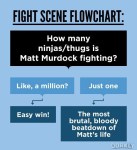
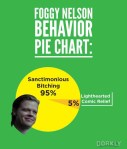
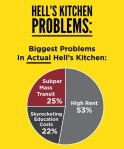
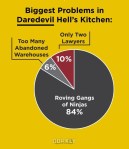






This is highly accurate and entertaining in most ways but the graphic on the top problems facing real Hells Kitchen is a bit off. It should be more like 85% of the problem is high rent. I worked on a campaign in the neighborhood years ago (and I still go there a ton). I don’t claim to have the expertise of a current resident of the neighborhood. But if there is ONE thing I know for sure about new york it’s that the cost of education is NOT skyrocketing.
Why?
Because we have free fucking public education. It’s underfunded.
Our schools are over crowded. There need to be new buildings. They need recess, art classes, more ESOL and less standardized tests.
But the COST of education? What could that be referring to?
The cost of pre-school is an issue. In NYC we have FREE PRE-K (Thanks to groups like mine and to our Mayor Bill de Blasio) but that only starts when kids are 4 or 5 years old. We need pre-k for 3 year olds and yes the cost of that is too high.
In conclusion: tax millionaires to fund education. Sign our petition to show your support.
And get ready for the essay I’m writing in a new ebook. It’s going to be about Hells Kitchen in the MCU. And it’s going to rock.

I love Phonogram so much and now that fact is on printed matter. I’m so excited that my review was excerpted on the back of The Immaterial Girl’s Trade Paperback– available in bookstores near you!
Godbless @teatime-brutality for flagging me on this. He’s up there too saying deep stuff of course.
Anyway, what I wrote is true: if you love music you need to read Phonogram. Even if you don’t love the music in Phonogram.
I reviewed issue 1 to tell you why you should read the series, I wrote a big thinkpiece on issue 2 and the series in general which I’m very proud of, I talked about breaking up with bands, depression and our protagonist’s personality crisis when covering issue 3 (which is a bit of a rambling post), I made a fanmix for issue 4 and then I opened up my guts covering the series conclusion, using Ziggy Stardust as an extended metaphor for Phonogram’s ending– ie The Immaterial Girl’s Rock and Roll Suicide.
ICYMI here’s the latest @graphicpolicy radio interview with Kieron Gillen.
He’s the best comics writer of my generation. Possibly yours. How old are you anyway?
PS I think this is my first review to be published in a TP. Thank you @kierongillen
Whoo-hoo!
 RFTIT Tumblr Backup