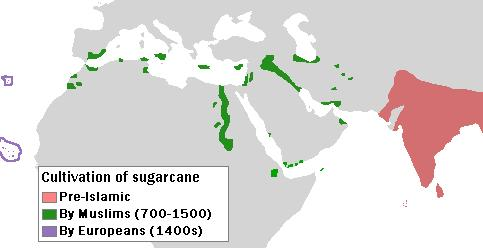
It’s not that sugar was impossible to get – it was just difficult to get your hands on, because sugar beets didn’t exist yet and sugar cane didn’t grow in most of Europe, so it had to be imported and was thus rather expensive.
(credit to Bless sins at Wikipedia)
By contrast, honey and fruits and nuts were plentiful, cheap, and right to hand, so it was a lot easier to sweeten dishes with those things than with imported sugar.
By the way, this is why European royalty were absolutely nuts for elaborate deserts made out of spun sugar and the like, because they were ostentatious displays of how ludicrously wealthy they were, that they could afford not just a bit of sugar but ALL THE SUGAR.
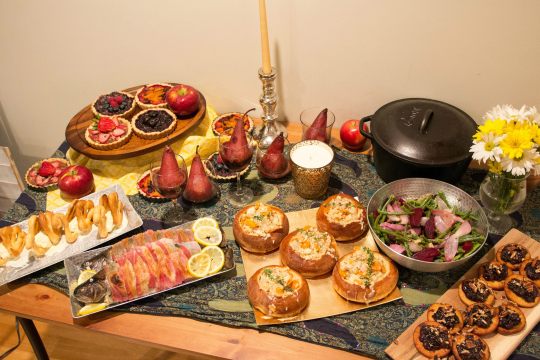
Well, Westeros leans more to harvest festivals than “Thanksgiving,” but I would imagine neeps (and probably parsnips too, based on English Christmas meals I’ve had where the potato and yam are less represented than in the U.S) are pretty heavily represented as a starchy side-dish, since potatoes don’t exist in Westeros (nor do any New World crops).
However, we don’t have to guess, since we have an example of a Northern harvest feast from Bran III of ACOK:
Such food Bran had never seen; course after course after course, so much that he could not manage more than a bite or two of each dish. There were great joints of aurochs roasted with leeks, venison pies chunky with carrots, bacon, and mushrooms, mutton chops sauced in honey and cloves, savory duck, peppered boar, goose, skewers of pigeon and capon, beef-and-barley stew, cold fruit soup. Lord Wyman had brought twenty casks of fish from White Harbor packed in salt and seaweed; whitefish and winkles, crabs and mussels, clams, herring, cod, salmon, lobster and lampreys. There was black bread and honeycakes and oaten biscuits; there were turnips and pease and beets, beans and squash and huge red onions; there were baked apples and berry tarts and pears poached in strongwine. Wheels of white cheese were set at every table, above and below the salt, and flagons of hot spice wine and chilled autumn ale were passed up and down the tables.
…The serving men brought every dish to Bran first, that he might take the lord’s portion if he chose. By the time they reached the ducks, he could eat no more. After that he nodded approval at each course in turn, and waved it away. If the dish smelled especially choice, he would send it to one of the lords on the dais, a gesture of friendship and favor that Maester Luwin told him he must make. He sent some salmon down to poor sad Lady Hornwood, the boar to the boisterous Umbers, a dish of goose-in-berries to Cley Cerwyn, and a huge lobster to Joseth the master of horse, who was neither lord nor guest, but had seen to Dancer’s training and made it possible for Bran to ride. He sent sweets to Hodor and Old Nan as well, for no reason but he loved them. Ser Rodrik reminded him to send something to his foster brothers, so he sent Little Walder some boiled beets and Big Walder the buttered turnips.
So if we look at the menu, you’ll notice that the meats tend towards game animals – aurochs, venison, duck, fish, pigeon, boar – although there are some stock animals like beef and mutton and poultry as well, which points to the necessity of trying to keep as much of the livestock alive through the winter as possible so that you can continue to get eggs, milk, cheese, and wool off of them.
As far as starches go, in addition to the trenchers which serve as plate and bread at the same time, you have black bread and oaten biscuits, which speaks to the northern climate where hardier grains like oats and rye do better than more fragile wheat. There’s a lot of starchy veg as well, with leeks, turnips/neeps, (parsnips don’t show up here but they do in other feasts), etc. “Pease” refers to pease porridge, which is usually made with bacon or ham as well as carrots, onions, turnips, and various spices.
Also as you might expect from a harvest meal, there’s a lot of seasonal fruits, both used as sauces and served on their own, and it’s all richly spiced both for flavor and as a preservative b/c food cannot be wasted.
Yes, I listen to the Revolutions podcast. And I echo the recommendation.
In terms of Westeros, not really because there’s not a standing army. Not that you can’t have political movements by knights, but they tend to have different dynamics.
So my initial plan is to do a chapter-by-chapter of Fire and Blood, although it’ll probably be in bullet point form similar to what I did with WOIAF.
Then, I was planning to do an update on some of my essay series, similar to how I wrote a followup essay about “Hollow Crowns and Deadly Thrones” after WOIAF.
At the moment, I don’t have any definite plans for which essay series to revisit: obviously, the “Hollow Crowns” series is most likely, but whether I’ll do the “Hands of the King” or “Laboratory of Politics” depends on what kind of material there is in Fire & Blood Volume 1.
The officer corps tend to be important in revolutions and coups for a couple reasons:
first, they tend to have more cultural capital than the rank-and-file, which means that they tend to be more plugged in to political ideas (which is necessary for perceiving poor conditions as injustice) and political movements (which are important for coordination). They also tend to have a higher socioeconomic status, which means that they feel that they deserve a political voice.
second, as I discussed before, the rank-and-file spend a good part of their training learning to obey orders from their officers, and looking to them for guidance. This means that when a crisis happens, if the officer corps says “crush the rebels” or “don’t join the rebels,” the rank-and-file tends to do just that, often to the great disappointment of the rebels. (See the June Days of 1848, or the June Rebellion of 1832 that inspired Les Miserables.) On the other hand, if the officer corps says “don’t fire on the protest” or “we’re going to overthrow the monarchy in the name of the people,” they also tend to obey. This is why it’s very stupid to do things that antagonize them, like when Charles X dissolved the National Guard in 1827 but forgot to take their weapons…
It is in the nature of historians to be pedantic about periodization and labelling, but I would argue that we should stick with the name.
It’s already in common use, so it’s a term that people will understand when historians use it, whereas they might not understand a new term which isn’t much used.
The name speaks to the unusual nature of this Westerosi civil war, that rather than a fight between two factions over the succession as was the case in the Dance and the Blackfyre Rebellions, you have many sides, not all of whom are interested in the Iron Throne but all of whom ultimately claim royal status.
It’s not uncommon for names to be not quite accurate when it comes to complicated conflicts. For example, the War of Jenkin’s Ear is technically part of the War of Austrian Succession, but in the former Britain and Spain were not fighting over the succession of Archduchess Maria Teresa and in the latter, no one was fighting because Spanish coast goards cut off the ear of a British smuggler.
As to the War for the Dawn, I think it will be seen as a second conflict, as the cause, sides, conflict zones, etc. will be distinctly different from the War of the Five Kings.
My guess is that you probably have the three male gods on one side and the three female gods on the other, and the entryway is the Stranger (symbolizing the whole death and rebirth thing).
In terms of ordering, I would guess that if the bottom side is the door/Stranger, and then going around the room on the right hand side, it probably goes Smith, Warrior, Father, Mother, Maiden, Crone.
Thus, symbolically, the Smith and the Crone are in the back (because who cares about peasants and old women), the Warrior faces the Maiden he’s supposed to protect, and the Father and Mother are side-by-side.
That makes complete sense. And for the record, in The Mystery Knight, Dunk crosses Whitewalls’s sept to find Egg by the Father’s altar. And then in his fight with Black Tom Heddle, they battle until Dunk’s backed into the Father’s altar, then he forces Tom backwards all the way across the sept and cuts his arm off by the Stranger’s altar.
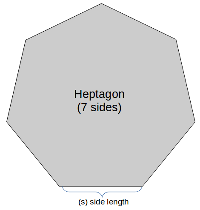
with the doorway in one of the pointy ends, trimmed off.
Huh. Interesting. Miller’s design is a bit weird, imo, because whichever of the seven is on the wall across from the door would seem to have way more visual prominence than the others, which cuts against the whole Seven Who Are One thing.
It also bugs me a bit that the doorway technically makes it eight-sided.


 RFTIT Tumblr Backup