Short version: because it contained some really dumb strawmanning of people who have been disagreeing with Nick Spencer’s politics on Twitter.
Long version: working on a blog post.
Just a backup in advance of the detumblring
Short version: because it contained some really dumb strawmanning of people who have been disagreeing with Nick Spencer’s politics on Twitter.
Long version: working on a blog post.
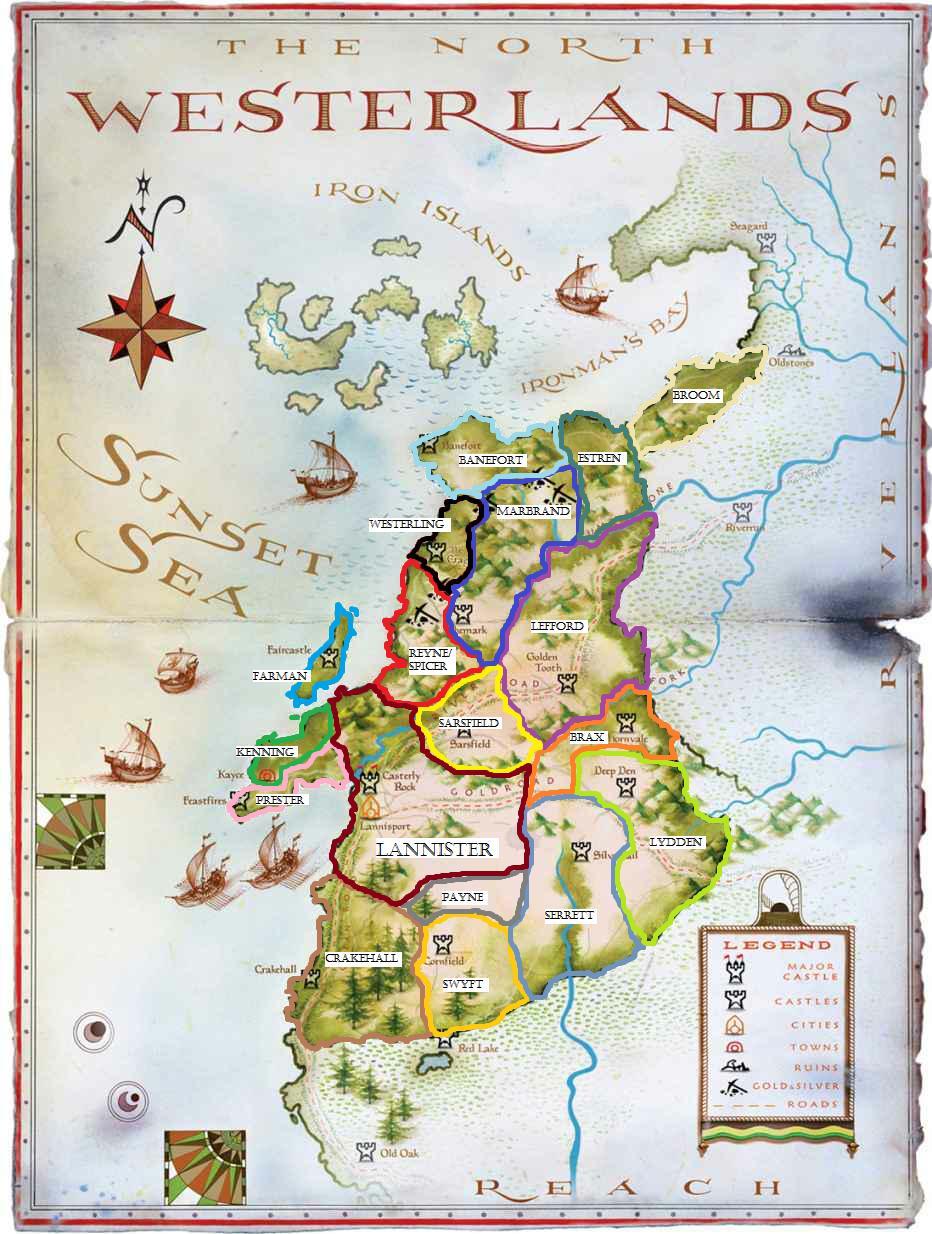
Politics of the Seven Kingdoms, Part VI (The Westerlands)
Hey folks! If you’d like to read my essay on the politics of the Westerlands collected together in one place, it’s now up on Tower of the Hand here. Check it out!
Well, I don’t know about Nancy Isenberg, but in Sean Wilentz’ case, I know that this goes back to something of a generational divide within American History: during the late 40s/50s/early 60s, there was a generation of historians who were looking for a “usable past” that would find roots for New Deal liberalism dating back to the 19th century and hopefully to the American Revolution, and who found it in the 19th century Democratic Party. This includes folks like Arthur Schlesinger Jr. (especially in his argument that Andrew Jackson was the first coming of FDR because banks = evil), Gordon Wood (Radicalism of the American Revolution), and yes, Sean Wilentz. Chants Democratic (1984), the book that made Wilentz’ career, was an attempt to find an authentic, class-conscious, anti-racist working class politics in the various “Workingmen’s” political movements within and around the Democratic Party in the early 19th century NYC.
Now, there were always problems with this particular analysis – for one thing, you had to look very hard to find people who fit Wilentz’ schema, because Tammany Hall was laissez-faire on economic policy, the Democratic Party very waffly on unions until quite late, and you have to go pretty far into the margins of the 19th century Democratic Party to find someone who was anti-slavery, let alone anti-racist. For another, the comparisons only worked as long as you focused on a limited area of anti-capitalist/populist rhetoric (working people good, banks and big business bad) or public policy (support for the income tax, or the Nullification Crisis) – because once you start looking too closely, the dark side of the 19th century Democratic Party becomes too obvious to ignore. Finally, it simply ignored too many complicated shifts in national politics that took place after the 19th century without which you wouldn’t have a Democratic Party that any of its current members would ever have joined.
And then came along a new generation of historians who took a revisionist approach to the study of political parties in the 19th century, one more attuned to concerns of race and Jim Crow, war and empire. And these historians pointed out, quite accurately, that the 19th century Democratic Party was the party of white supremacy, both pro-slavery and pro-imperialism (indeed, the two things went hand-in-hand for much of the 19th century as many of America’s wars of expansion were wars to acquire land for slavery to expand into), that it was the party that invented the idea of States’ Rights, nullification, and strict constructionism, and so on.
By contrast, these scholars looked at the 19th century Federalists, Whigs, and Republicans and instead of seeing the elitist party of big business, saw political parties that believed in an activist Federal government in economic policy (nationally planned public works, central banking), social welfare policy (the construction of schools, hospitals, orphanages, asylums, etc.), and civil rights, that (however ineffectively or inconsistently) opposed imperialist wars against Native Americans, Mexico, etc., that believed in social reform and had links to major social movements.
To bring this all back to Hamilton, Chernow’s biography was definitely in the latter camp, emphasizing Hamilton as an upwardly mobile immigrant, a modernizer, anti-slavery advocate, champion of an activist Federal government against the opposition of southern slaveholders like Thomas Jefferson.
Funny, I’ve always thought of the people of the Vale as having something of a Welsh accent. Must be all those mountains and valleys, and the fact that I saw Pride recently and that movie really makes you want to say everything in a Welsh accent.
Don’t really have much of a headcanon of other Westerosi accents. We know that “the Dornish speak the Common Tongue” with an accent that involves “stretching some sounds, rolling others, and lilting still others in odd places,” due to the influence of Rhoynish. We know that there is a distinct Northern accent, as Brienne meets a member of the BWB (likely Harwin whose voice is “frosted with the accents of the north.” Given that the names of the FIrst Men are described as “short and blunt and to the point,“ and that the Old Tongue is described as sounding “gruff and guttural, but Jon heard the music in it and recognized the Old Tongue,” the Northern accent is likely similar.
The Free Cities I’ve always thought of as having various Romance language accents, given their common linguistic decent from Valyrian similar to the relationship between the Romance languages and Latin. Although in-universe their accents in Westerosi are described as “liquid” or “lilting.”
This is more of a question for @goodqueenaly, but I’ll take a first stab at it.
Normally, it’s not ok. This is why morganatic marriages exist, and why those few royals who did marry downwards usually ennobled their intended before the wedding (I’m thinking of Henry VIII making Anne Boleyn the Marquess of Pembroke prior to their marriage).
Most likely. Or the equivalent thereof.
The former, I think. But if you want a further explanation, see here.
Given that Quellon Greyjoy was the one to ban thralldom, I’m going to say no.
I think it’s more a question of location, location, location:
These depredations finally led the Kings of Winter to send their own war fleets to seek dominion over the Sisters—for whoever holds the Three Sisters holds the Bite.
War had already been avoided by Baelor’s peace treaty, so no that dog won’t hunt.
 RFTIT Tumblr Backup