Well, with the big Westerlands essay done, the next writing project is Jaime II of ASOS. That’s going to be a while coming, so in the mean-time, let’s see what we have on the Tumblrs: How did “forest laws” work? European reaction to the French Rev vs. the English Civil War. Some thoughts on Oliver Cromwell: Part I Part II Why is slavery illegal in Westeros? Thoughts on Sir John Churchill. What…
(2/2) Westeros seems to, or someone somewhere is producing an outrageous quantity of food. Given the geography of the Free Cities, I can’t help but think that a) the Disputed Lands were unquestionably very fertile and productive; b) Pentos’ lands were extremely valuable; c) Braavos’ coastline was more important than previously implied; and d) the banks of the Rhoyne were highly lucrative. What at your opinions? Thanks!
Excellent question! Yeah, the agricultural economy is absolutely fundamental to the broader political economy of Terros.
Volantis’ vast Rhoynish hinterland – Volon Therys, Valysar, and Selhorys, etc. -seems eminently capable of feeding the metropole through organization into latifundia. It seems that cold beet soup, i.e borscht, is a staple of the Volantene diet, and as any number of central and eastern european peasantries can tell you, you can feed a lot of serfs on borscht.
I’m somewhat skeptical as to how much food the Braavosi coastline can produce, but I imagine they produce some because you can’t rely entirely on imports from Westeros given the vagarities of sea transportation.
No, I don’t think so. Rather, I think the two Houses would merge, and depending on how far apart their fiefdoms were, there might be a castellan ruling one holdfast while the family ruled the other or they might split their time between the two, etc.
It’s a fair cop, guv; I find the Blackfyres interesting in much the same reason that I find the Brackens interesting – they’re the unloved losers of historical conflicts and I’m curious as to what motivated them.
But I do want to push back on something: Daeron and Co. were not on Team Smallfolk.
Were there women in Daeron’s court? Yes, noblewomen. Were there Dornishmen? Yes, highborn Dornishmen. Did any of them care or understand about the smallfolk in the slightest regard? Ask Tansell Too-Tall.
To the extent that Daeron was a reformer, he was an elite reformer focused on questions of efficiency and honesty in administration, and the project of peacefully unifying Dorne under Targaryen rule. He was not Aegon V.
Now, Jaime would have an unusually difficult time because there would be the argument raised against him that he wasn’t the rightful Warden of the East, that the lords of the Vale were of course ready and willing to answer the call from an Arryn, etc. etc.
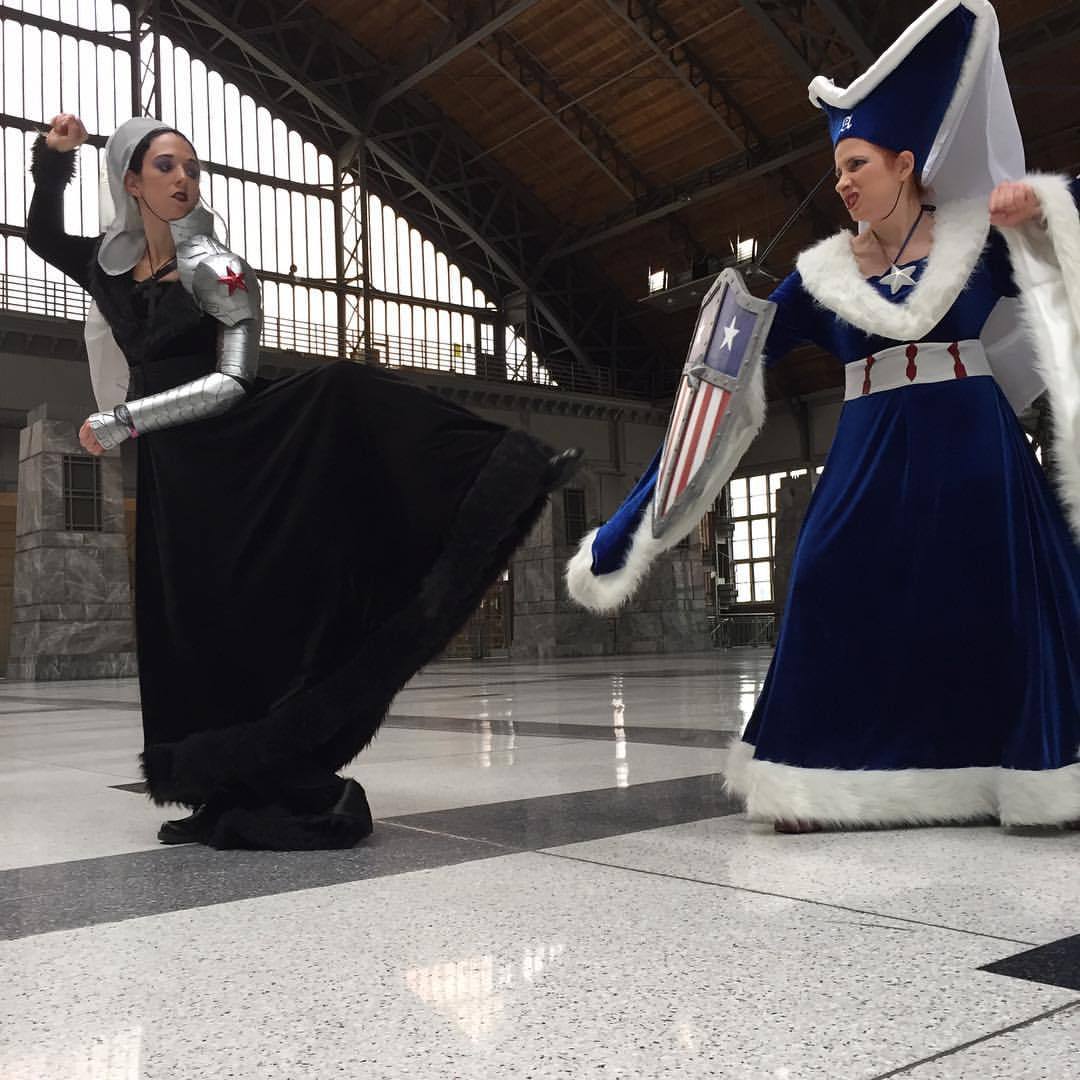
Civil War of the Roses! Thank you to @tea_time_for_mad_girls for taking this photo! #captainamerica #wintersoldier #captainamericacosplay #wintersoldiercosplay #captainamericacivilwar #teamcaptainamerica #cosplay
I LOVE EVERYTHING ABOUT THIS.
Well, this speaks to my overlapping interests so much that the Venn diagram is just a circle.
As I’ve discussed earlier, one of the major areas of disagreement I’d expect to see would be competing claims for regional pre-eminence, similar to how the Bishoprics of Rome, Constantinople, Alexandria, and Damascus fought to be recognized as the first among equals. So I’d definitely see whatever the Sept of the Vale is claiming that as the oldest Sept, they should outrank the Starry Sept, and so on.
However, I also imagine you’d see quite a bit of syncretism to local conditions, similar to what we saw with the Ironborn. So I would be very surprised if the Dornish church hasn’t figured out some way to square the circle between the Faith’s precepts and Dornish customs, I imagine you’d see some remnants of Rhoynish religious imagery – the Mother is going to look a LOT like the Mother of Rivers, and I imagine you’d see a lot of turtle icons in Dornish septs. Likewise, given the way in which things like chivalry were imported into the Reach’s legends of Garth Greenhand and his offspring, I would also imagine that the Father in the Reach bares a lot of visual similarity to the green man of the Reach.


 RFTIT Tumblr Backup