In a church that has seven sides, each of them significant, which God has to host the door to get in?
Good question!
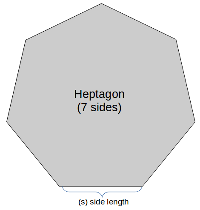
My guess is that you probably have the three male gods on one side and the three female gods on the other, and the entryway is the Stranger (symbolizing the whole death and rebirth thing).
In terms of ordering, I would guess that if the bottom side is the door/Stranger, and then going around the room on the right hand side, it probably goes Smith, Warrior, Father, Mother, Maiden, Crone.
Thus, symbolically, the Smith and the Crone are in the back (because who cares about peasants and old women), the Warrior faces the Maiden he’s supposed to protect, and the Father and Mother are side-by-side.
Same anon asking about becoming a Historian- what kind of courses did you take? What kind of things did you learn? I kinda want to teach history too yet im scared of presenting. Im trying to overcome that fear on my own but are there any parts in courses that help or does one need to go to teaching school?
Hello again!
As an undergraduate, I took a pretty wide range of courses in history: I took a course on the Early Roman Empire, a course on the Late Roman Empire, a course on Greek and Roman political philosophy, a course on the history of capitalism, Eric Foner’s class on the American Left and his class on the Civil War, Simon Schama’s course on narrative history, Kim Phillips-Fein’s course on the history of public policy, a course on the history of capitalism, a course on African-American history from Reconstruction to the present, and a bunch I’m sure I’ve forgotten in the years since.
As a graduate student, there was a core set of courses you have to take: as an Americanist, I took a three course sequence that covered early, middle, and modern American history, but there were also required courses on historical methods and historical theory. As someone who studied public policy history, I took a lot of courses on that. I also took courses to round out my other fields, so I took a bunch of intellectual history courses, a bunch of labor history courses, and some modern European history courses.
In terms of teaching, I think the only way to get over that fear is learning by doing, which you do starting as a teaching assistant, where you don’t have to write up the syllabus or lectures (although you should absolutely pay attention to how the professor set up both and how you would do things similarly or differently), but you do have to walk the students through the readings, do the grading, answer students’ questions, etc. Then a bit later you probably get asked to give a guest lecture or two, which gets you used to the public speaking part of the job, and then you end up teaching a course on your own which is initially a lot of work and scary but eventually you learn how to do it.
Since Jorah was annointed by the High Septon himself, are we sure he didn’t convert to the Faith (at least superficially) to be knighted?
Other Watsonian explanation: he WAS anointed by the High Septon, but actually KNIGHTED by Robert.
The full, fancy knighting ceremony, with vigils and ceremonies and suchly, involves both “dabbing and dubbing.” Sandor Clegane, Sansa II, AGOT:
So here’s the thing: Illyrio says that Jorah was anointed by the High Septon. However, Jorah says in ACOK Dany I that he got his knighthood for storming the breach at Pyke, and the WOIAF app confirms that Robert knighted him.
There’s a coujple Watsonian explanation: Jorah might have been anointed in a victory celebration later but didn’t convert, or Illyrio’s making shit up b/c he wants Dany to trust Jorah so that Jorah can be his man on the insdie once Dany leaves for Vaes Dothrak.
The Doylist explanation: early installment weirdness on GRRM’s part.
Gregor got his ointments too. Four years later, they anointed him with the seven oils and he recited his knightly vows and Rhaegar Targaryen tapped him on the shoulder and said, ‘Arise, Ser Gregor.’“
The anointing the and actual knighting are part of the same process but two separate steps of it that are probably done by two separate people; any knight can make a knight, but I bet you need a septon for the anointing.
It is entirely logical that Robert dragged the High Septon with him to Pyke, especially since campaigns against the Iron Islands are kinda-sorta holy wars be default. And we know that handing out post-battle honors can be a lengthy, time-consuming process done en masse; witness all the knightings and awardings of honors taking all damn day after the Blackwater.
My in-universe guess would be that Ser Jorah was kneeling in a line along with like, forty other dudes, and the High Septon walked on down the line and anointed them all with the seven oils (the dabbing), and then Robert called them up one by one and tapped his sword on their shoulders (the dubbing.)
I would be very surprised if Robert dragged the High Septon to an active warzone. But I agree that it was likely a mass ceremony.
Thoughts About Bran Stark
So, I’ve been thinking, and I have Thoughts About Bran Stark. More specifically, I have thoughts about Bran’s injury. I’m not an expert or anything, but…
In some ways, it seems like Bran Stark might be the luckiest cripple in Westeros. Based purely on what we see, the level of function he gets to keep after being pushed out of a window is really, REALLY high. Abnormally high.
He’s got full and unrestricted control of his upper body (including fine motor stuff with his fingers, which sometimes deteriorates even if it’s not totally lost) and even potentially some of the lower – he can’t feel or control his thighs or anything lower than that, but he seems able to use his hips at least a little bit. Not all paraplegics have that, since the level of control you get to keep depends on exactly where your injury is and exactly what kind of damage was done in that spot.
He’s had no mention of pressure sores or of circulation issues. This is huge. Circulation is an almost universal issue for people with limited mobility, including me and every wheelchair user I’ve ever met, but Bran doesn’t have a hint of it. We’d KNOW if he did, because cold makes circulation issues much worse and he’s been north of the Wall for sodding ages. If there was any character who should have serious issues in those conditions, it’s Bran, but Bran’s fine and somehow it’s Jojen Reed who falls apart.
He SEEMS to have surprisingly good bladder and bowel control. Again, this varies depending on where the injury is and what kind of damage was done…but there’s no mention of it, which sticks out a bit considering how happy GRRM is writing characters (even very young ones) being helplessly and gratuitously biological.
Every flip of the coin after his injury seems to have gone Bran’s way. Every single one. As I said, I’m just a layman…but he seems to have been freakishly lucky.
Is this just me?
Thoughts? Anyone? @nobodysuspectsthebutterfly, @racefortheironthrone, @dknc3? @joannalannister? @cynicalclassicist?
My own experience with disability doesn’t extend to paraplegia, but after thinking about this a lot recently wrt to Jaime and amputation, I think you have a point here. My guess is that the “luck” has to do with plot requirements – it’s already barely plausible that Bran could make it from Winterfell to Bloodraven’s treefort in the midst of winter, and adding on more realistic side-effect issues only makes that tougher.
Since Jorah was annointed by the High Septon himself, are we sure he didn’t convert to the Faith (at least superficially) to be knighted?
So here’s the thing: Illyrio says that Jorah was anointed by the High Septon. However, Jorah says in ACOK Dany I that he got his knighthood for storming the breach at Pyke, and the WOIAF app confirms that Robert knighted him.
There’s a coujple Watsonian explanation: Jorah might have been anointed in a victory celebration later but didn’t convert, or Illyrio’s making shit up b/c he wants Dany to trust Jorah so that Jorah can be his man on the insdie once Dany leaves for Vaes Dothrak.
The Doylist explanation: early installment weirdness on GRRM’s part.
RFTIT Tumblr Weeklyish Roundup
RFTIT Tumblr Weeklyish Roundup
Hello everyone! So, we’re heading into a really interesting period. FIre & Blood Volume Iis almost upon us – my plan is to do an extended bullet-point chapter-by-chapter analysis, and then probably a new Hollow Crowns followup essay like I did after WOIAF came out – and then I’ve got the last part of Hour of the Wolf, and I’m writing outlines for ASOS with the aim of getting to the mid-point of…

Do you think Ned was ever offered knighthood when he was growing up in the Vale?
Maybe? It could be that Vale knights would particularly insist on the link between the Seven and knighthood, given their cultural traditionalism on everything else, as opposed to Robert who clearly didn’t give a damn when it came to knighting worshippers of the Old Gods.
It wouldn’t have been appropriate to give the second born son of the Lord of Winterfell (formerly a kingdom) a foreign knighthood as it was lower status than Ned’s pre-existing titles. If anon’s talking about Ned actually joining the Knights of the Vale; he couldn’t possibly. He’d have to swear allegiance to House Arryn in a way that would make his duties to Winterfell and House Stark impossible. His allegiance lies with Winterfell, it wouldn’t make sense for him to be offered and accept a position in a foreign military force. If this had happened in the 15th/16th century for instance several eyebrows would be raised and it’d definitely be seen as an insult.
I don’t think that’s how it works. No one thought it was inappropriate for Jorah Mormont to be knighted, even though he was Lord of Bear Island. And as a second son, Ned didn’t have a title.
Hello, I’m kind if knew so I’m assuming a lot but are you a historian? You know so much about different things in history so that’s the only thing I can come up with. I’m asking this bc I want to be a historian as well but I’m not sure exactly how-to pursue it. I’m also in Canada too so who knows how different it is, though I’m assuming there has to be some general similarities. If not, could you say what it’s like at least, sorry if this question is super weird.
Yep. I’m an officially minted PhD historian and adjunct professor.
In terms of how to pursue a career in history, in general terms, you probably need a BA in history (although I imagine you could get away with a BA in interdisciplinary studies), then you apply for grad school in history, then you get a degree and you try desperately to get a job. If you have more specific questions, I’d be happy to answer them.
I feel it’s important to say right at the start that the history job market is really bad right now; there’s way too many PhDs for the number of jobs out there, there’s fewer and fewer full-time positions and a lot of us are working part-time. So you need to be sure from the start that this is something you really want to do, and you absolutely need to make sure that the program you’re applying to will provide full funding, because you don’t want to go into debt getting a history degree.
However, there are options for jobs outside the academy if you go through a history program which can give you a credential you can apply towards working in a museum, or something like that. In my case, I got my degree in the history of public policy, and now I teach in a public policy program rather than a history department.
Hi Steven! I’m currently trying to worldbuild for a story & was searching thru your blog for money & economics for the middle ages. It’s been v helpful (more so than my wiki searches) but I’m still not quite grasping how they decide the worth of coins. I know the more gold in supply effects the worth but how do they decide gold is X value? Also if you know of any resources/links that would be v helpful, since I don’t want to keep bothering you w/ questions. Thank you so much for your time!
The way that medieval coinage would generally work is that a decision would be made about how many coins would be struck from a given weight of metal, which would therefore indicate the value of the individual coin.
So to take the pound as an example, starting with King Offa of Mercia, the Anglo-Saxons established that 240 silver pennies would be struck from one pound weight of silver, and further than one penny was worth four farthings and twelve pennies were worth 1 shilling (which meant that twenty shillings were worth one pound). Offa in turn was borrowing from Charlemagne, who established that one pound of silver was equal to one livre, which was worth 20 sous/sols, which in turn were worth twelve deniers. Keen eyed observers will note that the notations for the different currencies – l, d, s – are the same in the British and Frankish systems. The reason for that is that Charlesmagne and his copiers in England, Italy, Spain, etc. were in turn copying Roman currencies: the “l” stands for “libra,” the “d” for “denarius,” and the “s” for “solidus.”
In other words, tradition and culture matters. Rome was associated with a commercial, currency-based economy and even after the fall of the Roman Empire, the memory of that economy was still strong, so associating your coins with theirs went part of the way towards ensuring that people thought your currency was good.
So for gold coins, you’d figure out how many coins would be struck from how much gold. Again, to take the English example, the “noble” was the first English gold coin to circulate widely. Originally, the noble was 138.5 grains or 9 grams of gold, so that one pound of gold would produce 453 or so nobles.
However, one thing to keep in mind is that, with a metallic standard, the government has to be careful that the cost of the coin doesn’t exceed its value (which means you’re actually losing money by making it), and there’s always an incentive to exercise the right of seignorage by declaring the face value of the coin to be greater than the actual metallic content of the coin (which means you’re making money by making money). Combined with the constant problem of private individuals producing counterfeit coins by clipping, sweating, or plating, the actual weight and purity of the currency in circulation tends to change over time.
OP, a good way of thinking about it for worldbuilding purposes:
The coin is worth nothing. It’s the quantity of metal that is worth something. The coin is merely a convenient form for the metal to take.
You know how scales are associated with merchants and trade? They have that association because any good merchant or tradesman would have a set of scales with weights (and the laws regarding this could get complex and intricate real fast) and they’d stick your coins on the scale when you went to make a purchase. If you gave them coins that were supposed to equate to a certain weight of metal, and they come in below that weight because they’d be sweated or clipped, they’d be all “you still owe. Put coins on the scale until it balances.”
That request could actually lead to MORE clipping; in order to make the scales balance, you might need more weight than was in X amount of coins but less weight than was in X + 1 amount of coins. So you’d take a coin and clip off a piece. (This might or might be illegal depending on the jurisdiction or the coin issuer; some coins were DESIGNED to clip.)
And of course this could all lead into more areas of fraud and abuse, because the scales have trouble detecting coins that have been adulterated, and unscrupulous merchants might doctor their weights, so as to slowly collect extra 1/50th of a pound weights of metal over a long period of time…
This is largely accurate, but as someone who’s read his share of MMT, there is one important proviso: the coin matters a lot when it comes to taxes and government purchasing. So even if the coin is debased, if that’s the unit that taxes are paid in and which you get paid in when the king’s soldiers show up looking to buy grain, it has value from that.
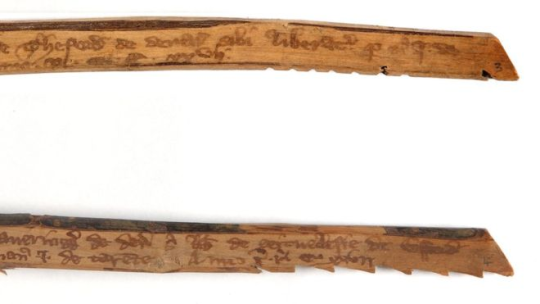
Which brings us to the non-metallic currencies that existed in medieval societies. See, in a world in which there’s a lot of barter rather than currency-based commerce because precious metals are scarce and a lot of people are subsistence farmers, tally-sticks would be used as records of tax payments or public debt. And because their value was back-stopped by the ability to turn them in lieu of tax payments or as letters of credit, they circulated as currency.
 RFTIT Tumblr Backup