RFTIT Tumblr Weekly Roundup!

RFTIT Tumblr Weekly Roundup!

Hello everyone! It’s been a super-busy week: the Kickstarter launched (which if you haven’t contributed to yet, we’re only $40 away from unlocking a Dunk and Egg essay series), a whole bunch of chapters got posted, I did a guest post on Tower of the Hand, and a guest appearance on the History of Westeros podcast! However, I didn’t neglect my Tumblr fans either, so we have some interesting things…

View On WordPress

A question prompted by your kickstarter page; What do you think of Joe Abercrombie’s work? Oviously there’s not as much to work with in terms of worldbuilding and, arguably, characterisation, but I think he writes the best fight scenes around.

Well, I’ll discuss this in more depth when I write the bonus essay, but I ultimately feel that Abercrombie is better at tearing down the tropes of traditional fantasy than he is at building his own. I actually usually like his characterization; I think he has a knack for making us empathize with really flawed and unlikable people. And he does write amazing action scenes. 

But I started to find that, as I read his books, they tended to make me feel depressed and angry. And when I tried to figure out why, it was that, when all of your characters are awful people, when your plots always end with the world a worse place, what was once a bracing and surprising shock just becomes dreary miserablism. And speaking from a meta perspective, I don’t find Black vs. Black Morality any more mature or realistic than Golden Age comic book morality. 

Chapter-by-Chapter Analysis: Bran VI, ACOK

Chapter-by-Chapter Analysis: Bran VI, ACOK

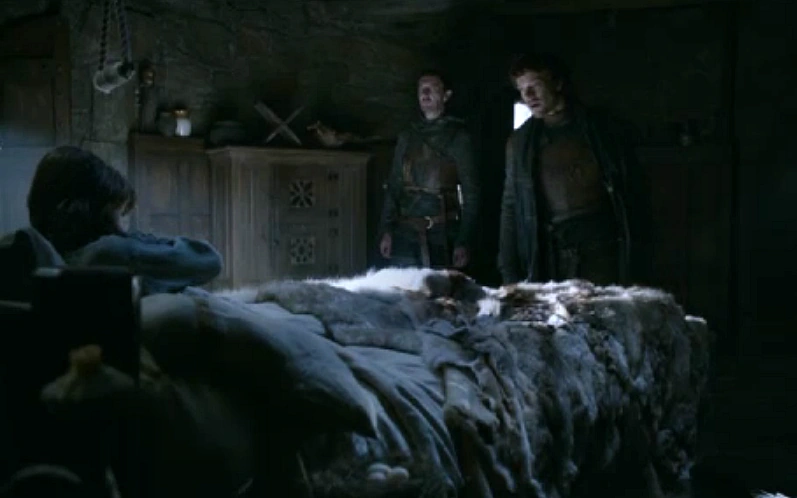
“Cruel places breed cruel peoples, Bran, remember that as you deal with these ironmen.” Synopsis: Bran awakes from a wolf dream to find that Theon has captured Winterfell, and has to formally surrender the castle to his foster-brother. SPOILER WARNING: This chapter analysis, and all following, will contain spoilers for all Song of Ice and Fire novels and Game of Thrones episodes. Caveat lector.…

View On WordPress

You and BryndenBFish discussed Robb’s tendency to lead from the front. In your opinion could it be partly motivated by his attempt to prove himself to his men as a commander? Stannis held Storm’s End for a year, while Tywin has been commanding since the Ninepenny Kings/the Reyne/Tarbeck affair; they have their armies’ respect/fear. By contrast, Robb had no experience before the Whispering Wood; do you think that he’s partly making up for that by being on the front line?

That’s a part of it, but we also have to keep in mind that – in medieval warfare – leading from the front was also a big morale boost for the troops. It showed that your commander was invested in the fight, it made running away both an abstract and a personal act of betrayal, and it demonstrated the bravery and chivalry of your king and thus his right to rule.

Robb’s historical counterpart, Edward IV of York, was famous for leading from the front and being universally successful in so doing. Starting from the Battle of Mortimer’s Cross, where his speech to the Yorkists interpreting a terrifying astrological phenomenon as a sign that God was on the side of York prevented a rout, to the Battle of Towton, where Edward intervened to ensure a vital river crossing and then personally held together the left wing which was being attacked from the front and flanks at the same time, to Barnet, where Edward personally held the center against repeated attacks from the high ground and sent in a decisive attack with his reserves that broke the Lancastrian line, to Tewksbury, where Edward’s center fought virtually alone, cut off from his right and left by the hedges, Edward leading from the front brought victory every time. 

So I think GRRM decided to borrow from the Wars of the Roses to depict Robb as a brilliant field commander who was never defeated when in command. 

Much as I’d love to see the Republic of Westeros with Davos Seaworth for President/Prime Minister (and maybe Sansa as purely ceremonial monarch – she’d be great at the ribbon-cutting stuff) I doubt that will happen. What do you think could be done, realistically, to improve the lot of the smallfolk? The economic development programs are a great start — but what rights/privileges could be added in a medieval setting?

There’s a lot, actually, depending on what the actual legal status of the smallfolk is. For example, we have no idea what the rights and privileges Aegon V tried to give the smallfolk were. 

To me, the major areas where things could use improvement are:

  1. royal justice system. Local lords having the right of pit and gallows over their smallfolk is a system ripe for corruption and oppression, which is why historically one of the ways that monarchs gained power against their nobles was to ally with the commoners by creating royal courts, appointing royal judges and sheriffs, etc. so that the commons could have their cases heard by the king. Abolishing the right of pit and gallows, appointing royal judges in the various kingdoms, establishing the right to appeal to these courts and maybe even the right to trial by jury – these things could make a huge difference. 
  2. self-government. Part of the reason I won’t shut up about city charters is that they were a major source of rights and liberties for the common people, and once the commoners got city governments up and running, they historically formed the basis for resistance to noble and royal authority.
  3. poor relief. One of the things that was omnipresent in medieval Europe but doesn’t seem to be present in Westeros is a system of poor relief. Historically, the Catholic Church provided a crude but surprisingly comprehensive system of supports for the poor – hospitals for the sick and disabled, hospices for the dying, leper houses, orphanages, alms for the poor and almshouses for the homeless, etc.  Especially in an environment with very severe swings in weather and climate, you’d think that the Faith of the Seven would have some sort of system to help people survive the winters. 
  4. common land and customary rights. Another aspect of medieval society that doesn’t seem to be present are common lands and customary rights for the smallfolk. Historically, villages and manors had some area of land that was not divided into individual plots but rather held in common by the people, who were allowed to make use of the land. This land was vital for the poorer peasants, especially those who had little or no land of their own – they used the commons to grow vegetable patches, graze some livestock (chickens, pigs, sheep, etc.), and in general help make ends meet. At the same time, communities also had customary rights to various forms of land use – the right to gather fallen wood or cut down a certain number of trees in various forests, the right to hunt various kinds of animals, water rights wrt to local rivers and streams and the like, and so on. 

I can’t seem to recall mention of any Dornish participants in any of the mentioned tourneys in the series, am I just being forgetful or does Dorne have it’s own intra-regional tourneys? Thanks!

You’re being forgetful. Oberyn Martell is a frequent jouster, having fought in the Tourney at Storm’s End before the rebellion, and the unnamed tourney where Willas got crippled. Arthur Dayne fought at the tourney at Harrenhal, at Storm’s End, and at Lannisport in 276, etc.

Would you expect the eastern Riverlands towns like Saltpans, Maidenpool, and Lord Harroway’s town to be strongly fortified with real warships anchored there to provide some measure of defense against foreign nations (or rival lords paramount with their own navies) just cruising up the mouth of the Trident?

Probably not, because the same strong fortifications would allow those towns to be more independent from Riverrun, so there’s probably an impulse to keep them from developing them on the part of the Lords Paramount.