Depends on when she does so (i.e, before or after Lysa’s death).
Category: Uncategorized
What do you think is Dalbridge’s backstory? Which king did he squire for? How come he was never knighted despite his obvious martial skills ? And how did he end up at the wall?
Dalbridge squired for Jaehaerys II, and he probably wasn’t knighted because Jaehaerys II died unexpectedly. Like Ser Hugh of the Vale, Dalbridge wasn’t of a family sufficiently ennobled to merit a last name; unlike King Robert, who honored Jon Arryn’s memory by knighting his squire, Aerys II was rather keen to replace his father’s favorites and didn’t feel beholden to a young squire of no family of significance.
And, I would guess, unlike Ser Hugh who had Littlefinger’s gold to pay for a suit of armor, a horse, and the other necessary equipment of knighthood, Dalbridge didn’t have the money to become a knight.
As to how he ended up at the Wall, I don’t know. It could be that he remained in King’s Landing and was sent to the Wall for being a Targaryen loyalist by Tywin Lannister along with Aliser Thorne; it could be that without any other means of income, he turned to banditry or some other criminal pastime to keep body and soul together; it could be that he went of his own volition, because the Night’s Watch offers room, board, and clothing to anyone who joins.
Hey Dany during her wedding that that if Daario had loved her he would have taken her at sword point like Rhaegar took Lyanna. That implies that she does believe that Rhaegar kidnapped Lyanna rather than running off with her but she still seems to have a high opinion of her brother that doesn’t seem to me can you explain it?
Well, this has to do with the idea of abduction as a trope in chivalric romance. In these stories, there really wasn’t a big difference between “running off with her” and “kidnapping.” Whether it’s Lancelot and Guinevere or Tristan and Iseult of chivalric romances, or the earlier Celtic sources whether Welsh or Irish (there’s a very similar story that’s part of the legend of Finn Mac Cool), the lady is married and is carried off by the knight against the wishes of her husband (hence why it’s called abduction/kidnapping and not elopment).
Moreover, in a lot of these stories, there are very weird parallels between the very-much-married lady being kidnapped by a mysterious knight and spirited off to a strange castle in the Land of Summer or the Twisted Woods – and if all of this is starting to sound a lot like Faerie, you’re not wrong – from which she is rescued by the gallant knight (which is the spark for their falling in forbidden love) and the lady being rescued by the gallant knight from her husband’s wrath when the adultery is discovered, and spirited off to another castle, which is equally strange.
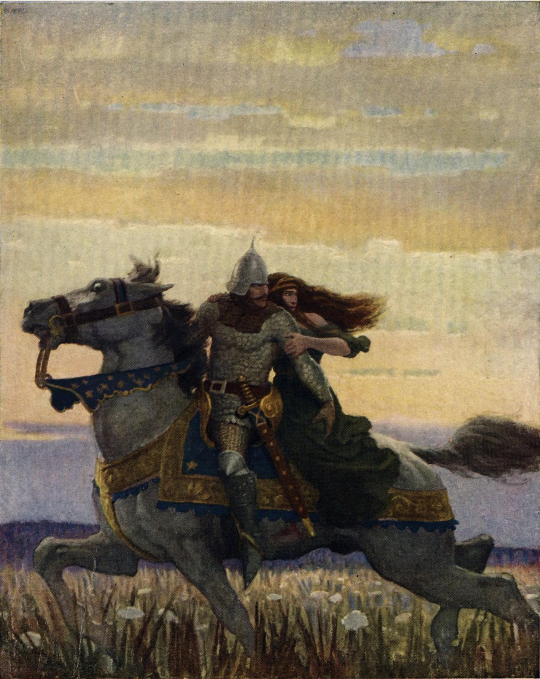
To bring this around to Rhaegar and Lyanna, the name of the castle that Lancelot takes Guinevere back to is Joyous Gard/Joyeuse Garde. Gard/garde means a keep, a keep is a fortified tower, and thus we get the Tower of Joy. However, Joyous Gard has a deeper significance than just the name: in the beginning of the story, it’s known as Dolorous Gard because the castle has been put under an evil enchantment; Lancelot takes the castle and breaks the spell, but finds within the castle a tomb with his name on it, and knows that he is going to be buried there one day. When Guinevere visits his castle – at a time when she’s still with Arthur and Lancelot and Guinevere are holding to a chaste romance – Lancelot changes the name of the castle to Joyous Gard in her honor. When Lancelot and Guinevere give in to their passion and their adultery is discovered, the castle becomes Dolorous Gard again, suggesting a Fisher King-like situation where the purity of chaste love has become the impurity of carnal love, dooming the land just as their adultery has caused the fall of Camelot, even as the castle becomes the refuge of the lady and her knight.
The point is there’s a lot of doubling: the good knight and the evil knight, the lady fair and the adulterous queen, the good castle and the evil castle, and thus (to get all the way back to your ask) the kidnapper and the rescuer.
How much power do legal wills have? Cersei ripped up Robert’s but Daeron honored his father’s commitments to the bastards. Rohanne would have lost her inheritance b/c of her father’s.
Whoops, didn’t see this. Apologies, @moonlitgleek.
Yes, wills are important. To quote myself here:
I’m a bit out of my depth here because my knowledge of legal matters are fairly limited and I don’t have enough historical knowledge to pull from. My only source of info would be the text and the examples we have of legal wills so if you want a more comprehensive answere, you might be better served checking with someone like @racefortheironthrone for that.
As far as the text goes, we have a few examples of wills, most of which are related to matters of inheritance which makes things murkier, but they are still informative. The most famous – and infamous – will in Westerosi historiography is the one left by Aegon IV Targaryen in which he legitimized all his natural children on his deathbed. While Daeron II might not have appreciated his father’s last spiteful act and the dangers it brought, he was in no position to rescind a royal edict because to do so would be tantamount to denying that his father had the royal authority to legitimize bastards. Daeron couldn’t very well claim that he inherited his royal authority from his father (which he was very conscious to emphasize, as evidenced by him crowning himself with his father’s crown, to counter the doubts cast upon his own legitimacy by Aegon) and simultaneously try to argue that his father didn’t posses the full authority of a king. And since legitimizations can not be rescinded in general, there was nothing Daeron could do. Note that the continuance of incomes bestowed on Aegon’s natural children through Daeron’s reign was not a part of the will. Daeron II simply chose to allow them to continue, honored the betrothal Aegon made for Daemon and additionally granted him a tract of land to build a castle on, probably in the hopes that the crown’s generosity towards his newly legitimized siblings, especially Daemon who was primed for an attempted usurpation by the machinations of Aegon IV, would curtail any thoughts of rebellions.
Technically the same circumstances should have applied to Robert’s will naming Ned regent to his heir. That was a royal edict presented by the Hand of the King who, by law,
speaks for the king in his absence. In normal
circumstances, that will should have installed Ned as regent, as the king
has the authority to choose the regent and Robert chose Ned. Cersei
planned a coup though. With the exception of Barristan Selmy (who
absolutely should have fought for Ned in that throne room but, well,
Selmy tends to ascribe to a very narrow view of a Kingsguard’s duty and has shown an inability to take a stand in morally complicated situations),
and Ned and his men who were promptly arrested and slaughtered
respectively, everyone present was either Cersei’s man, in her pocket,
or in Littlefinger’s. There was no one left to enforce Robert’s will
after the showdown in the throne room and no one to challenge Cersei after she destroyed the physical will and accused Ned of treason.Also a royal edict is Robb Stark’s will in which he legitimized Jon Snow as Jon Stark and names him his heir, but this one has its own complications.
Between the fact that we don’t know where the written will is and that
all the witnesses are in no position to do anything with the
information; that Stannis Barartheon is in the North and that he
definitely does not recognize Robb’s authority as king to accept his
legitimization of Jon as a Stark and certainly not as the next King in the
North; that Jon is dead and about to be resurrected which is bound to
change a lot of things; that there are schemes aimed to bring Sansa and
Rickon back to the North with the explicit goal to install each as the ruler of
Winterfell by their own factions which will certainly conflict with the
edicts in the will; that, oh yeah, Jon is not biologically Ned’s son
which is known by Howland Reed (currently the host of Galbart Glover and Maege Mormont, two of the
witnesses of Robb’s will), almost certainly known by Benjen Stark and is bound to be
discovered by Bran Stark, I think it’s unlikely that it will be allowed to stand.That leaves the two non-royal wills. The first one is the will left by Wyman Webber dictating that his daughter Rohanne had to marry within two year of his death or Coldmoat would go to her cousin. In normal circumstances Lady Rohanne might have had grounds to protest the unnecessary stipulation and argue that this will undercuts normal Andal-First Men succession laws but the cousin that was designated as heir in case she failed to meet her father’s conditions was married to her overlord’s sister so Lord Rowan was more prone to enforce Wyman’s will than to set it aside. Too, Ser Lucas Inchfield, her castellan and the man Lord Webber installed to “scare off unworthy suitors”, looked to use the will to corner her into marrying him so she wouldn’t lose her inheritance. It was pretty hard for Rohanne to challenge her father’s will without support from any side.
Lastly, there is the document Ramsay Snow forced Donella Hornwood to sign naming him heir to the Hornwood. Everything about this was made under duress and so should have easily been set aside but Ser Rodrik Cassel certainly seemed to give it weight when discussing the matter with Maester Luwin, despite the maester arguing that vows made at sword point do not count. But Cassel pointed out that Roose Bolton might not agree and try to press the claim. And while Robb probably wouldn’t have allowed the Boltons to appropriate the Hornwood if he’d survived, Roose’s treachery and alliance with the Lannisters meant that Wyman Manderly did have to concede the Hornwood lands that he seized after Lady Donella’s death to the Boltons on grounds of her marriage to Ramsay and her will.
It’s also worth mentioning that GRRM identified “will of the deceased” as one of the things that makes inheritance laws vague and contradictory, which suggests that this is one of the things that gives one a claim in succession. So I don’t think there is a clear cut answer, not in practice at least. It seems that, like inheritance laws, the acceptance of a will is as dependent on politics and force of arms as it is on legality. In a strictly legal sense, the king’s last will and testament should be binding as a royal decree otherwise his heir risks his own authority. But we’ve seen royal wills destroyed or ignored for the lack of an authority to enforce it. Vows made under duress shouldn’t count, but politics could force the recognition of a claim made through those vows. I think it’s mostly a case by case thing where the presence of an authority to either enforce or override a will, the political and/or military weight of the parties involved and the recognition of the authority of the testator and their right to make such a directive all play a part in whether a will is followed or not. At least that’s as far I can tell.
“wills can be powerful sources of legitimacy – after all, Stephen may have usurped the crown from the Empress Maude (or Aegon II from Rhaenyra if you’re being picky), but Henry I’s will (or Viserys I’s) was still important enough to pull half the kingdom behind the challenger to the throne and fuel a civil war that lasted for years. A will was enough to make Richard III Lord Protector of England, and that was enough to make him King. Octavian Caesar was a rather unimpressive youngster competing against a decorated and beloved military commander in Marc Antony, but at the end of the day Caesar’s will naming him his son and heir was vital to his becoming Augustus.“
Cersei’s ripping up Robert’s will was one example among many of her norms-trangression as Queen Regent. (Hence Ser Barristan’s shocked reaction.) In the moment, she got very very lucky that the broader political community didn’t see her do that, because it would definitely have been used as a propaganda tool against her: the evil queen tore up the king’s will! Why would she do that if it didn’t name [Stannis/Renly/Insert Candidate Here] as the true heir? (Stannis would never stoop to such lengths, but no way in hell does Renly not produce a “secret copy” of the will at some point.) Maybe the rumors and satires about Robert’s “hunting accident” are true? Maybe Stannis’ letter is correct, because it explains so much!
That being said, wills are not self-executing, and the degree to which a will is binding depends very much on who has their hands on the reins of the state – it really mattered whether the Greens or the Blacks were in conrol of the Small Council when Viserys I died, or whether Cersei or Ned had purchased the loyalty of the goldlcloaks.
However, the often-dominant nihilistic/Machiavellian perspective isn’t right either: the Greens could put a crown on Aegon II’s head but they couldn’t make the Blacks accept his coronation as legitimate; Cersei could put Joffrey on the throne by main force, but that didn’t stop most of the Seven Kingdoms rebelling against him.
if the english crown were vassals to the french kings could it be fair to say that france was an empire?
See, it’s questions like this that lead to Hundred Year Wars…
Who exactly do the First Men think the Old Gods are supposed to be? Deceased ancestors? Greenseers from ages past? Some generic type of “Spirits”?
“For her sake, Ned had built a small sept where she might sing to the seven faces of god, but the blood of the First Men still flowed in the veins of the Starks, and his own gods were the old ones, the nameless, faceless gods of the greenwood they shared with the vanished children of the forest.” (AGOT)
“The gods the children worshipped were the nameless ones that would one day become the gods of the First Men—the innumerable gods of the streams and forests and stones. It was the children who carved the weirwoods with faces, perhaps to give eyes to their gods so that they might watch their worshippers at their devotions.” (WOIAF)
Revelations about the weirwood network of long-dead greenseers aside, what followers of the Old Gods actually believe is a straightforward case of animism.
On a re-read something struck me – shouldn’t there be more Starks around? In fact a lot of the bigger houses seems to be lacking in cousins/aunts/uncles, second/thirdcousins etc.
How often did medieval commoners migrate from place to place? Like, say the North had developed booming textile and lumber industries and a commoner from a different kingdom wanted to move there for the work, how likely would it be they could do that?
Scholars seem to disagree, with some saying that most people never traveled further than ten miles from their birthplace, and other people pointing to the popularity of pilgrimage and other examples of medieval migration.
What I would say is that because most migration tended to be local and regional rather than long-distance, it would be unlikely that you’d see commoners moving to the North from Dorne. Rather, I think you’d see a lot of internal migration by Northerners and external migration from the northern Riverlands and the Vale.
By the time you get a textile industry, you’re in the Late Middle Ages, and commoners migrate for ALL sorts of reasons:
to escape from plague, to escape from war, to find a war and make a living by pillage, to become brigands and make a living by pillage (same difference…), to find a better landlord than the brutal cheapskate you’re stuck with, to find any landlord because the one you had kicked you out (“booming textile industry” means raising sheep replaces agriculture, but it’s also less labour-intensive, so suddenly thousands of people are left in the lurch with no
livelihood and no home), to get yourself to that big city you hear so much about where maybe there are jobs, or to wander with other wanderers from town to town.In England (and other parts of Europe), the textile boom coincided with — and party caused — tremendous social upheaval. I’m not sure how you can insert it in Westeros and assume nothing else changes. And while it’s debatable how common migration was before
the Great Spring Sicknessthe Black Death, after that point it becomes TOO common, and the law keeps trying to suppress it in a crescendo of brutality, and keeps failing. The wave was unstoppable.
Of course, if we limit our scope to migration which is legal and desirable, or at least tolerated by the status quo, then it was pretty minor. But… why should we? Escaped serfs, expelled tenants, wayward servants, broken levies, rogues and vagabonds, and undesirable minorities of all sorts, were all commoners. Of flesh and blood, just like everyone else. They should count.
Further reading:
- J.J. Jusserand, English wayfaring life in the middle ages. Excerpt: “Outlaws and escaped serfs in 14th century England”.
- Lisa J. Steele, Fief:
A Look at Medieval Society from Its Lower Rungs. Except:
“Travelers, Bandits, Mercenaries, and Foraging Parties”.- Fernand Braudel, “The Great Imprisonment” (excerpt from A History of Civilizations)
- This Rogue, “No rest for the wicked: Anti-vagrancy laws in Tudor England, 1495-1604”, “Stealing back the commons”
- Frank Aydelotte, “Elizabethan rogues and vagabonds: Origins” (excerpt)
This is an excellent addition. My only caveat is that, in Westeros, we have to take into account the greater distances involved, hence why I think you’d see migration to textile centers in the North primarily happening within the North and secondarily from the northern Riverlands and Vale, with sharp fall-off thereafter.
Historically, what was the legality of melting down coins for their metals?
Usually illegal, due to the close link to counterfeiting.
How often did medieval commoners migrate from place to place? Like, say the North had developed booming textile and lumber industries and a commoner from a different kingdom wanted to move there for the work, how likely would it be they could do that?
Scholars seem to disagree, with some saying that most people never traveled further than ten miles from their birthplace, and other people pointing to the popularity of pilgrimage and other examples of medieval migration.
What I would say is that because most migration tended to be local and regional rather than long-distance, it would be unlikely that you’d see commoners moving to the North from Dorne. Rather, I think you’d see a lot of internal migration by Northerners and external migration from the northern Riverlands and the Vale.
 RFTIT Tumblr Backup