Thanks for joining me!
Good company in a journey makes the way seem shorter. — Izaak Walton

Just a backup in advance of the detumblring
Thanks for joining me!
Good company in a journey makes the way seem shorter. — Izaak Walton
I’m obviously less exposed to the change than a lot of artists on this platform, but I still think it’s not just a terrible idea but a characteristically Silicon Valley terrible idea. You see similar things with Twitter’s inability to deal with bots and Nazis, Facebook’s problems with fake news, Russian bots, and hate speech, and so on and so forth: the basic problem is that all of these companies don’t want to shoulder the responsibility for or pay the costs of having actual humans do the moderating that’s desperately necessary, so instead they turn to algorithms.
The problem is that these algorithms are blunt, imprecise instruments which tend to be bad at tasks like these, because they’re so reliant on human understanding of nuance and context. (I.E, when is a nipple porn vs. art?) And ultimately they’re only as neutral and “objective” as the people programming them, and given that Tumblr’s starting from a really flawed position (the already-infamous “female-presenting nipple” is a hell of a tell), this algorithm is likely to be bad even by the standards of their kind.
In terms of my plans…not totally sure yet. After all, this Tumblr site grew out of my WordPress page, so that’s not going anywhere. Twitter isn’t really a good place for answering asks or posting meta, but I do post a lot of progress updates and announcements on my twitter, so you can look there too. If you’re planning to leave Tumblr and want to keep seeing my content, please follow/subscribe on those platforms.
That being said, I’m not planning to leave Tumblr any time soon, although I’m definitely backing up everything just to be on the safe side. My plan is to keep puttering around on here writing meta and answering asks until it’s a little clearer where the fandom is going, because I don’t really have the time or patience to set up new pages on pillowfort or mastadon only to find out that everyone’s gone to some other site.

Roose Bolton is not your woobie. If you need proof of this, remember what he did to the miller’s wife, and the miller, and the miller’s brother. All of that while Domeric Bolton was very much alive.
Domeric’s desth was an inconvenience, but let’s not pretend it was the the inciting incident of Roose’s tragic past that sent him down the path to darkness.
A nobleman like Robin of Locksley? No. Noblemen served in the Crusades either as part of their feudal obligations to their liege lords or as volunteers. And the vast majority of commoners in Crusader armies were professional soldiers or volunteers too.
On a separate topic, it pisses me off how working-class figure of resistance Robin Hood got turned into nobleman savior and good king loyalist Robin of Locksley. The Richard Lionheart loyalist stuff was added in the 16th century, and the nobleman thing didn’t come in until practically the 17th century.
The O.G Robin Hood was an anti-monarchical yeoman.
I’m gonna heartily agree in spirit with @racefortheironthrone, by vigourously disagreeing about the specifics. 🙂
- Who even is the O.G. Robin Hood? We don’t know. It was an unrecorded oral tradition long before the Geste was written (c. 1450), and while we can gather that in its earliest form it was considered base entertainment, rowdy, and possibly bawdy, we don’t actually know what it said.
- The nobleman thing came in c. 1600, until then it’s either yeoman or unspecified commoner. The “contemporary of Richard I” thing is earlier, but “loyalist”? Actually championing the good king? I think that’s Walter Scott, c. 1820. As for the ransom plot, that’s 20th century Hollywood.
- By the way, the ransom plot is what pisses me off most. We stole (or re-appropriated) ALL THIS BLING, and instead of giving it back to those who need it, or hell, keeping it for ourselves, we’ll use it to ransom a warmongering moron just because “he’s the rightful king”? Ugh. How Lawful Stupid.
- Now, earlier, the ballads give us many instances of Robin respecting the King, bowing to the King, accidentally capturing and then gladly letting go the King, declaring himself a loyal subject of the King, sure… but also pranking the King, mocking the King, poaching from the King, and fleeing the King. That’s oral tradition for you, things are fluid.
- Earlier still, in the Geste, Robin respects the King (some King Edward) and dutifully accepts his invitation to join the royal court. But then he gets all restless, and splits without the King’s leave, and sods off to forest to be an outlaw again.
- That said, “anti-monarchical” is a stretch. Robin Hood never opposes royal authority, like he opposes bishops and sheriffs and the like. At most, he refuses to actually give a shit. Which is pleasing enough. 🙂
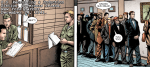
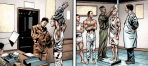




Captain America: First Vengeance #2 (2011)
written by Fred Van Lente
art by Luke Ross & Richard Isanove
I have no personal animus whatsoever against any of the people involved in making this comic, but as someone who has thought WAAAAAAAAAAAAAY too much about Captain America, this is a very particular pet peeve of mine.
It’s the date. Discreetly tucked away in the upper left, saying “December 24th, 1941.” While it being Christmas Eve is a bit schmaltzy even for a character who is done best with a good helping of schmaltz – looking at you, Joe Johnston you genius you – it’s the 1941 that bugs me.
Because Steve Rogers did not join the U.S military because of Pearl Harbor.
One of the reasons we know this is that Pearl Harbor hadn’t happened when Captain America #1 came out in March of 1941 with a big picture of Cap punching Hitler on the jaw on the cover. Jack Kirby and Joe Simon had come up with Captain America to argue that America needed to get into the fight against fascism, which they saw as a threat at home and abroad.
So then why did Steve Rogers join the military, if the United States hadn’t been attacked and his country was at peace? Because Steve Rogers was a “premature anti-fascist.”
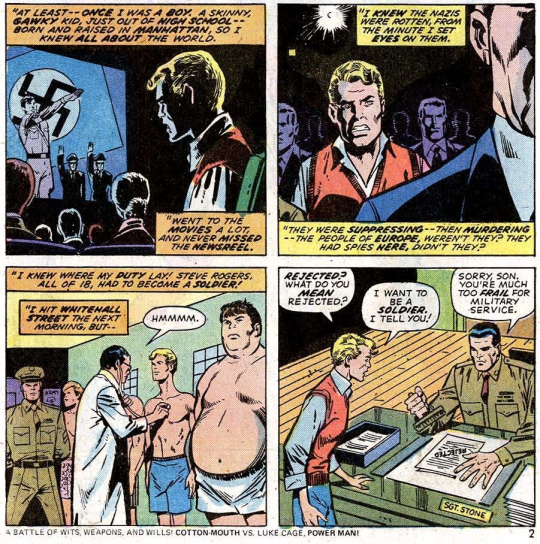
And this is what sets him apart from the deluge of patriotic superheroes from the 1940s like American Eagle, Captain Battle, Captain Comamndo, Captain Courageous, Captain Flag, Captain Freedom – no, comics have never had a problem with plagiarism, why do you ask? – the Fighting American, the Fighting Yank, and on and on. Steve Rogers had a very specific political point-of-view, one that only could have come from New York City in the 1930s, and it went way beyond a sanitized patriotism.

The specificity of Captain America’s politics is something that Marvel haven’t always been willing to talk about in recent years, but it’s what makes him genuinely interesting.
So please, can we have a moratorium on post-Pearl Harbor origin stories? They miss the point completely.
I think the girls swapped themselves.
Yes, although it’s a bit vague:
“Prince Maron had won a few concessions in the accord, and the lords of Dorne held significant rights and privileges that the other great houses did not—the right to keep their royal title first among them, but also the autonomy to maintain their own laws, the right to assess and gather the taxes due to the Iron Throne with only irregular oversight from the Red Keep, and other such matters.
Dissatisfaction at these concessions was one of the seeds from which the first Blackfyre Rebellion sprang, as was the belief that Dorne held too much influence over the king—for Daeron II brought many Dornishmen to his court, some of whom were granted offices of note.” (WOIAF)
We don’t know what the “other such matters” are, but that’s what the Dornish got.
De Jure, yes. De facto…it would probably take an existential threat to get the Dornish to accept a Reacherman general, although I imagine the tens of thousands of relief troops wouldn’t hurt.
Quite standardized through the various Colleges of Heralds.
The whole point of heraldry was that an insignia should be instantly recognizable proof of identity for men in armor. This was important for a number of reasons: making sure you got taken prisoner and ransomed rather than killed, making sure you don’t kill a friend or family member accidently because you didn’t recognize them in full armor (something that happens all the time in Arthurian myths when someone dresses as a mystery knight), making sure your soldiers know who to follow on the battlefield if they can’t see the banner, etc.
I don’t think that title would be used, since that title was used during the First Dornish War to adorn a colonial viceroy, who was so hated that he was thrown to his death from the Spear Tower.
Better to let that lie.
 RFTIT Tumblr Backup