So what exactly is right to work legislation in the US? I never quite got it tbh

Sure, I’ll try to explain. 

One of the things that unions and management typically negotiate over is mechanisms by which unions ensure that people in unionized workplaces actually become members of the union. These mechanisms have taken different forms: 

  • closed shops required workers to already be union members before they could be hired, and were common in fields like longshoring and construction. These were outlawed by the Taft-Hartley Act of 1947.
  • union shops allowed management to hire non-union members, but required all workers to join the union within a certain period after they were hired. These were outlawed by the Supreme Court in the 80s. 
  • agency shops came after the banning of the first two forms, and limited themselves to saying that workers had to pay partial dues (known as “agency fees”) to repay the union for the cost of collective bargaining and grievance handling but not political activities or organizing campaigns. 

“Right-to-work” laws are state level laws authorized by section 14b of the Taft-Hartley Act, which ban unions and management from agreeing to union shop or agency shops in that state. 

The effect of these laws is that they inhibit union organizing for a couple reasons:

  • they create a massive free-rider problem: workers can get all of the benefits of being in a union – wage increases, benefits, protections and grievance structures, etc. – without having to pay unions. This in turn means that unions in right-to-work shops are underfunded, which means they can’t finance further organizing drives. 
  • they change the default in favor of non-membership: in union shops and agency shops, the default tended to be joining a union – in the former, you could be fired or fined if you didn’t join, so most people did; in the latter, you were paying dues anyway, so you might as well join. Just like shifting a program from opt-out to opt-in reduces participation, “right-to-work” means that there’s no push or pull factors in favor of joining, and instead there’s an economic penalty for joining. 

Question, when you tagged you book post “Right to a Job”, were you talking about “Right to Work” legislation or something completely different? Because you’ve seemed fairly pro-union in the past.

They’re completely different. 

The right to a job, which is described in international circles as a “right to work” (hence why I prefer using the term right to a job, because it leads to less although not no confusion in U.S circles), is the idea that an individual has a right to earn a living and that if they can’t find work in the private sector, government has an oblgiation to provide a job for them. 

In other words, it’s a way of describing a job guarantee but emphasizing the right of the individual as opposed to the oblgiations of government. In the U.S context, it flows out of FDR’s Second Bill of Rights:

“In our day these economic truths have become accepted as self-evident. We have accepted, so to speak, a second Bill of Rights under which a new basis of security and prosperity can be established for all—regardless of station, race, or creed.

Among these are:

The right to a useful and remunerative job…”

So the right to a job comes from a left-wing, pro-labor background, whereas the “right to work” (for less) comes from a right-wing, anti-labor background. 

The Venture Bros. Podcast: Season 7 Ep 5: The Inamorata Consequence

graphicpolicy:

The Venture Bros. #Podcast: Season 7 Ep 5: The Inamorata Consequence #VentureBros #TheVentureBros #AdultSwim

The Venture Brosshow has rich continuity and character arcs that play out over many years. Then layer on pop culture and historic references with thematic significance? It’s a lot to sift through. So join pop culture and history experts Elana Levin and Steven Attewell for our Podcast examining each episode of this hit Adult Swim show.

This is Season 7 episode 5: The Inamorata Consequence.

Learn…

View On WordPress

Congrats on the book! But I’m a bit curious, how did you decide on your specialization ? 20th century public policy seems like a rather dull domain to fall in love with, over other “sexier” fields of history. (no offense)

Thanks very much!

My interest began when I took a seminar on policy history as an undergraduate that really inspired me, because it was the first time I was exposed to books like Theda Skcopol’s Social Policy In the United States, which presented an entirely new and different way of looking at issues like poverty, inequality, welfare, social insurance, work, the New Deal, racial discrimination, etc. that I really cared about but didn’t have the tools to explain why things were the way they were. 

I was already interested in political history even though it had fallen out of fashion during the social turn, because I knew government was a big part of the story. Normally, I guess I’d have ended up in political science, but historical theory and methodology have always appealed to me more than political science’s heavy emphasis on statistics. Also, I wasn’t as interested in studying about elections or political parties, and I knew that was a big part of poli sci. 

Policy history, because of its ties to the American Political Development school of political science, borrows a lot of theoretical tools and models from APD – path dependence, policy feedback, and other historical institutionalist concepts – while still remaining primarily a subfield of history. So studying policy history would give me the tools I needed, while still letting me do the kind of research I was interested in doing. 

All this dovetailed with my undergraduate senior thesis. I had read Arthur Schlesinger Jr.’s The Coming of the New Deal, and I was fascinated by a very short chapter on the Civil Works Administration, and why I’d never heard anything about a program that put 4.26 million people to work in three months, which seemed an astonishing feat in comparison to contemporary politics. So I decided to write my thesis about the CWA in New York City – it helped that there are a bunch of CWA records in the Municipal Archives down on Chambers street – and in the process of writing that paper, I read a lot more policy history.

So I knew by that point that I wanted to study policy history in grad school, so I looked for the history PhD program with the largest number of policy historians in it, and the rest was…well, history. 

Announcement: Book Club! – Lawyers, Guns & Money

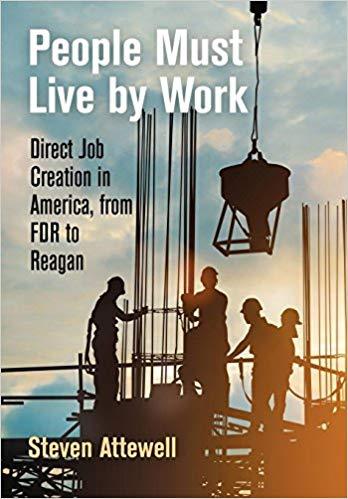
I’m very excited to announce that my first academic book, People Must Live By Work: Direct Job Creation in America, from FDR to Reagan, officially hits shelves today, September 4th! (You can buy a copy here and here, hint hint.) So to celebrate this long-awaited milestone, starting next week, Lawyers, Guns, and Money will be …

Announcement: Book Club! – Lawyers, Guns & Money

Which stories are those Doctor Doom panels from?

The first one is from Triumph and Torment, an amazing Marvel Graphic Novel by Roger Stern and Mike Mignola in which Doctors Strange and Doom travel to the depths of Hell to save the soul of Doom’s mother from Mephisto.

The second one is from Emperor Doom, another Marvel Graphic Novel, in whcih Doom actually succeeds in conquering the Earth by weaponizing the Purple Man’s mind control powers, but finds the ease of conquest boring so he lets the heroes defeat him and returns to Latveria, telling the heroes to put up a better fight next time. 

Godscast Issue 4 The One With Yeezus

graphicpolicy:

Godscast Issue 4 The One With Yeezus. The #podcast that dives into #wicdiv one issue at a time #comics

Hosted by Steven Attewell and Chris Holcomb, Godscast takes you issues by issue through the hit comic series The Wicked + The Divine by Kieron Gillen and Jamie McKelvie.

Every ninety years, twelve gods incarnate as humans. They are loved. They are hated. In two years, they are dead. Welcome to The Wicked + The Divine, where gods are…

View On WordPress

More podcasting for you all!