These days, I’m nostalgic for the late 90s for a whole lotta reasons…
Author: stevenattewell
Thinking About the White Walkers and the COTF
So I was talking with @goodqueenaly about the whole Season 6 revelation that the Children of the Forest created the White Walkers, and our conversation crystallized some problems I have with this twist.
- If the White Walkers were a weapon, why weren’t they used during the war between the First Men and the Children during the Dawn Age, given that that war was an existential crisis for the Children where they brought down the Hammer of Waters on the Arm of Dorne and the Neck?
- Why the two thousand year gap between the Pact that ended that war and the Long Night, which is the first recorded encounter between humans and White Walkers?
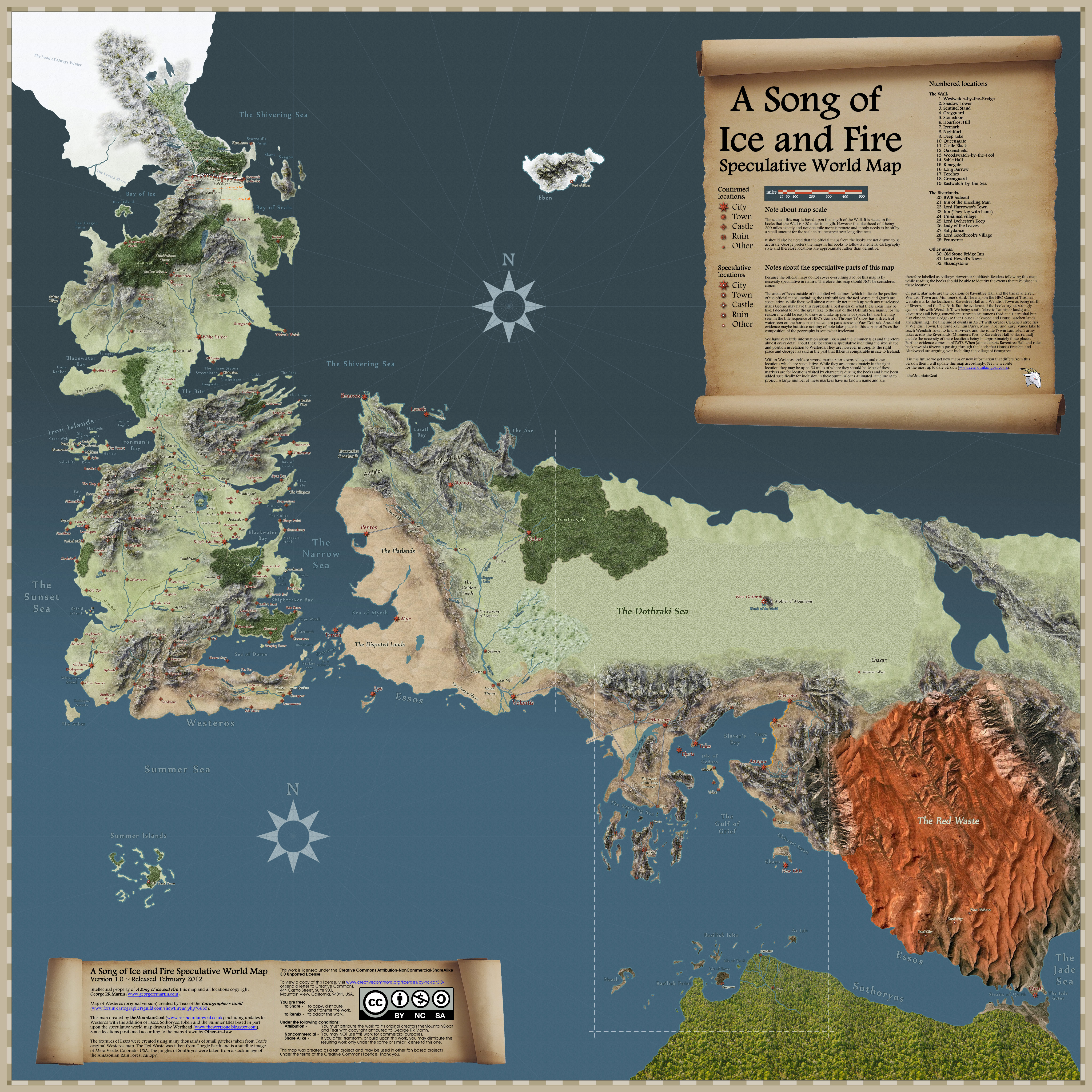
- If the Long Night was so centered on Westeros, why are there records of the conflict across Essos, from the Rhoynar in the west (who tell of the hero of the Rhoyne who sang the secret song to bring back the day), to Asshai (where the legend of Azor Ahai was born), to the Bone Mountains (where the patrimony of Hyrkoon the Hero was founded), to Yi Ti (where the woman with the monkey’s tail saved the world from the Lion of Night, and the Pearl Emperor built the Five Forts to guard his lands from the Lion’s demons)?
Anon Asks
If the Seven Kingdoms were to break up again post ASOIAF series, do you think the Riverlands would stand a chance of making it as an independent nation?
With the right policies and the right development, yes.
Chapter-by-Chapter Analysis: Bran I, ASOS
Chapter-by-Chapter Analysis: Bran I, ASOS

IMAGE
“They never listened to what he wanted, even though Bran was a Stark and a prince besides, and the Reeds of the Neck were Stark bannermen.”
Synopsis:
Warning
(more…)
3,000 Followers!

I just checked and apparently the tumblr hit 3,000 followers when I wasn’t looking…which is pretty damn amazing for a side-blog devoted primarily to ASOIAF, history, and occasionally comics.
So thanks very much for following my blog, and I hope to continue to provide you with enjoyable content in the future!
Analysis of CK2 Vassal Maps
Trying this again, because CK2 maps are tricky and change over time, which makes comparison difficult and leads people to delete their posts in frustration. This time, I have a new set of images that I am reliably informed are from 283 AC in-game, so there’s consistency there.
So let’s compare these maps to the Imgur ones:
The North:

First things first: holy hell, the Rills are way too big, encompassing both the Stony Shore and Sea Dragon Point. Also, there’s an inconsistency here w/r/t the handling of “masterly houses” – the Wolfswood is separated out from the Stark domains despite the Glovers being a masterly houses, whereas Torrhen Square is not, even though the Tallharts and Glovers are of the same standing.
Beyond that, most of the names for the hill clan areas – Arrendell, Crow’s Edge are rather spurious – and Breakstone Hill for the Flints is based on an assumption that the First Flints and the Flints of Breakstone Hill are one and the same.
The Vale:

This is…interesting. Crab’s Shore doesn’t exist, neither does Darkmoore, and we don’t have any reason as to why House Templeton is that far west when the rest of the Lords Declarant are more to the east.
Inside the Vale proper, things get weird. The Redforts have been swallowed up by Runestone, even though the Redforts are a principal House the same as the Royces; likewise, the Waynwoods have seemed to swallow up the Melcoms. The Eastweald and Northweald aren’t real names either, and the former would seem to give House Hunter a lot of territory.
Over the mountains, the Corbrays look awfully small compared to the Belmores. I like the detail of the Royces having Coldwater Burn in their affinity, but the Lynderlys of Snakewood are pretty hard to see. Crow’s Barrens doesn’t exist, nor does that hard to read area next to it.
I will say that I think the Imgur maps do a better job with the smaller Houses, although again it’s a bit of a guess as to who’s where.
The Riverlands:

The Freys are way too big, even if they are a significant house, that’s more land than Harrenhal has. indeed, the lands north of the Trident are messy in general – Wycombe isn’t a real name, nor is Chiltern or Still Fenn. I also don’t think the Tullys have any land at the intersection of the Trident, as much as I think they should. My bigger problem is that we don’t see House Roote of Harroway’s Town, and I think House Darry is actually south of the Trident as per AGOT and AFFC, probably where “Deddington”(?) is on the map.
My next problem has to do with the Vances, where I actually have a beef with both sets of maps. I agree with Ser Mountain Goat that Wayfarer’s Rest logically occupies a position on the River Road equidistant between RIverrun and the Golden Tooth: this would explain both why Karyl Vance was involved with the Mountain’s raids on the border, and why the castle that name, since it probably got its start catering to traders and travellers along the road.
I also have a problem with some of these invented names: Acorn’s Ridge doesn’t make much sense when Atranta is there to be used. Likewise, Southstone is pretty much exactly where Stone Hedge should be, so why not use that name?
Once again, I think the Imgur does a better job reminding us of the existance of lesser Houses like the Rygers (although I would place them nearer to Riverrun given their history), the Vyprens (who are definitely near the Darrys, given the Battle of the Widow’s Ford), the Goodbrooks, the Wayns, etc.
Iron Islands:
Skipping b/c you can’t read the map.
Crownlands:

Let me just say how boring I find the Crownlands, and that the only reason I’m writing about them is for the sake of completeness and my undying love for you all.
First things first, it’s a bit odd that House Wendwater isn’t on the Wendwater, and that House Fell from the Stormlands holds the Kingswood, that seemingly House Seaworth holds the Blackwater Rush, etc.
Second, there’s some missing houses here: the Buckwells of Antlers, the Brones of Brownhollow, the Rykkers of Duskendale, etc.
Westerlands:

The first thing that jumps out to me is that the Gold Road is outside the borders of the Westerlands, so I don’t know what’s going on there. Next, the Lyddens of Deep Den should be in-between Silverhill and Hornvale. further south, I’m not sure why the landed knights of Greenfield are more powerful than the principal House Swyft of Cornfield, nor what Lonmount is supposed to be. Other mysteries: what Lang Tower is, or Tendring is, and why it’s where Oxcross should be.
Sarsfield seems way too big, as does Ashemark. Tarbeck Hall can be seen, but not Castamere. The Banefort seems to have been gobbled up by the Westerlings for some unknown reason; likewise, the Kennings of Kayce seem to have absorbed the Presters of Feastfires.
The Reach:

The list of non-existent names is getting too long, so I’m just going to skip them and just talk about the power dynamics. The Rowans of Goldengrove seem way too big, making the Cranes and Oldoaks seem too small.
Blueborn and Cockleswent doesn’t exactly work very well as regions – I doubt the Meadows control all of the former, or the Ashfords the latter. Likewise, the Westmarch seems too big for the Tarlys alone to handle – where are the Peakes? Where are the Vyrwels? Inchfield doesn’t exist and wouldn’t be there if it did – Coldmoat and Standfast need to be to the west of House Rowan’s holdings, given Wilbert Osgrey’s duel with Lancel IV.
In general, probably my least favorite to date, not particularly suitable as a political map.
The Stormlands:

House Wendwater is in the Crownlands, not the Stormlands, and why is it in two places? Tarth is ridiculously large, having somehow grabbed the lands of House Penrose of Parchments. House Buckler of Bronzegate also seems to have vanished. House Fellwood is north of where it should be, House Morrigen is to the east of where it should be, Stonehelm is labelled the Red Watch, and for some reason Dragonstone holds the Rainwood (is that supposed to be Davos? Even so, he’s a bit north of where he should be).
Also not one of my favorites.
Dorne:

The penchant for HUGE fiefdoms continues apace, it seems. The Ullers are much much too big, encompassing the lands of the Qorgyles as well. The Tolands likewise seem to have gobbled up the Jordaynes and much of the Allyrions. The Fowlers and the Manwoodys look squished together. Spottswood I think is on the wrong end of Dorne, it should be much closer to the Yronwoods.
Better than average, I guess?
Cast-amere and Cast-erly
Well… pretty much there was a theory on reddit that posited the Reynes as a bastard branch of the Casterlys, an idea whose link was included in the wonderful post of @joannalannister in her words for House Reyne. That was pretty much why I said it.
Also, when I spoke, I meant how Ellyn Reyne does resemble Barbrey Ryswell. Ellyn Reyne wanted to become a Lannister with much more intensity than anyone else recorded, like Barbrey and Theon wanted to be Starks above all.
Ah, I see. It’s a fine theory as it goes, the whole reversed arms thing, but the WOIAF I think is pretty strong evidence to the contrary. I’d also point out that we don’t know what the heraldry of the Casterlys was, and that if the connection was through the Casterlys, why would they have reversed the sigil of the Lannisters?

I don’t know if I would agree that Ellyn wanted to become a Lannister, exactly. She “had for years anticipated one day being the Lady of Casterly Rock,” and certainly pursued Tywald and Tion and even Tytos.
But Ellyn doesn’t show any of the signs of alienation from her original family that, say, Theon did. As “the Lady of Casterly Rock in all but name,” Ellyn made damn sure that House Reyne profited from her success with Tion. Hence “her brothers Roger and Reynard were ever at her side, and offices, honors, and lands were showered upon them, and upon her uncles, cousins, and nephews and nieces as well.” Likewise, when she was finally exiled from Casterly Rock, Ellyn promoted the fortunes of Houses Tarbeck and Reyne as much as she could, shaking down Tytos for as much gold as she could get, putting it in to Tarbeck Hall and its surrounding lands.
So I think of Ellyn as more self-possessed than Theon and less bitter than Barbrey. Which I think means that she didn’t necessarily want to be a Lannister, but rather wanted to be the Lady of Casterly Rock and the mother of the next Lord…regardless of whether this was as a Lannister or as a Reyne or as a Tarbeck.
Does Show Tywin mentioning that the family gold mines are exhausted have any basis from the books? I don’t see it anywhere. If it was true in the canon how would it change his decision making?
No, GRRM has explicitly said that Casterly Rock is not exhausted.
What if Lady Ellyn had sisters who married…
What would have happened if the Reyne-Tarbeck rebellion would have had outer support? With this I mean that the Reynes had claims to Casterly Rock older than the Lannisters themselves. Supposing than Ellyn Reyne would have had younger sisters who would have been capable of marrying one a Tyrell and another a Tully (or a Redwyne), how much would that have changed the outcome and even the beginning of the rebellion? Tywin relied on speed after all to defeat them, but supposing the Tyrells or Redwynes or Tullys would have been willing to meddle on Westerlands affairs (The Tyrells being eager with having a wide support, the Redwynes being the monopoly on the sea-trade and the Tullys still hurt for the broken betrothal of Celia) so, just speculation, really, because a web of alliances (other than the Reyne-Tarbeck themselves) may have been essential. And now that I think of it… did the Gardeners marry some Reyne to try overthrow the Lannister regime in some age before the Draconic Conquest?
Also, is Ellyn Reyne supposed to be an alter-ego of Barbrey Dustin more than one from Cersei? Both wanting to be their overlord’s family above all, but ending up hating them more than nothing in Westeros? One in the North, the other in the West
I don’t know what you mean by “claims to Casterly Rock older than the Lannisters themselves.” If you’re talking about Loreon the Lion, not only is that claim very much on the distaff side, but it doesn’t predate the Lannisters. I couldn’t find any mention of an alliance between the Reynes and Casterlys, for example.
As for outside support during the Rains, I think a house would have had to be reckless to the point of ambitious – Aegon V had already militarily intervened twice in the Westerlands, and there’s no reason he wouldn’t have gone for a third. But yes, it would have helped.
I don’t think Ellyn Reyne is an alter-ego of anyone. As the song goes…
Another smallfolk question: Do you think the bolton smallfolk is similar to their masters? Do they hate the starks?
No, I think the Bolton smallfolk are afraid of their masters. Roose’s motto of “a peaceful land, a quiet people,” when considered in conjunction with his treatment of the miller and his wife, suggests a strategy of enforcing order through terror.
 RFTIT Tumblr Backup