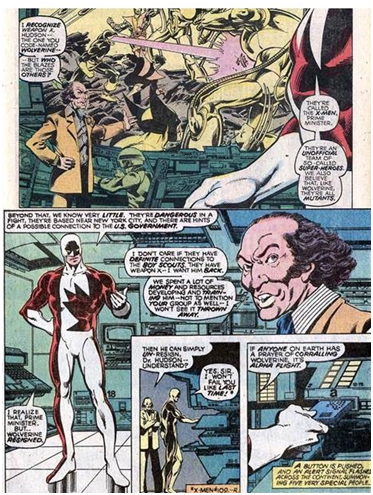
My general sense of Wolverine is that, like most people I fell in love with the character at this exact moment…

…right before he solo’d the entire Hellfire Club from the sewers up to the upstairs rooms where the Inner Circle were holding the X-Men prisoner, and providing the crucial distraction that allowed Jean to free them and save the day.
As a character, before the rush of imitators in the Dark Era of Comics and Wolverine’s own massive over-exposure in the 90s, Wolverine was the original anti-hero. But rather than being driven solely by ANGST and MANLY RAGE, Logan had a lot more going on that made him a fully three-dimensional character: while a staunch individualist, he was also fiercely loyal to his friends; while hot-tempered even when his berserker rage wasn’t at issue, he was also a snarky jokester; and most important and most enduringly, he was a protector and a mentor to children. (Something at the core of both Death of Wolverine and one of my all-favorite series, Wolverine and the X-Men.)

As an X-Man, he was absolutely crucial to the dynamic of Chris Claremont’s X-Men: he was the raging yang to Cyclops’ repressed ying, constantly questioning and pushing. Without him, there is none of the drama or conflict that distinguished the rowdy, more adult All-New X-Men from their milquetoast, demerit-fearing OG counterparts. And while it’s been somewhat blown out of proportions, he was the third leg in the Scott-Jean triangle that played a major part in the Dark Phoenix Saga, the alternative partner who was A. into Jean, B. anything but repressed sexually, and C. a little bit dangerous and spicy (and thus a “gateway drug” for a Jean Grey looking to explore those parts of herself given life by the Phoenix).
On a deeper level than the romance-comics-inspired love triangle, I think the key to Wolverine’s popularity was that he was a better fit for the 1970s than the late 50s/early 60s A-Type Cyclops:

In terms of the mutant metaphor, once you get to the early 90s and the truth of Weapon X gets fleshed out by Barry Windsor-Smith, Logan is the epitome of mutant oppression, having been almost completely dehumanized by a military-industrial complex that tried to turn him into a living weapon, erased his memories and implanted false ones, conducted medical experiments on him, and on and on until he rebelled. And this was a key part of what made him tick as an anti-hero – rather than simply indulging in violence purely hedonistically, for Logan, resistance means rising above the level of the animal, of the weapon.

In terms of origin stories, well, there’s been some better and some much, much worse. If I had to choose, I like Barry Windsor-Smith’s ambiguous version, where you get the sense that he definitely had a life before Weapon X, but where you can never be sure what’s real and what was a simulation that Weapon X implanted in his mind.


 RFTIT Tumblr Backup