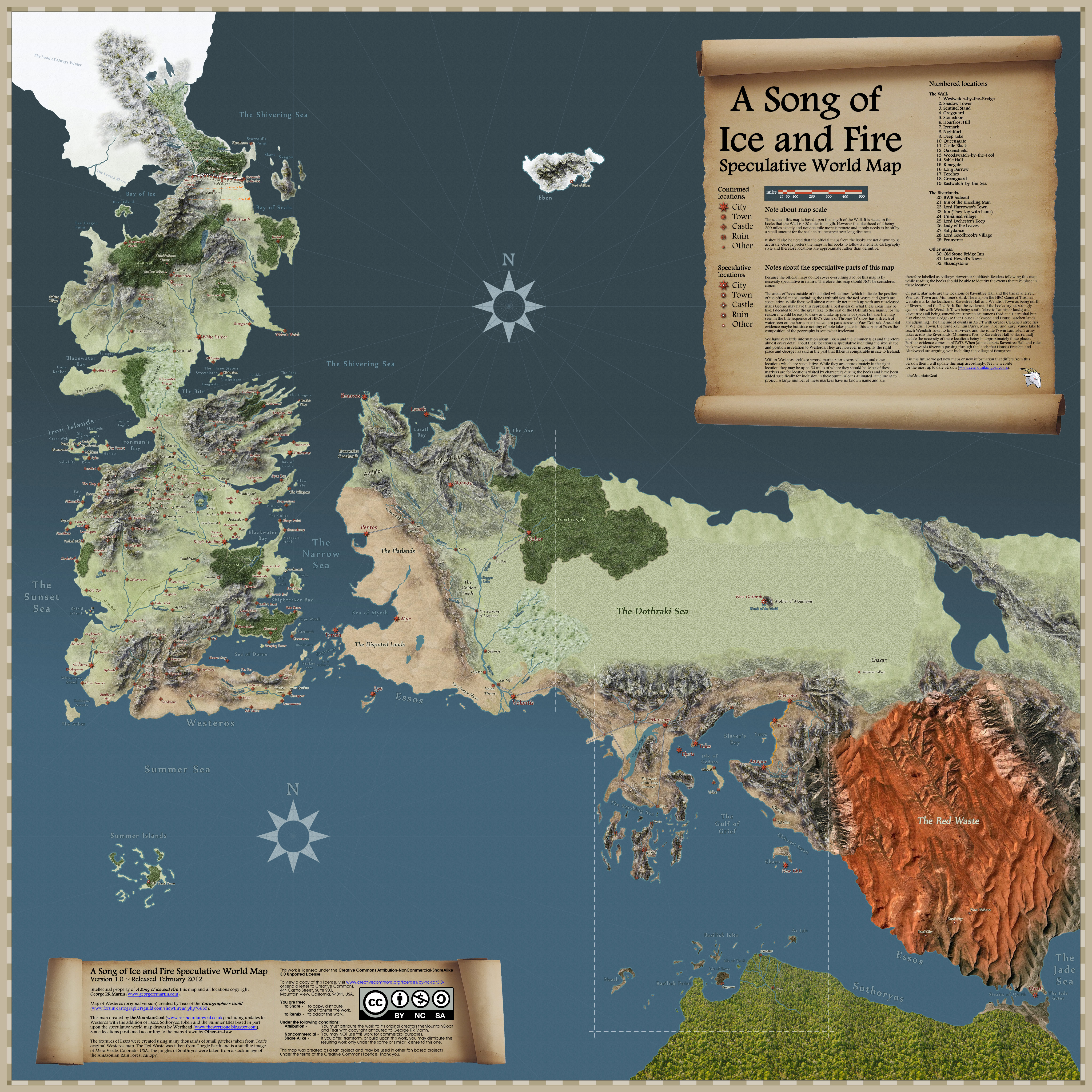
The Daynes are fairly prominent – they’re a principal house, they have that marriage link to Nymeria, etc. But the Jordaynes, Santagars, Allyrions, Tolands, Yronwoods, Wyls, and Fowlers are also principal houses and many of them have more useful economic advantages: the Tor and Ghost Hill sit on the Sea of Dorne which gives them a closer shot to the Narrow Sea trade, Godsgrace and Vaith sit on rivers that give them some of the rare arable land in Dorne and access to the Narrow Sea, the Fowlers sit on top of the caravan route through the Prince’s Pass, etc.
And as for the Daynes, it’s unlikely that there is much overland trade between Starfall and Oldtown, because that trade wouldn’t get much further than Starfall due to having to go over the Red Mountains to get to the rest of Dorne, as opposed to the easier route through the Prince’s Pass. Likewise, the high value export commodities probably aren’t produced in the arid Red Mountains – it’s far more likely that production takes place more in eastern Dorne.
Well, the Darrys are also an ancient House (one of the original First Men houses that managed to survive the Andals), and their shtick is the defense of the status quo no matter what – the first mention we have of them is fighting a losing battle against the Andals during the Andal invasion of the Riverlands, then we have them fighting on the losing side in defense of House Teague during the Battle of Six Kings, then getting almost wiped out by Aemond and Vhagar during the Dance, and on and on.
This tendency has been encapsulated in song:
“And there he stood with sword in hand, the last of Darry’s ten… And red the grass beneath his feet, and red his banners bright, and red the glow of the setting sun that bathed him in its light, “Come on, come on,” the great lord called, “my sword is hungry still.”) And with a cry of savage rage, They swarmed across the rill.”
Deremond isn’t just presented as a doughty fighter; he’s explicitly the last of ten Darrys who have fought and died upon the field, and he’s refusing to cede the field to a numerically superior enemy in favor of dying a heroicly stupid death.
So I don’t think you need blood ties to explain their loyalty – for the Darrys, it’s enough that Aerys II was the king, Ser Jonothor was his Kingsguard, and Ser Willem his master-of-arms (even if only to piss off Tywin).
Well, the Daynes’ prominence comes primarily from the fact that A. they’re one of the oldest Houses in Westeros, which gives them a lot of prestige, B. they’re also former royals, which gives them additional prestige, and C. they have a famous warrior tradition of the Sword of the Morning, which again gives them quite a bit of prestige in a warrior culture.Thus, despite not being one of the richest or most powerful of the Lesser Houses of Dorne, they have a ton of social/cultural capital.
In terms of their loyalty, I wouldn’t call the Daynes particularly notable as Targaryen loyalists beyond Ser Arthur Dayne himself – we don’t hear about any Daynes fighting at the Battle of the Trident, for example, nor do we see any Daynes of Starfall numbered among Oberyn’s partisans or Arianne’s conspiracy, and they arranged a betrothal to one of Robert Baratheon’s bannermen.
The King as a minor cannot dismiss his regent, because formally speaking he hasn’t been invested in royal authority yet – he is legally speaking a ward of his Regent, who holds that authority in trust.
So, Regent and Protector of the Realm: not quite the same thing, although they often go together, and they don’t have to happen during a minority. For example, Aemond was Regent when Aegon II was injured, and none of the Regents on the Regency Council of Aegon III were Protectors (not even Unwin Peake). Likewise, Daemon Targaryen was Rhaenyra’s Protector while she was Queen regnant, and Baelor Breakspear was named Protector by Daeron II.
So how we we understand the meaning of all these royal titles?
King of the Andals, the Rhoynar, and the First Men is a recognition that the King is monarch of three nations (in the sense of peoples), both in the sense of glorifying the union of the whole of Westeros but also a promise to respect the customs and folkways of these different peoples.
Lord of the Seven Kingdoms is a statement of feudal authority – the king as ultimate liege lord, whose right to rule in part flows from his acclamation and oath-taking by his vassals.
Protector of the Realm is a military title, recognizing the king as the supreme authority in warmaking – he’s the one who gets to declare war and make peace, he’s the one who calls the banners and who sits atop the chain of command in cases of dispute, and lesser military authorities like the Wardens Cardinal get their authority through him. But as I’ve said before, there’s also a recognition of reciprocal obligation to a social contract: because the King is the warmaking authority, he’s also the one responsible for the defense of the realm against foreign invasion and domestic rebellion.That’s why it’s the King’s Peace and the King’s Justice – he’s the one tasked with maintaining law and order in the face of everything from rebellious vassals to bandits and outlaws to common criminals.
And this is why I think we see the two titles sometimes separated. Daemon’s Protectorate was a recognition that he was the commander-in-chief of Rhaenrya’s armies; Baelor’s Protectorate was a statement from Daeron II that Baelor was being eased into becoming King, but also a way to counteract the king’s lack of skill by endowing supreme military authority on someone whose martial abilities were unquestionable. Whereas a Regent represents more the civilian side of power – the Small Council and the royal bureaucracy, the judicial and lawmaking sides of Kingship.
It’s somewhat complicated, but this is actually quite accurate to medieval societies. While there were a bewildering number of different kinds of land tenures under feudal law – everything from knight service and serjeanty to scutage, socage, copyhold, and quit-rent – it was extremely rare for land to be owned outright without any form of obligation or traditional responsibility to anyone. What is known in common law as freehold ownership was very rare, and in most cases until quite recently were actually “customary freehold,” which was itself a kind of copy-hold lease.
This is why Polayni argued that state action was necessary to bring into being a free market in land, to turn it into a fungible commodity that could be bought and sold, that could be turned into futures and other forms of derivatives, etc. The vast vast majority of those feudal tenures were all based on custom – rents and rights and obligations were usually fixed either by some document held at local manorial courts (copyhold for example is a form of tenure where tenancies were written down in the rolls of the manorial court and tenants were given a copy to ensure that the terms of their tenancy couldn’t be altered), or by tradition (in the common law, a property or benefit that had been held since “Time whereof the Memory of Man runneth not to the contrary” did not need any record other than the memory of the oldest man in the parish), and could only be changed with great difficulty subject to challenge in court.
However, this doesn’t mean that people were not possessive of land – ask any number of medieval kings who faced aristocratic rebellions when they tried to transfer fiefdoms or “innovate” their way to some new revenue – but rather that they didn’t think of possessing land as being free from all other claims. If a given manor had “belonged” to a family for hundreds of years, they thought of it as theirs, even if they had to pay traditional rents to a liege lord or give three pheasants a year to the local bishop.
The name of the formal charge is actually….”felony.”
Indeed, if we consult legal dictionaries, we find that “felonia” was originally understood to mean “the act (or offense) by which a vassal forfeited his fee.”
Excellent question! My answer will come in two parts, relating to different ways to think about money.
The first has to do with the relationship of money to land in a feudal society. As I explained with regards to Littlefinger:
If you’re asking why he doesn’t have more land (other than the lands of Harrenhal, which are quite extensive if slightly cursed), it’s that Westeros doesn’t have a free market in land, wherein land becomes a fungible commodity that can be bought and sold at will and abstracted into derivatives and futures, etc.
Land in Westeros is distributed through feudal relationships that are traditional and customary in nature – fiefdoms are hereditary, taxation and rent levels are fixed, and tenancies are more likely to involve feudal obligations than pure cash rents.
Karl Polayni, in his masterwork Great Transformation, identified the transition from feudalism to capitalism as the creation of a free market in land, labor, and money where none had existed before: the feudal contracts that stretched from the king on high all the way down to the peasant on the manor had to be destroyed so that land could be bought and sold as a commodity; serfdom had to be abolished and the commons enclosed to first free the peasants from the land they were bound to and then drive them into the factories; and usury laws that had hampered lending money for profit needed to be abolished to allow the banking industry to flourish.
This hasn’t yet happened in Westeros, for the most part. The only mention that land can be bought comes from the extended Westerlands chapter, where at Ellyn Reyne’s “urging, Lord Tarbeck expanded his domain by buying the lands of the lesser lords and landed knights about him… and taking by force the holdings of those who refused to sell.” The canonicity of this event being in question, nevertheless the context suggests extra-legality, with cash payment being used to mask violent seizure.
So even if they wanted to, no I don’t think the Lannisters could buy Westeros. I’d also point out that it would never occur to them to do so; as I’ve said before, the Lannisters are aristocrats and have an aristocrat’s conception of money rather than a merchant’s conception of money. Gold becomes land by buying swords to take it, not by going to a market like some Pentoshi cheesemonger.
The second has to do with inflation, as @joannalannister suggested. As I wrote here, the size of the Westerosi economy itself acts as a limiter on House Lannister’s ability to spend its gold:
The danger of dumping 18 billion gold into the Westerosi economy is that you’d generate a wave of hyper-inflation so bad that you’d make the SpanishPrice Revolution look like a mere stock market hiccup. While in the long run providing the liquidity necessary for Westeros-and indeed even Planetos-wide economic development, the short-term implications would be the destruction of the Westerlands economy, as skyrocketing inflation would destroy the value of our reserves, cause our goods to be non-competitive, and cause the price of food to soar faster than wages, leading to massive socio-economic conflict.
When the Kingdom of Spain conquered Mexico and Peru in the late 15th-early 16th centuries, they got their hands on the great silver mines of Zacatecas and Potosí, which produced $2.7 trillion in 2015 dollars. This vast tidal wave of precious metals, torn out of the ground by slaves, had the paradoxical effect of destroying Spain’s economy with inflation. Inflation meant that it was far cheaper to import raw materials and manufactured goods into Spain, rather than produce them at home, so manufacturing and even farming went into decline. Rather than invest in agriculture or commerce, the wealthy put their money into government debt instead so as to be repaid in silver.
And of course, the irony of all of this is that the Crown’s vast treasure hoard by its very vastness destroyed its value. Drunk on their own precious metals, the Kings of Spain tried to conquer all of Europe for Catholicism and the House of Hapsburg, and went bankrupt in the process. As I discuss here:
@racefortheironthrone estimated that Westeros has an annual GDI of 525 million gold, while I think the Lannisters have an annual income of approximately 6 million gold. The Lannisters’ annual income is a little more than 1% of Westerosi GDI per year. (For comparison, Rockefeller’s entire net worth – not his annual income, but his entire fortune – was 1.5%-2% of GDP.)
Phillip II of Spain, despite all the gold and
silver of Mexico and Peru, went bankrupt four times (1557, 1560, 1575, and 1596),
and historians suggest that his *personal* debts were equal to 60% of Spain’s
GDP at the time..
It got so bad that during the Dutch Revolt, which lasted from 1568-1648 (if you want to know where all the money was going…), that Phillip II had to get his financing and supplies from the Dutch because no one else would lend him money to pay for his war against the Dutch. The Dutch bankers agreed to finance him at exorbitant rates of interest, and then turned around and used his own money to support the rebellion against the Spanish.
So the Lannisters have to tread lightly when it comes to their gold…
Trying this again, because CK2 maps are tricky and change over time, which makes comparison difficult and leads people to delete their posts in frustration. This time, I have a new set of images that I am reliably informed are from 283 AC in-game, so there’s consistency there.
First things first: holy hell, the Rills are way too big, encompassing both the Stony Shore and Sea Dragon Point. Also, there’s an inconsistency here w/r/t the handling of “masterly houses” – the Wolfswood is separated out from the Stark domains despite the Glovers being a masterly houses, whereas Torrhen Square is not, even though the Tallharts and Glovers are of the same standing.
Beyond that, most of the names for the hill clan areas – Arrendell, Crow’s Edge are rather spurious – and Breakstone Hill for the Flints is based on an assumption that the First Flints and the Flints of Breakstone Hill are one and the same.
The Vale:
This is…interesting. Crab’s Shore doesn’t exist, neither does Darkmoore, and we don’t have any reason as to why House Templeton is that far west when the rest of the Lords Declarant are more to the east.
Inside the Vale proper, things get weird. The Redforts have been swallowed up by Runestone, even though the Redforts are a principal House the same as the Royces; likewise, the Waynwoods have seemed to swallow up the Melcoms. The Eastweald and Northweald aren’t real names either, and the former would seem to give House Hunter a lot of territory.
Over the mountains, the Corbrays look awfully small compared to the Belmores. I like the detail of the Royces having Coldwater Burn in their affinity, but the Lynderlys of Snakewood are pretty hard to see. Crow’s Barrens doesn’t exist, nor does that hard to read area next to it.
I will say that I think the Imgur maps do a better job with the smaller Houses, although again it’s a bit of a guess as to who’s where.
The Riverlands:
The Freys are way too big, even if they are a significant house, that’s more land than Harrenhal has. indeed, the lands north of the Trident are messy in general – Wycombe isn’t a real name, nor is Chiltern or Still Fenn. I also don’t think the Tullys have any land at the intersection of the Trident, as much as I think they should. My bigger problem is that we don’t see House Roote of Harroway’s Town, and I think House Darry is actually south of the Trident as per AGOT and AFFC, probably where “Deddington”(?) is on the map.
My next problem has to do with the Vances, where I actually have a beef with both sets of maps. I agree with Ser Mountain Goat that Wayfarer’s Rest logically occupies a position on the River Road equidistant between RIverrun and the Golden Tooth: this would explain both why Karyl Vance was involved with the Mountain’s raids on the border, and why the castle that name, since it probably got its start catering to traders and travellers along the road.
I also have a problem with some of these invented names: Acorn’s Ridge doesn’t make much sense when Atranta is there to be used. Likewise, Southstone is pretty much exactly where Stone Hedge should be, so why not use that name?
Once again, I think the Imgur does a better job reminding us of the existance of lesser Houses like the Rygers (although I would place them nearer to Riverrun given their history), the Vyprens (who are definitely near the Darrys, given the Battle of the Widow’s Ford), the Goodbrooks, the Wayns, etc.
Iron Islands:
Skipping b/c you can’t read the map.
Crownlands:
Let me just say how boring I find the Crownlands, and that the only reason I’m writing about them is for the sake of completeness and my undying love for you all.
First things first, it’s a bit odd that House Wendwater isn’t on the Wendwater, and that House Fell from the Stormlands holds the Kingswood, that seemingly House Seaworth holds the Blackwater Rush, etc.
Second, there’s some missing houses here: the Buckwells of Antlers, the Brones of Brownhollow, the Rykkers of Duskendale, etc.
Westerlands:
The first thing that jumps out to me is that the Gold Road is outside the borders of the Westerlands, so I don’t know what’s going on there. Next, the Lyddens of Deep Den should be in-between Silverhill and Hornvale. further south, I’m not sure why the landed knights of Greenfield are more powerful than the principal House Swyft of Cornfield, nor what Lonmount is supposed to be. Other mysteries: what Lang Tower is, or Tendring is, and why it’s where Oxcross should be.
Sarsfield seems way too big, as does Ashemark. Tarbeck Hall can be seen, but not Castamere. The Banefort seems to have been gobbled up by the Westerlings for some unknown reason; likewise, the Kennings of Kayce seem to have absorbed the Presters of Feastfires.
The Reach:
The list of non-existent names is getting too long, so I’m just going to skip them and just talk about the power dynamics. The Rowans of Goldengrove seem way too big, making the Cranes and Oldoaks seem too small.
Blueborn and Cockleswent doesn’t exactly work very well as regions – I doubt the Meadows control all of the former, or the Ashfords the latter. Likewise, the Westmarch seems too big for the Tarlys alone to handle – where are the Peakes? Where are the Vyrwels? Inchfield doesn’t exist and wouldn’t be there if it did – Coldmoat and Standfast need to be to the west of House Rowan’s holdings, given Wilbert Osgrey’s duel with Lancel IV.
In general, probably my least favorite to date, not particularly suitable as a political map.
The Stormlands:
House Wendwater is in the Crownlands, not the Stormlands, and why is it in two places? Tarth is ridiculously large, having somehow grabbed the lands of House Penrose of Parchments. House Buckler of Bronzegate also seems to have vanished. House Fellwood is north of where it should be, House Morrigen is to the east of where it should be, Stonehelm is labelled the Red Watch, and for some reason Dragonstone holds the Rainwood (is that supposed to be Davos? Even so, he’s a bit north of where he should be).
Also not one of my favorites.
Dorne:
The penchant for HUGE fiefdoms continues apace, it seems. The Ullers are much much too big, encompassing the lands of the Qorgyles as well. The Tolands likewise seem to have gobbled up the Jordaynes and much of the Allyrions. The Fowlers and the Manwoodys look squished together. Spottswood I think is on the wrong end of Dorne, it should be much closer to the Yronwoods.
Ultimately, what these royal judicial reforms are all about is trying to create direct connections between the individual subject and the monarch, cutting through the various layers of subinfeudation.
So going to the Great Houses to ask for their help is kind of counter-productive, because it at least implicitly establishes the precedent that the Great Houses have a say in what royal policies will be in their realm. Instead, you want to assert that the Great Houses have an obligation as Lords Paramount holding their titles from the King, to uphold the King’s Justice.
As for the younger sons, you’d probably want to encourage some formal training, whether that’s by being sent to the Citadel or having them be tutored by a maester. Depends on what’s more practical.
Three hides of land is a good bit – it’s a bit below a “knight’s fee” which was usually five or more hides, but a single hide enought to support one family, or 30 modern acres. So each of Gregor’s men gets 90 acres of land, which would put them solidly in the ranks of the yeoman – below the knight but above the knave, as it were.


 RFTIT Tumblr Backup