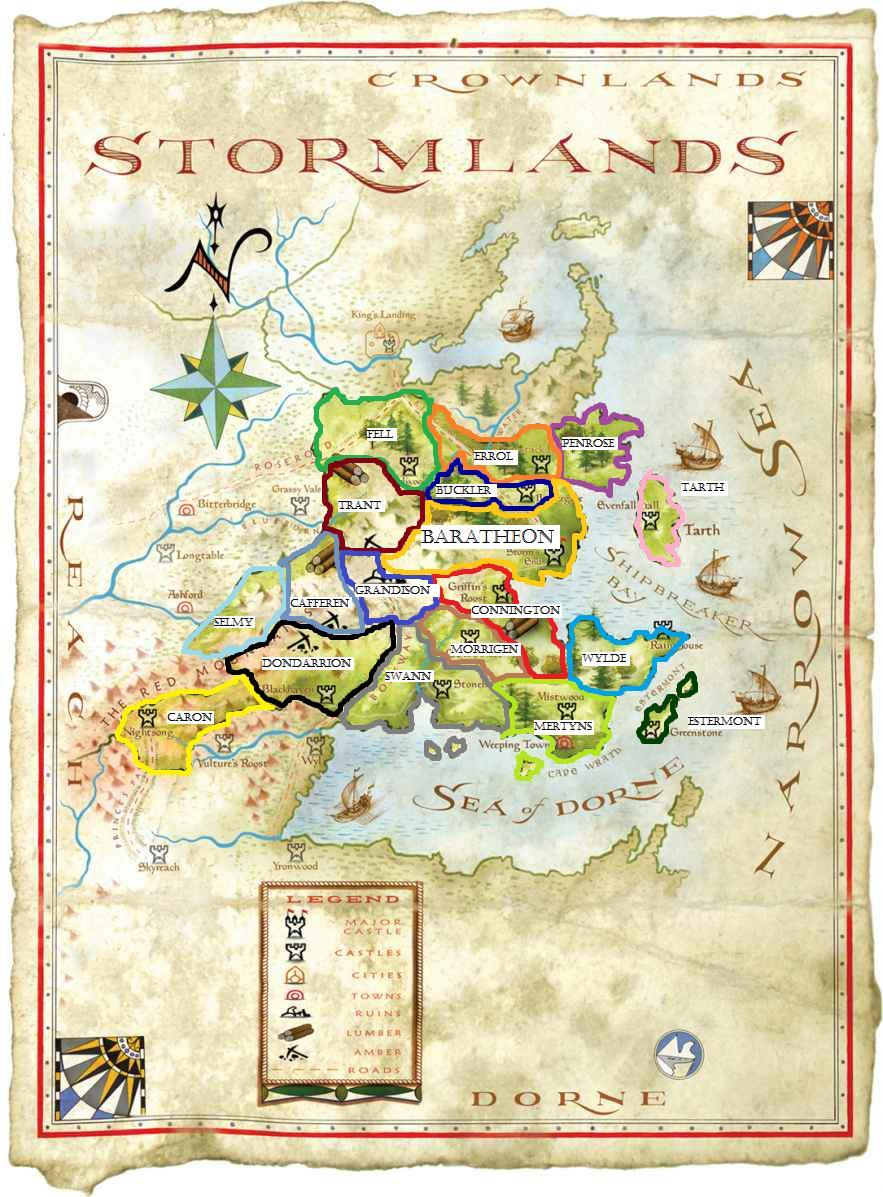
Politics of the Seven Kingdoms: Part VIII (The Stormlands)
Hey folks! If you’d like to read my essay on the politics of the Stormlands collected in one place, it’s now up on Tower of the Hand here. Check it out!
Just a backup in advance of the detumblring
Politics of the Seven Kingdoms: Part VIII (The Stormlands)
Hey folks! If you’d like to read my essay on the politics of the Stormlands collected in one place, it’s now up on Tower of the Hand here. Check it out!
Politics of the Seven Kingdoms: The Stormlands (Part II)

credit to ser other-in-law The Andals in the Stormlands Earlier, I discussed some of my frustration with the historical sections of the Stormlands chapter. In this section, we get to some of my biggest pet peeves with this section of the WOIAF – namely, that its account of the Andal Invasion of the Stormlands doesn’t really pass muster, especially when viewed in comparison to the other Seven…
I’m pretty sure that’s exactly what he did.
We learn in the Prologue to ACOK that only half the Stormlords actually sent men to Renly, while the other half “sit behind their walls waiting to see how the wind rises and who is likely triumph.” And Selwyn Tarth is explicitly listed as belonging to that faction, as Davos reports:
“I broke bread with Gulian Swann and old Penrose, and the Tarths consented to a midnight meeting in a grove.”
So yeah, I think Selwyn held back his levies but let his idealistic daughter pursue her dreams.
Ok, so I’m the new lord of the Stormlands. I’ve got a kickass castle, bad weather, and a very dysfunctional family – how can I improve on this?
Goal 1: Timber and Trade
The two basic natural advantages of the Stormlands are that it’s really close to Essos and that it has an enormous amount of timber (the amber is nice, but it’s not particularly useful) – but it’s not really making any good use of these advantages.
So the first step is to begin making use of the Rainwood and the Kingswood (altho the king has sole hunting rights over the kingswood, he doesn’t seem to have sole cutting rights, as there are settlements in the kingswood. If necessary, bribe the king). Set up sawmills on the Slayne, Wendwater, etc. to build up a lumber industry and clear land for farming – while being careful to practice good forestry management. Encourage carpentry and woodworking in a big way – tax benefits, free land, guild charters, industrial espionage against House Forrester, etc. – to begin moving up the value-added chain and have something to export.
Once I have that infrastructure, engage in sufficient bribery and/or industrial espionage in Braavos and the Summer Isles to begin building up a shipbuilding industry second to none – which in turn should support a huge navy and merchant marine. This in turn, requires port cities – which means charters for any decently-sized and minimally-stormy harbor, and given that I’ve got some pretty hefty competition with King’s Landing means I’m going to have to heavily undercut my competition in terms of tariffs, harbor fees, warehouse fees, etc. Need to be careful to stay in the black, at least to start, and hope that my home-grown merchant marine can compensate.
In the early stages, this will have to be concentrated on Cape Wrath between Stonehelm and Weeping Town (which seem to be a bit more protected by the Rainwood), but once you’ve got revenue up, I’m going to need a massive system of breakwaters, lighthouses, and beacons to make Shipbreaker Bay a productive marine economy, as right now it’s at least a third of my territory and it’s not good for much.
Goal 2: Immigration
One of my major problems as the Lord of the Stormlands is that “the realms of the Durrandons and their successors have always been thinly peopled when compared to the Reach, the Riverlands, and the west.” A thin population means a low tax base, small labor force (which in a predominantly agricultural society means some hard limits on food supply, and thus population growth) and a small army.
So my second main goal is to attract immigrants – especially skilled craftsmen and sailors, but also lumberjacks, saw mill workers, longshoremen and warehouse workers, and farmers. And my main strategy here is going to be quite similar to a lot of German Princes after the Thirty Years War which depopulated much of the HRE – offer free land and tax exemption for a limited number of years to entice people to immigrate.
Given that primogeniture seems to be the rule, it shouldn’t be too hard to lure supernumerary sons from the Reach and the Riverlands. However, given my need for expert shipbuilders, sailors, merchants, and artisans, I’m going to need to look abroad too – the Summer Isles, Myr, Braavos, etc. Which is no doubt going to cause some social disruption, but that’s the cost of progress, and I am an ambitious early modern state-builder after all.
Goal 3: Administrative Reform
At this point, I have to recognize, even with a stronger economy and a larger population, there are hard geographical limits to the Stormlands, at least as long as the Iron Throne is operative. I’m not going to be able to grow as much food or field as many troops as the Reach, so I’m going to have to be more efficient, so that the extra ships, the extra farmland, the extra tax revenue is used to best advantage.
So that means I need my own version of the Small Council and a small army of clerks to push the Stormlands into something more like the Tudor state, although my ultimate aim is something like the Prussian Reforms.
————————————————————————-
Up Next: Dorne
This is something that happens almost completely off-page, but it’s really really unclear what exactly happens and I’ll be following up on this in Tyrion X of ACOK.
There’s a big bit of confusion in that Renly claims to have 80,000 men at Bitterbridge when Catelyn meets him there (60,000 foot and 20,000 cavalry), but in the next Catelyn chapter has him claiming to have 100,000 foot in addition to his 20,000 cavalry.
Then Randyll Tarly rides for Bitterbridge. The next time we see the Tyrell army after Blackwater, they have somewhere between 50-70,000 men, with most estimates coming out to 60,000.
Now, given these wildly varying possibilities, it could be that almost no-one died at Bitterbridge – if Renly had 60,000 foot and Tarly grabbed the lot and just killed some officers. If Renly had 100,000 foot, then Tarly must have killed 40,000 men, which would be the largest single death total in any battle in ASOIAF world history.
Even for a massacre, 40,000 is improbable, so let’s see if we can firm some things up. Given that we know Mace brings up his 10,000 from Highgarden, that would suggest that only 50,000 of the Tarly army at Blackwater came from Bitterbridge. To me, this suggests that Renly was full of shit, and had 80k rather than 100k men, 60k men were left at Bitterbridge, and Tarly had 10,000 men – mostly Florents, but also Fossoways, Cranes, etc. – killed. Which would put the massacre up there with Oxcross, but not way ahead of it.
However, this leaves some open questions:
Continuing with the numbers issue in the South, Tarly,Rowan & Loras salvaged 5000 from Renly’s 20000 horse at Storm’s End. So that likely represents the mounted strength of Horn Hill, Goldengrove & a few other Reacher houses. The Florents,Cranes,Varners, Fossoways, Mullendores, Willums & Meadowes switched to Stannis. Combined their mounted strength should amount to at least 5-6000. Of Mace’s 10000 reserve, around 3-4000 should be knights/squires. We know that 2 of the richest & most powerful houses-the Hightowers & their vassals(Beesburys, Costaynes) & the Redwynes had stayed away from Renly’s host.These houses should be able to field around 3-5000 cavalry at least. Add to it the houses Renly names as his supporters but never show up(Shermer, Dunn,Footley, Blackbar, etc.) and the ones he never named (Peakes, Vyrwells, Ball, Roxton, Leygood, Ambrose, Ashford etc.) , and we can account for another 5-7000 cavalry at least. So all in around 25-27000 Reacher horsemen accounted for.at least . Some other forces would have been left to guard the castles.
So if we assume that at least 5-6000 Reachers switched over to Stannis, that would mean that at most 9-10000 Stormlanders joined his cause at Storm’s End. Whatever infantry Caron, Errol, Morrigen, Penrose and others mobilised would have been left behind at Bitterbridge when Renly sped off to Storm’s End, meaning the Stormlander foot had no choice but to serve under Randyll Tarly when he returned and seized control at Bitterbridge. A good % of these men are probably in the Riverlands & KL even now. So that leaves around 10000 of Stormlander military strength unmobilized (assuming that 9-10000 SL horse was matched by at least 10-15000 SL foot in Renly’s force, and that the SLs can field 30-35000 men all in all).
Let’s work through this, with Anonymous’ correction re: the Stormlands taken into account.
If Renly had the full support of both the Reach and Stormlands, his army should have been 140,000 strong, with 38,000 cavalry. As it stands, Renly seems to have around 80,000 (with 10k at Highgarden, so 90,000 or 65% support) with 20,000 cavalry (which roughly fits the ratio) – although he’ll claim to have 120,000 with 20,000 cavalry (which is way below the ratio).
Now, we know that Loras and Tarly grabbed 4,000 cavalry from Storm’s End, which includes House Tarly, House Rowan, and House Tyrell. Can’t forget this last part – the Tyrells brought a lot of manpower to Bitterbridge and Storm’s End, which is reflected by the ubiquity of their banners.
I’m going to use a rough estimate that the Houses have an average of 2,000 soldiers each, with ~540 being cavalry. So the seven Reach Houses (Florents, Cranes, Varners, Fossoways, Mullendores, Willums, Meadows) who see service with Stannis should equal roughly 3,780 cavalry. We know that 13 Stormlander Houses (Morringens, Estermonts, Carons, Conningtons, Errols, Hastys, Bollings, Horpes, Peaseburys, Fells, Wyldes, Grandisons, and Wensingtons) see action with Stannis. That’s roughly 7,020 men.
Together, that accounts for 10,800 of the 16,000 who join Stannis at Storm’s End. Now, there are a couple of possible explanations here:
That gets us pretty close, up to 15,000 men.
So….if around 4,000 Reachermen joined Stannis, that suggests that there’s another 23,000 Reach cavalry around. 4,000 of them went with Loras and Randall, so that leaves us with 19,000 to account for. Using the same 27% rule, around 2,700 of them were with Mace, leaving 16,300 unaccounted for.
If we look at the Reach houses that are either mentioned by Renly and don’t seem to have been there (Bulwer, Costayne, Hightower, Blackbar, Shermer, Dunn, Footly, Caswell), or the significant houses that seem to have been left out (Vrywel, Redwyne, Appleton, Ashford, Chester, Serry, Grimm, and Hewett of the Shield Islands, Cordwayner, Graceford, Merryweather, Peake, Roxton), that gives us 11,340.
So really there’s only around 5,000 unaccounted for, and House size could easily explain that.
 RFTIT Tumblr Backup