(I know I said Dorne was next, but you go in the direction the muse points)
The nice thing about doing development policy for the Reach is that you’ve got a lot to work with – the Reach is highly productive, densely-populated, and quite wealthy. However, despite these natural advantages, there are some glaring examples of missed opportunities.
Step 1: Harnessing the Land
The great strength of the Reach is in its incredibly fertile soil, so we begin by playing to our strength, focusing our efforts on making sure that the farmers of the Reach are at their most prosperous, so that House Tyrell can be as well.
This begins with constructing a Mander-to-Blackwater Canal. It’s something I’ve talked about before(link), but the advantages are so clear that it’s kind of mind-boggling that it hasn’t been built yet. King’s Landing needs huge supplies of grain, the Reach is the major source of grain in Westeros; Oldtown is tied for the largest commercial entrepot in Westeros, and yet the journey from Oldtown to Essos (or vice versa) is easily twice as long as the journey from Plankytown or Gulltown or White Harbor or King’s Landing.
A canal linking the two rivers would expand the Reach’s, well, reach enormously, by reducing the time-to-market from around 21 days from the Reach to King’s Landing to 8 days.
- To begin with, this would allow the Reach to dominate the agricultural market on both coasts of Westeros and the Free Cities, shipping not only more perishable goods like wine but produce and grain (products where a few day’s difference can mean the spoilage of huge amounts of goods).
- Moreover, it makes the Mander the natural commercial highway of Westeros – leaving aside the fact that no foreign merchant in the world is going to take the longer and dangerous route across the Sea of Dorne to trade with the west coast, the speed advantage of ships vs. carts means that internal trade will gravitate towards the Canal, because why take five and a half months overland from Gulltown to Lannisport when you can take the Canal and get your goods there in 13 days?
- Finally, it massively increases the Tyrells’ power at court. With the capitol’s trade passing through my canal, with Tyrell grain able to undercut any competitors from the Reach or the Riverlands, and with travel to and from the Reach decreased in time, it’s much easier to project both soft and hard power w/r/t the King and Small Council.
Equally importantly, once the Canal is built, it becomes an enormous moneymaker for the Reach. Taking the port of London for a historical example, in 1613 the port of London brought in 109,000 pounds in customs duties (this was well before the explosion of commerce that would see the port bringing in 1.26 million a year in 1710 and so on and so forth) – that works out to 87,200 dragons annually in revenue. That’s a staggering amount of money on top of what House Tyrell already earns from its lands and feudal taxes, which means it can be put to use instantly.
That money would help to capitalize a Land Bank of Highgarden. This would essentially be a kingdom-level central bank, which with 87,000 dragons annually as its reserve (to say nothing of House Tyrell’s normal tax and land revenues, or deeds to House Tyrell’s lands and real estate) would produce 872,000 dragons in deposits and 741,000 in loans – and that sum is going to increase dramatically as the reserve keeps growing thanks to our canal. So this land bank has all of the sudden made House Tyrell the equal of House Lannister in income…unless the Lannisters start their own bank (more on that when I get to the Westerlands).
Here I’m going to borrow from the Populists, and link the Land Bank to a sub-treasury system. The basic idea is that farmers would have the right to sell their crops to a public warehouse at a guaranteed minimum rate in exchange for an official letter of credit, which they could then redeem for their crops again if prices rose. It works on several levels:
- first, it increases and stabilizes farmer’s incomes and their access to credit, while massively expanding the Land Bank’s reserves by a huge factor (forget the Lannisters, I’m now the richest House in Westeros by far); the classic Tyrell style of doing well by doing good.
- Second, it allows for the stabilization of agricultural prices. If food prices falling is going to damage the incomes of peasants and lords alike (including that of House Tyrell), the sub-treasury’s minimum ensures that a bumper crop benefits farmer and consumer both. If a sudden spike in food prices would lead to famine, House Tyrell is here to save the day (our pleasure really, sure you’ll return the favor some day) and making itself the indispensable force across a continent’s economy.
- third, it massively increases House Tyrell’s influence within and without the Reach. Within the Reach, the sub-treasury’s bargain is too good to turn down – which now means that the whole of the smallfolk now have a direct connection and dependence on House Tyrell, as will many lords who’ll be all to happy to turn their excess crops into cash in hand. Except now House Tyrell has the power to seize your crops and capital, rouse your smallfolk and vassals into rebellion, if you cross me. Outside the Reach, our influence over the price of food is now so strong that we would make Petyr Baelish’s proposed manipulations in the Vale look like child’s play.
- fourth, it provides for an explosion of credit to invest in increasing productivity. Want to build a barn or pens for livestock or a silo or a mill, buy more livestock or a new plow, or some new seeds for a more diverse crop or more fertilizer for a better yield, or maybe drain some marshy land or clear a wood for more farmland? The Land Bank of Highgarden is happy to extend a loan on easy terms. As prospers the land, so prospers the fisher king.
Step 2: Industry and Infrastructure
So now I’m hugely rich and have money to invest, it’s time to diversify the Reach’s economic base. To begin with, textiles – with my immense and more productive farmland, the less fertile land can be turned over to large-scale flax production for linen. The foothills of the Red Mountains are perfect for herding sheep for wool. Combine that with all of the lovely rivers and setting up watermill-powered factories for the production of linen, thread, and woolen cloth. Once you’ve got that up and running, time to do some industrial espionage – see if you can copy (or bribe craftsmen who know how to make them into immigrating to the Reach) Dornish silks and satins, Lorathi velvet, tapestries from Qohor and Myr, fine woolens and lace and carpets from Myr. They don’t need to beat them for quality as long as I can bring to market more cheaply than the competitor thanks to the Canal.
Next, there’s probably good minerals in the Red Mountains – so let’s get some mines running, poach some craftsmen from Qohor or the Westerlands to build up metalworking. Not that I’ll necessary need an arms industry right now (in the mean time, they can make pots and pans), but I don’t want to be dependent on imports from the Westerlands if I might need to go to war with them.
Third, infrastructure. The Canal is good, but the Hightowers would pay nicely for an extension linking the Mander to the Honeywine to diminish the threat that the Canal would shift trade away from Oldtown. Moreover, as a matter of security, boom chains on the Mander and the Honeywine would provide protection against Ironborn raiders and improved control over canal traffic.
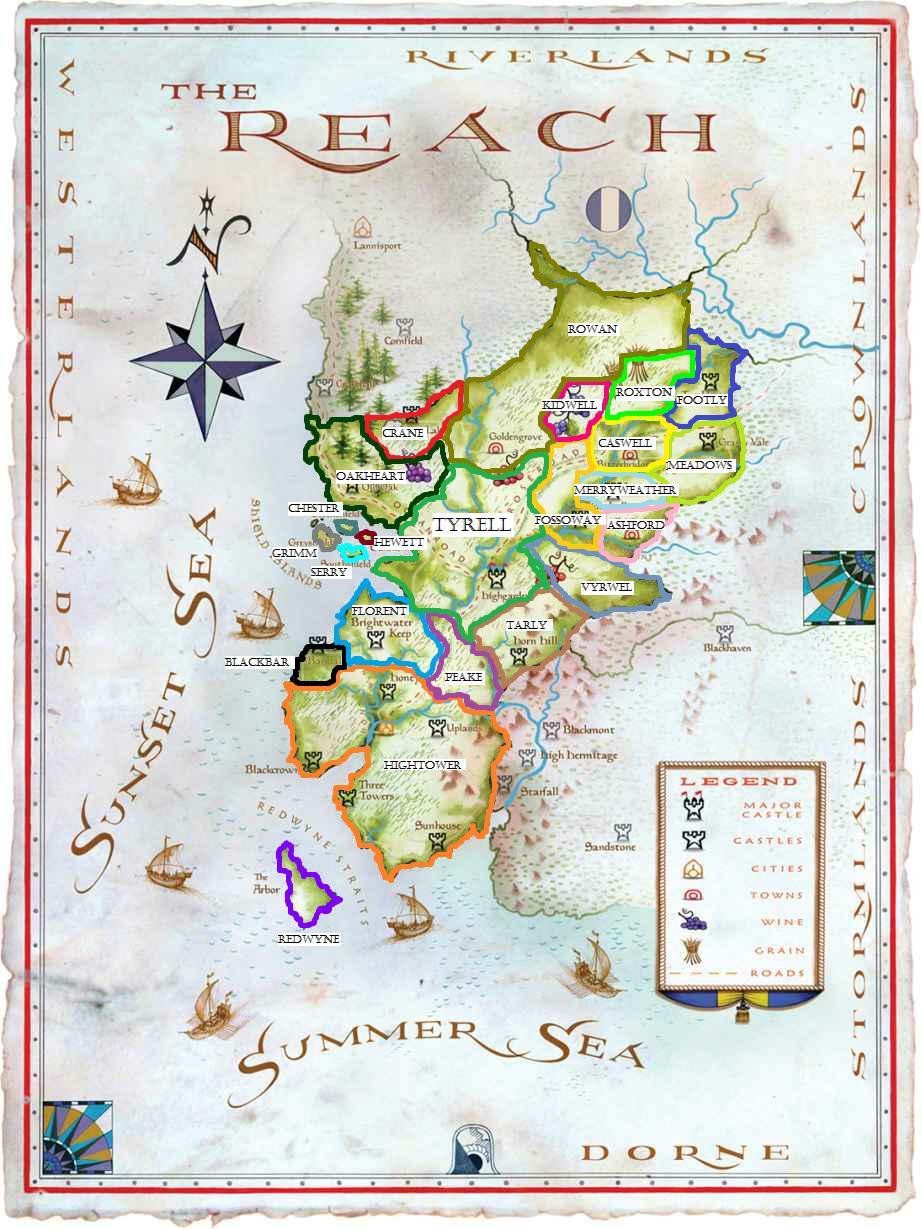
The Reach has a fair few roads, but it could stand to use more. In the north, a ringroad that connects Old Oak, Goldengrove, and Tumbleton would allow for swifter reinforcements on my northern border, and enhance overland travel and trade; in the south, a ringroad connecting Sunflower Hall, Uplands, Horn Hill, Ashford, and Grassy Vale (as well as Oldtown and Highgarden) would do the same for my southern border. Finally, bridges – while I want to keep the Canal clear (with one exception), for better movement I want a stone bridge over the Silverhill river by Goldengrove, over the Blue Byrne by Grassy Vale, and over the Cockleswent by Ashford.
Step 3: Institution-Building
With all of this increasing wealth and productivity and increasing industry, I’ll need some cities to put people in. To a certain extent, I’ll need to play this by ear – don’t know where concentrations of agriculture, commerce, and industry will warrant cities, precisely – but I do have two cities particularly in mind.
First, a port-city at the mouth of the Mander (Canalmouth? Mandertown? New Oak?). In addition to quite a lot of harbor facilities to service the Canal trade, this port city will be designed around a shipyard, as well as a sizable garrison to protect the boom chain (I will make very sure that the port and shipyard are behind and not in front of the chain). In addition to providing repairs and refits for passing ships, the purpose of this shipyard is to build a proper navy for the Shield Isles (as well as a decent riverrine navy with plenty of transports). A few dozen longships is not sufficient for my major northern naval defenses, so I want to build up a decent-sized fleet of at least 20 if not 50 ships of the line – House Redwyne may need to be mollified by creating a reserved Redwyne post somewhere in the chain of command – Admiral of the Northern Navy? Lord/Castellan of the city? Master of the Shipyard? Depends what they’re willing to give me for the privilege.
Second, a city across the river from Highgarden – to be known as Newgarden – with a swinging bridge across the Mander, with its . The first purpose of this city and this bridge is to act as the central customs point for the Canal (although subsidiary points will be needed at Canalmouth and at Tumbleton), and I’ll probably need to build an artificial harbor to host the canal trade as they pay their due. The second purpose is to give a location for the Great Council of the Reach – which I want for the same reasons that the Lord Paramount of the Riverlands does, but even more so because it’s the chivalry and pageantry-obsessed Reach, and a Versailles strategy will be super-effective. Throw some epic Grand Balls, hunts, jousts at Highgarden proper – but only if you’re important enough to get an invite across the bridge – to keep everyone currying for favor, but to keep everyone busy, stuff Newgarden full of gambling dens, race tracks, Braavosi theater troupes, all the singers you can shake a mandolin at, go wild with it. While I’m at it, recreating the Order of the Green Hand a la the Winged Knights is a great idea – but why not shoot for 700?
Next, time to invest my money in human capital. First things first, time to start sponsoring students at the Citadel – but my object here is to produce large numbers of half-maesters who I can use as administrators, experts, and above all, teachers. The Citadel might get stroppy, but as long as all of them have to get their accreditation at the Citadel and we agree that a maester’s chain is necessary for the top management jobs. Second, establish a network of free schools – probably can’t manage one per village, but one per town/major castle should work – with a competitive examination system to get into the Civil Academy at Newgarden I’ll establish to train and recruit the vast army of bureaucrats to run my new institutions.
At the same time, can’t neglect the practical subjects – I’ll want a Naval Academy at the Arbor (go where the ships are) to train up professional naval officers, a Military Academy at Old Oak (close to the Shield Isles and the northern borders) to do the same for the land forces, and an Engineering Academy somewhere close to the new industries by the southern border.



 RFTIT Tumblr Backup