In ADwD one of the Northern Clanlords mention that Winterfell used to ask for hostagewards from the hill clans, & those whose fathers went against the Kings of Winter would be sent back minus head. Given that the hill clans seem to be steadfastly loyal, what kind of events would necessitate something as drastic as execution of the wards?

Probably internal warfare and the breaking of peaces:

“These clans—located largely in the mountainous regions beyond the wolfswood, in the high valleys and meadows, and along the Bay of Ice and certain rivers of the North—owe their allegiance to the Starks, but their disputes have oft created difficulties for the Lords of Winterfell and the Kings of Winter before them, forcing them to send men into the mountains to quell the bloodshed (commemorated in such songs as “Black Pines” and “Wolves in the Hills”), or to summon the chiefs to Winterfell to argue their cases.” (WOIAF)

I would guess what happened is that the Starks took hostages when they sent men into the mountains to prevent a further outbreak of violence, and then someone was dumb enough to break the peace, and to prevent another war and another intervention from Winterfell, a Stark cut off some heads to show that they would enforce the peace personally if they had to.

So it’s not about disloyalty to the Starks, it’s more about the folkways of feuding and vendetta. 
Hi again, i’m the anon from the northern and southern style of politics, i was wondering how different is ned’s ruling style from other lords of winterfell, and if that difference is more from been raised by jon arryn or some other reason (his uniquely strong sense of honour, the fact that he was a second son, raised to served his older brother) ? thanks for the fast answer btw!

That’s a good question – we don’t really have a good sense of how Ned’s very personal approach to power and his benevolent paternalism compares to the Starks who came before him. We know Rickard Stark was interested in continental power politics, dynastic marriage alliances, and fostering agreements but we don’t know much about how he related to the lords of the North. 

What we can say is that Ned Stark was widely respected and beloved by his lords even past his death, so his style couldn’t have been been that far from the norms of Northern politics. 

Hi Maester Steven, its very common in the asoiaf fandom to contrast northern and southern politics, usually saying that the northern lords are way more honest and loyal than their southern counter parts, and on the main series there are very evident differences. But after reading woiaf i’m now under the impression that the political styles aren’t really that different, but that ned ruled in a different manner than before. What is your opinion on this?

I’ve been saying that Northern feudal politics are just as complicated and ruthless as Southern feudal politics since Bran VI of AGOT. Leaving aside the manifest disloyalty of the Boltons and the Karstarks as shown in ASOS and later, we can see from the Hornwood Crisis in ACOK that the lords of the North are constantly jockeying for position and power and that the Stark in Winterfell has to work very hard indeed to keep the Manderlys and the Umbers or the Glovers and the Tallharts working in harness. 

How does infeudation works in stark lands? Glover and thallarth and cerwyn have lands but the cassels . Are the clans directly loyal to winterfell or they are like the umber, boltons etcccc

Good question!

The Glovers and Tallharts are “masterly” Houses, which makes them equivalent to landed knights – as principal Houses, they hold a lot of land (Deepwood Motte/the Wolfswood and Torrhen’s Square respectively) directly from House Stark, but they don’t have the right of pit and gallows. Instead, on Glover or Tallhart land, justice comes from the Starks themselves (which fits with Northern custom and tradition).

The Cassels and the Pooles are minor, unlanded nobility (i.e, sworn swords or the equivalent of household knights) in customary service to the Starks of Winterfell: the Cassels serve in various military capacities as master-at-arms, captain of the guard, castellan, etc. whereas the Pooles serve as stewards of Winterfell.

The Cerwyns are regular bannermen of the Starks: they have their own land near Winterfell, they have their own castle, they have the title of lords, indeed they even have vassals in the form of House Condon. So technically the Cerwyns have a higher status than the Glovers or Tallharts, even though the Glovers and Tallharts have much more land than they do.

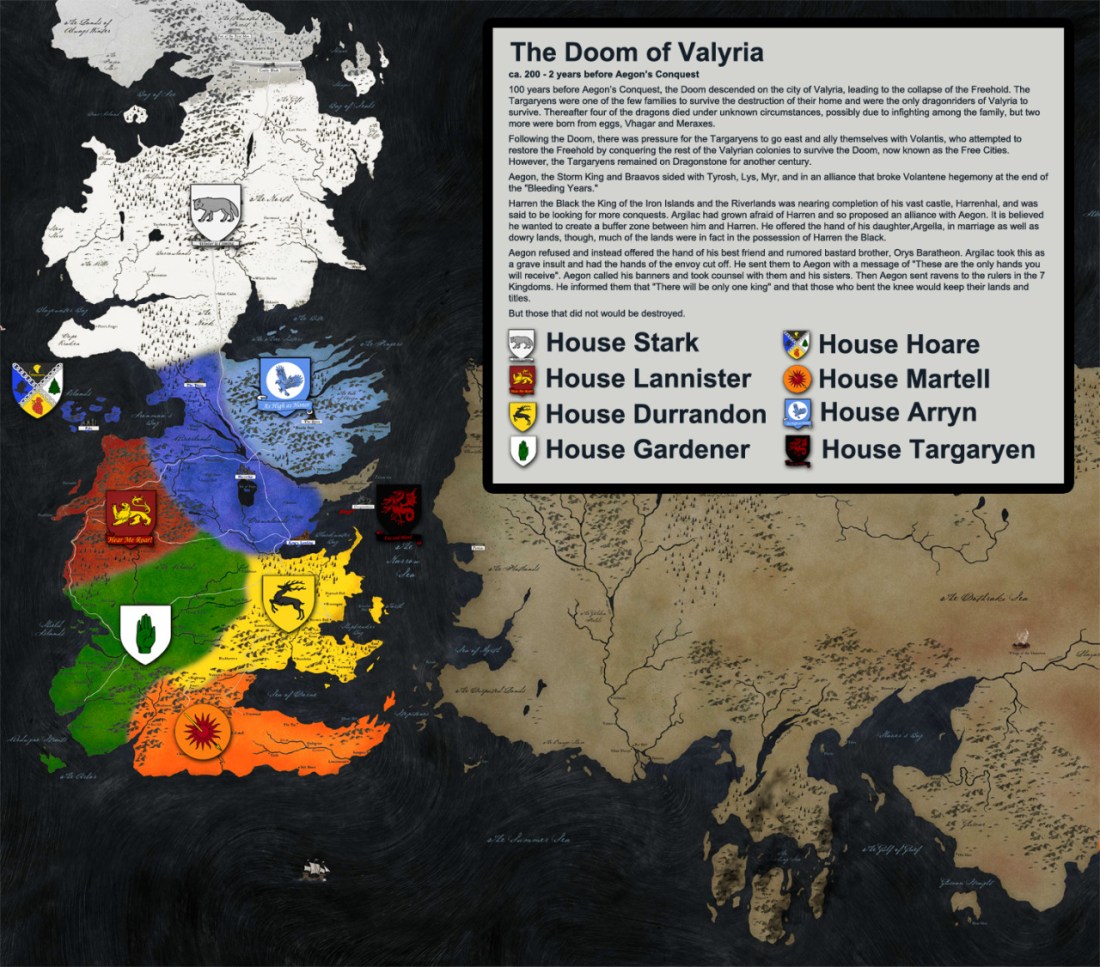
The hill clans are direct vassals of Winterfell, and given the unusual terms of their feudal contract with Winterfell, I’ve argued that they were probably among the first vassals of House Stark. Notably, unlike the Umbers or Boltons (and most of the other Northern houses), there are no records of the hill clans being subjugated in war by the Kings in Winter. 

In the context with debate about the recent North lore video (which I agree is rife with inaccuracies but nevertheless) it does bring up the question of how much influence and authority do you think the Barrow Kings actually wielded to make the claim of dominion over all first men, like something akin to the Fisher Kings or early Gardner Kings as potential comparisons?

Here’s how the WOIAF puts it:

“the Barrow Kings to their south, who styled themselves the Kings of the First Men and claimed supremacy over all First Men everywhere, even the Starks themselves.”

The use of the terms “styled” and “claimed” suggests their reach was larger than their grasp, that they held authority over the south-west of the North but not the whole. 

So more like the Fisher Kings or the Yronwoods. 

Hello! I read your Politics of the Seven Kingdoms series, and it’s really great. Do you think that after the Battle of the Weeping Water, Theon Stark may have turned on his Bolton allies to complete his conquest of the North, the Red Kings being sufficiently weakened for him to end the Stark/Bolton wars?

So as I discuss here, it’s not entirely clear quite how the sequence goes. 

What we know is that the Red Kings of the Boltons were the last rivals of the Starks to bend  the knee, we know that Rogar the Huntsman “swore fealty to the King of Winter and sent his sons to Winterfell as hostages, even as the first Andals were crossing the narrow sea in their longships,” we know that “King Theon Stark, known to history as the Hungry Wolf, turned back the greatest of these threats, making common cause with the Boltons to smash the Andal warlord Argos Sevenstar at the Battle of the Weeping Water,” and we know that “after the defeat of the Boltons, the last of their Northern rivals, the greatest threats to the dominion of House Stark came by sea.”

Two of the three pieces of evidence suggests that the Boltons surrendered before or just as the Andals attacked the North, but the third suggests the opposite, as the use of the phrase “common cause” suggests that the Boltons were still independent during that initial battle with Andal invaders. 

There’s a couple different possibilities: one is that Rogar bent the knee to get military support from Theon to defeat Argos Sevenstar. Another, as you suggest, is that Theon turned on Rogar after the battle, taking advantage of their exhaustion. A third is that Theon’s support might have prompted Rogar to bend the knee freely after the battle, seeing the existential threat that the Andals posed. 

How do you think the Manderlys managed to flee to the site of White Harbor, which is on the eastern seaboard of the North? As far as I know, the Mander doesn’t link with any river draining into the Narrow Sea, & the Reach borders the Sunset Sea not the Narrow Sea, so wouldn’t it have made more sense for them to flee to somewhere on the Stony Shore or Sea Dragon Point? Plus, why did they flee all the way to the cold North instead of say, the more verdant Riverlands or Vale?

Well, they probably sailed east around Dorne and then up the Narrow Sea.

As to why not the Riverlands or the Vale…the Riverlands is famously fractious and prone to private wars over land, why would any houses stand by and let some king take their land and give it away to a Reacherman when the Reach had been invading the Riverlands since the fall of House Justman? And what Riverlander king would have the authority to make that stick? 

Likewise, the Vale is pretty small and the lands had been divided up early on, which is one of the major reasons why the Andals had invaded the Riverlands with the encouragement of the Arryns – not enough space, need to get people to emigrate. 

Whereas the Starks had vacant land, because the Wolf’s Den was not being properly held and had been repeatedly attacked by the Arryns and the Sistermen and slavers from the Stepstones. The Manderlys offered an opportunity to solve a major security problem without the Starks themselves having to pay for it. 

Is settling the wildlings on the Gift the best way to integrate them into the North? Based on how the mountain clans operate, where their vassalage requires a more personal touch from the Lord of Winterfell, couldn’t something like that be done with them? I have this idea of maybe making them be a roving force through the North that answers only to Winterfell’s will. A sort of cheap, standing army. Is that too crazy? They’re a tribal, nomadic ppl, and making them lords, even minor, might be hard

To integrate the wildlings into the North, they need land to settle on. Having them remain nomadic is not going to work – the rest of the North are settled agrarian people and they are not going to put up with wildlings migrating through their land taking whatever they want. It’s a recipe for cattle raids and bushwhacking and endless conflict. 

The problem then becomes, what land do you give them? The Gift is the only “unclaimed” land in the North – giving them any other land means taking it away from the people already on it, and that’s not going to happen without a fight. 

The hill clans make this point very very clearly when they show up in Jon XI of ADWD:

“Lord Snow,” said The Norrey, “where do you mean to put these wildlings o’ yours? Not on my lands, I hope.”

“Aye,” declared Old Flint. “You want them in the Gift, that’s your folly, but see they don’t wander off or I’ll send you back their heads. Winter is nigh, I want no more mouths to feed.”

Settling the wildlings in the Gift is the least bad solution, as Torghen Flint recognizes. It means the wildlings will be on their own land, and so won’t be making incursions into anyone else’s land. It reduces as far as possible the chances that violence will break out between the two groups. 

The North’s Economic Development Plan

aspareme:

racefortheironthrone:

(for previous parts in the series, see here)

Of all of the regions of Westeros we’ve planned for, the North is perhaps the most difficult case we’ve deal with, next to Dorne (which had a much better export profile). 

As the Lord of Winterfell, my main difficulties are that the North is severely underpopulated, and has extreme weather conditions that exacerbate the northerly climate’s limits on agricultural productivity. 

So how do we overcome these problems…ideally, before winter comes?

Keep reading

This is brilliant–the idea of a canal system to connect the North is one I hadn’t considered, but it works.

Though–how would that be affected by the North’s sub-Arctic climate? Would a canal system be completed in the course of a summer?

The horse-breeding and emphasis on cavalry does make sense, though. You could also establish a policy of relative political isolationism–not totally, because trade will still be a necessity, but at the very least a policy of “don’t start none won’t be none” with the southern kingdoms, and then hold the line at the Neck.

Train your citizenry in what essentially amounts to guerrilla warfare, sort of like House Reed’s strike-and-disappear strategy, and you’d avoid the the Riverland’s’ problem of a helpless peasantry.

With the exception of the sections immediately adjacent to the existing rivers, digging a canal is basically digging a giant trench – it’s easier to do that during the summer, but you’re not limited to the summer. 

Now, one major drawback to a Northern canal is that it’s going to ice over in the winter – which is when you’d need to bring in the sleds – so a lot depends on the level of competition. If a Manderly-Blackwater or Blue Fork canal are active, the economic impact of a canal in the North is going to be severely hampered. 

In canals, tho, there’s a huge first-mover advantage. The Erie Canal wasn’t the shortest canal to the west, but because it was up and running before anyone else, it easily beat the pants off the competition, even after the arrival of the railroad potentially made it obsolete.