For Ygritte’s tribe, and we don’t know which one it is, it’s custom that “women who bed brothers or fathers or clan kin offend the gods, and are cursed with weak and sickly children.” But it’s custom for the ice river clans to practice cannibalism, and as much as Ygritte argues that Craster is more Night’s Watch than wildling, that smacks more than a little of No True Scotsman.
If my theory is right, I would imagine that much of the memory of the original sacrifices has been lost to time, and indeed may have been deliberately erased from oral histories in the same way that the Night’s King was erased from the written records of the Night’s Watch. (Wouldn’t you if your people had done something so heinous that the rest of humanity exiled you behind the Wall?)
If it’s done at all today, it probably follows the model at Craster’s Keep: a largely unspoken and uncertain practice (Craster’s understanding of what makes the cold gods go away is pretty ramshackle – hence the missing sheep) carried out in isolated communities that have always done things this way, out of a vague sense that somehow it wards off ill fortune.
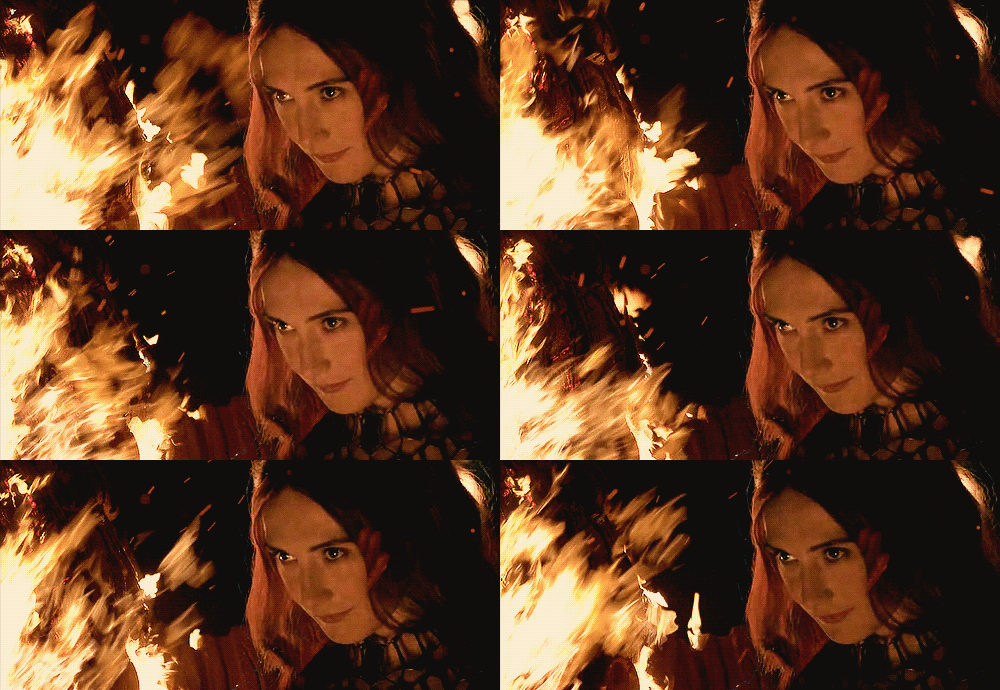
Melisandre nodded solemnly, as if she had taken his words to heart, but this Weeper did not matter. None of his free folk mattered. They were a lost people, a doomed people, destined to vanish from the earth, as the children of the forest had vanished.
Do those thoughts seem disturbing given she is essentially saying regarding the wildlings that their lives don’t matter?
I think there’s two ways to interpret this passage.
The first way starts with the fact that Melisandre’s brand of religious devotion is intensely Millennialist and prophetic in nature – as far as she’s concerned, the Final Battle between Azor Ahai Reborn and the Great Other is at hand as the prophecies have foretold, and the entire world faces apocalypse unless it unites behind her god and his chosen champion. This is part of the reason why Melisandre is the most misunderstood character in ASOIAF – she doesn’t sacrifice people or burn weirwoods because she’s actively malicious, she genuinely thinks that what she is doing is necessary for the salvation of humanity, and like Varys she’s a hardcore consequentialist. A truly just woman is no less to be feared than her male counterpart.
In this reading, Melisandre views the wildlings as doomed by fate to be casualties in the coming war – these dead-ender wildlings who insist on staying north of the Wall have placed themselves right in the path of the Army of the Dead. And her view is helped by the fact that these wildlings have rejected both the true god and his champion, who are the only path to salvation.
The second way of reading has to do with her attitude of cultural superiority. Remember, Essosi consider Westerosi to be barbarians only recently raised to semi-civilization by the last remnants of the Valyrian Empire. Melisandre, as someone raised in one of the most ancient cities of Essos, probably shares this view, given that she is also a missionary bringing the true religion to the heathen.
Now think what someone like that would think of a people that even Westerosi consider barbarians and savages. One of the things I actually really like about ASOIAF is that GRRM shows his main POV characters reacting to the widllings or the mountain clans as people from their backgrounds would react: Tyrion considers the mountain clans’ devotion to democracy and gender equality to be signs of backwardness and part of his plan for using them to take the Vale is to educate them in civilized ways, like obedience to a king. Jon Snow comes to empathize with the wildlings’ desire for freedom and their attachment to their cultural heritage, but he also thinks that these same qualities will doom them on the battlefield.
In this reading, Melisandre is expressing the softer side of Manifest Destiny doctrine – as opposed to the harsher side, which presented native peoples as dangerous threats, this view said that native peoples were “destined to vanish from the earth” as the progress of Western Civilization eventually overtook them. Indeed, the very trope of the Noble Savage was premised on the idea that this fate was inevitable, but now interpreted as a tragedy that could be safely lamented. So in Melisandre’s eyes, the wildlings have rejected enlightenment in favor of clinging to superstion and will thus be swept away by the force of history.
To integrate the wildlings into the North, they need land to settle on. Having them remain nomadic is not going to work – the rest of the North are settled agrarian people and they are not going to put up with wildlings migrating through their land taking whatever they want. It’s a recipe for cattle raids and bushwhacking and endless conflict.
The problem then becomes, what land do you give them? The Gift is the only “unclaimed” land in the North – giving them any other land means taking it away from the people already on it, and that’s not going to happen without a fight.
The hill clans make this point very very clearly when they show up in Jon XI of ADWD:
“Lord Snow,” said The Norrey, “where do you mean to put these wildlings o’ yours? Not on my lands, I hope.”
“Aye,” declared Old Flint. “You want them in the Gift, that’s your folly, but see they don’t wander off or I’ll send you back their heads. Winter is nigh, I want no more mouths to feed.”
Settling the wildlings in the Gift is the least bad solution, as Torghen Flint recognizes. It means the wildlings will be on their own land, and so won’t be making incursions into anyone else’s land. It reduces as far as possible the chances that violence will break out between the two groups.

 RFTIT Tumblr Backup