I definitely see why Patchface is likely the prophet of the Drowned God; he seems likely to have been a prophet even before he encountered the Drowned God when the ship went down, and went a little nuts after looking the God (demon?) in the face. I’m a little mystified by Thoros though. What did he do to draw R’hllor’s attention, and what led R’hllor to bestow his gifts on Thoros, who by all accounts was kind of a drunken lunatic before joining the Brotherhood Without Banners?

“he seems likely to have been a prophet even before he encountered the Drowned God” – how do you figure this?

As to why R’hllor worked his will by the Mummer’s Ford, I think it was a miracle. And as GRRM the recovering Catholic well knows, a miracle is cloaked in mystery and ineffable, inexplicable grace. Thoros notes that it has nothing to do with Thoros himself:

“I have no magic, child. Only prayers. That first time, his lordship had a hole right through him and blood in his mouth, I knew there was no hope. So when his poor torn chest stopped moving, I gave him the good god’s own kiss to send him on his way. I filled my mouth with fire and breathed the flames inside him, down his throat to lungs and heart and soul. The last kiss it is called, and many a time I saw the old priests bestow it on the Lord’s servants as they died. I had given it a time or two myself, as all priests must. But never before had I felt a dead man shudder as the fire filled him, nor seen his eyes come open. It was not me who raised him, my lady. It was the Lord. R’hllor is not done with him yet. Life is warmth, and warmth is fire, and fire is God’s and God’s alone.”

Now, there are some arguments that people have made that the spells and prayers that Thoros had been taught are secular magic hiding behind a religious wrapper, and that now that magic is coming back into the world, the spells are working again. (After all, the old priests never brought anyone back from the dead either.) After all, Melisandre often cloaks secular magic as reliigous in nature. 

However, I disagree. While it is possible that Thoros and Melisandre were trained in secular magic that they learned in the Red Temples as novices, Beric Dondarrion wasn’t. And yet Beric turned his blood into flame (the true version of Thoros’ old trick) without uttering a syllable or a spell, and brought Lady Stoneheart to life with a kiss that did not require filling one’s mouth with fire first. 

So I think it had nothing to do with Thoros, and solely to do with the ineffable plans of the Red God. 

not the previous poster

Aren’t R’hllorism and magic fundamentally connected? Every red priest we’ve seen openly practices magic. They also seem to use magic as a selling point for the religion. Melisandre is a true believer, while some of her magic is intentional misdirection, she thinks and does real magic and attributes it to R’hllor. If today high ranking Scientologists came out and started performing real magic and predicting the future and performing miracles, you’d think they’d get a lot of converts from other religions. Like whether the religion is true can’t be proven from the books, but she is in an honest to god magic cult, and that seems like it should be appealing.

Fundamentally? No. 

As I’ve discussed before, there are R’hllorite priests who know non-R’hlloric magic (like Melisandre or Benerro), there are R’hllorite priests who do not know non-R’hlloric magic who do R’hlloric magic (Thoros, Moqorro although he could be in the first camp), and there are people who are not R’hllorite priests and who don’t know non-R’hlloric magic who are able to spontaneously perform magic associated with R’hllor (Beric). 

At the same time, there are plenty of examples of people who use the same kinds of magic without any associations to R’hllor: Dany sees fire-mages and meets shadow-binders in Qohor, there’s Bloodraven, etc.

Moreover, R’hllorism is not the only faith that is associated with magic – the greenseers of the Old Gods, the water-wizards of the Mother Rhoyne, the miracles attributed to the Seven or the Drowned God, the secret association between Valyrian steel, blood magic, and sacrifices to the Black Goat of Qohor, and so forth. 

Do we know what the actual term for the shadow babies is, or is that the actual name of the magic in question (I’m operating under the assumption that there is more to shadowbinding than this practice alone)? I’ve always been under the impression that “shadow baby” was the term that the fandom collectively settled upon.

Sigh…first draft got eaten by tumblr, so I’ll try again.

The closest thing I can think of to an official term for them is that Melisandre refers to them, obliquely, as shadow sons:

“Is the brave Ser Onions so frightened of a passing shadow? Take heart, then. Shadows only live when given birth by light, and the king’s fires burn so low I dare not draw off any more to make another son. It might well kill him.“ (ASOS) 

At some times, Melisandre suggests that this is the work of R’hllor – “The Lord of Light in his wisdom made us male and female, two parts of a greater whole. In our joining there is power. Power to make life. Power to make light. Power to cast shadows.” – but I think this is a case of Melisandre propagandizing for her religion by attributing the magic known as shadowbinding to her god. 

To test this, I’ve looked for examples of shadowbinders who lack her religious affiliations doing things that Melisandre does. For example, Bloodraven is accused of using shadow assassins: “A shadow came at his command to strangle brave Prince Valarr’s sons in their mother’s womb.” (Mystery Knight) Now, this is most likely mere slander, but it does suggest that there is enough folk lore about shadow assasins out there that people think it’s a thing that magic can do.

Moreover, there is evidence that Bloodraven does have some knowledge of shadowbinding. In Mystery Knight, he pretty clearly uses shadowbinding to disguise himself as Ser Maynard Plumm:

“Distantly,” confessed Ser Maynard, a tall, thin, stoop-shouldered man with long straight flaxen hair, “though I doubt that His Lordship would admit to it. One might say that he is of the sweet Plumms, whilst I am of the sour.” Plumm’s cloak was as purple as name, though frayed about the edges and badly dyed. A moonstone brooch big as a hen’s egg fastened it at the shoulder

…Through the rain, all he could make out was a hooded shape and a single pale white eye. It was only when the man came forward that the shadowed face beneath the cowl took on the familiar features of Ser Maynard Plumm, the pale eye no more than the moonstone brooch that pinned his cloak at the shoulder.

This is almost identical in fashion to the glamour that Melisandre uses to disguise Mance Rayder and Rattleshirt in ADWD: 

Rattleshirt sat scratching at the manacle on his wrist with a cracked yellow fingernail…The big square-cut gem that adorned his iron cuff glimmered redly. “Do you like my ruby, Snow? A token o’ love from Lady Red.”

“The glamor, aye.” In the black iron fetter about his wrist, the ruby seemed to pulse. He tapped it with the edge of his blade. The steel made a faint click against the stone. “I feel it when I sleep. Warm against my skin, even through the iron. Soft as a woman’s kiss. Your kiss. But sometimes in my dreams it starts to burn, and your lips turn into teeth. Every day I think how easy it would be to pry it out, and every day I don’t. Must I wear the bloody bones as well?” (ADWD)

Melisandre associates these glamors with both R’hllor and shadows: “with whispered words and prayer (emphasis mine), a man’s shadow can be drawn forth from such and draped about another like a cloak.” By contrast, Bloodraven’s glamor is associated with shadows but not with R’hllor.

Another possible use of shadowbinding is that Quaithe the Shadowbinder appearing as an illusion to Dany: 

“They sleep,“ a woman said. "They all sleep.” The voice was very close. “Even dragons must sleep.”
She is standing over me. “Who’s there?” Dany peered into the darkness. She thought she could see a shadow, the faintest outline of a shape. “What do you want to me?”
“Remember. To go north, you must journey south. To reach the west, you must go east. To go forward you must go back, and to touch the light you must pass beneath the shadow.” (ASOS)

A woman stood under the persimmon tree, clad in a hooded robe that brushed the grass. Beneath the hood, her face seemed hard and shiny. She is wearing a mask, Dany knew, a wooden mask finished in dark red lacquer. “Quaithe? Am I dreaming?” She pinched her ear and winced at the pain. “I dreamt of you on Balerion, when first we came to Astapor.”
“You did not dream. Then or now.” (ADWD)

Now, it’s possible that this is actually a glass candle in action (”the sorcerers of the Freehold could see across mountains, seas, and deserts with one of these glass candles. They could enter a man’s dreams and give him visions, and speak to one another half a world apart, seated before their candles.” (AFFC)), since Quaithe mentions the glass candles but is also associated with shadows.
What do you think prompted the Triarchs of Volantis to permit the construction of a massive Temple of Rh’llor right outside the Black Walls and the creation of a religious militia wholly responsible to the priest of said temple? Even if the anti-slavery angle is a new one for the Red Priests, arming the Faithful like that seems like a very bad idea.

Well, as I said in my essay, Volantis is a particularly unstable slave society desperately trying to keep ahead of the ball, and that’s especially true with R’hllorism. 

The problem with R’hllorism is A. it’s too popular to destroy (half their slave soldiers worship the Red God, so even a radical reactionary like Malaquo knows that he doesn’t have the internal resources to pull it off), B. it’s not their religion, so they can’t dominate the hierarchy and re-fashion practice or doctrine into pro-slavery messages, and C. it’s an institution that crosses too many boundaries of nation and caste to be cowed by the hegemony of the Old Blood of Volantis. 

So consider their options? They say no to having the Temple built by the Black Walls – the High Priest has it built over in the Shadow City, and now it’s far less under their influence and a de-facto alternate government HQ. They say no to a religious militia – the High Priest tells the faithful that “all those who die fighting in [the] cause shall be reborn,” and now the Old Blood are fighting a religious civil war against the better part of five-sixths of their population, with an army whose loyalties they cannot trust. 

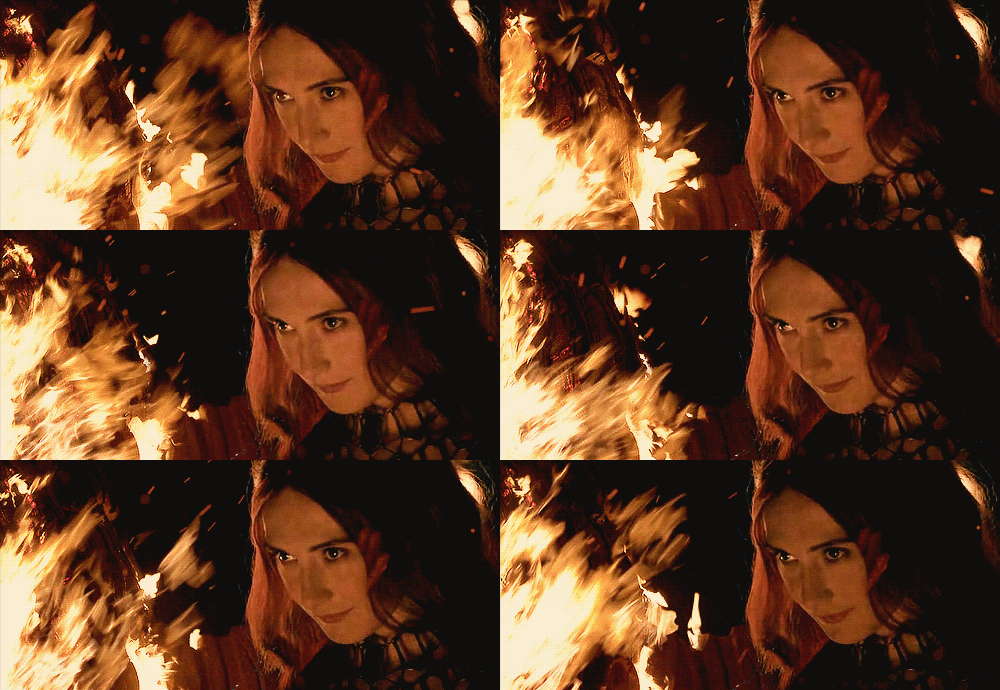
Melisandre’s thoughts on the wildlings

Melisandre nodded solemnly, as if she had taken his words to heart, but this Weeper did not matter. None of his free folk mattered. They were a lost people, a doomed people, destined to vanish from the earth, as the children of the forest had vanished.

Do those thoughts seem disturbing given she is essentially saying regarding the wildlings that their lives don’t matter?

I think there’s two ways to interpret this passage.

The first way starts with the fact that Melisandre’s brand of religious devotion is intensely Millennialist and prophetic in nature – as far as she’s concerned, the Final Battle between Azor Ahai Reborn and the Great Other is at hand as the prophecies have foretold, and the entire world faces apocalypse unless it unites behind her god and his chosen champion. This is part of the reason why Melisandre is the most misunderstood character in ASOIAF – she doesn’t sacrifice people or burn weirwoods because she’s actively malicious, she genuinely thinks that what she is doing is necessary for the salvation of humanity, and like Varys she’s a hardcore consequentialist. A truly just woman is no less to be feared than her male counterpart.

image

In this reading, Melisandre views the wildlings as doomed by fate to be casualties in the coming war – these dead-ender wildlings who insist on staying north of the Wall have placed themselves right in the path of the Army of the Dead. And her view is helped by the fact that these wildlings have rejected both the true god and his champion, who are the only path to salvation.

The second way of reading has to do with her attitude of cultural superiority. Remember, Essosi consider Westerosi to be barbarians only recently raised to semi-civilization by the last remnants of the Valyrian Empire. Melisandre, as someone raised in one of the most ancient cities of Essos, probably shares this view, given that she is also a missionary bringing the true religion to the heathen.

Now think what someone like that would think of a people that even Westerosi consider barbarians and savages. One of the things I actually really like about ASOIAF is that GRRM shows his main POV characters reacting to the widllings or the mountain clans as people from their backgrounds would react: Tyrion considers the mountain clans’ devotion to democracy and gender equality to be signs of backwardness and part of his plan for using them to take the Vale is to educate them in civilized ways, like obedience to a king. Jon Snow comes to empathize with the wildlings’ desire for freedom and their attachment to their cultural heritage, but he also thinks that these same qualities will doom them on the battlefield.

image

In this reading, Melisandre is expressing the softer side of Manifest Destiny doctrine – as opposed to the harsher side, which presented native peoples as dangerous threats, this view said that native peoples were “destined to vanish from the earth” as the progress of Western Civilization eventually overtook them. Indeed, the very trope of the Noble Savage was premised on the idea that this fate was inevitable, but now interpreted as a tragedy that could be safely lamented. So in Melisandre’s eyes, the wildlings have rejected enlightenment in favor of clinging to superstion and will thus be swept away by the force of history.

So which is it? Take your pick.

On what part of Planetos do you think R’hollorism first arose? I’m assuming not Asshai (although there’s probably a mission or semi-heretical sect or something) because a cult with a black-white moral system that aggressively tries to denounce other religions couldn’t have survived an infancy in a place as libertine as Asshai.

You think a city that lives “by-the-Shadow” where the very stones try to devour light, wouldn’t be attracted to a religion that worships the Light and believes that “the night is dark and full of terror”?

image

Moreover, Melisandre says:

“In ancient books of Asshai it is written that there will come a day after a long summer when the stars bleed and the cold breath of darkness falls heavy on the world. In this dread hour a warrior shall draw from the fire a burning sword. And that sword shall be Lightbringer, the Red Sword of Heroes, and he who clasps it shall be Azor Ahai come again, and the darkness shall flee before him.“ 

That suggests that Asshai was one of the earliest centers of R’hllorism.