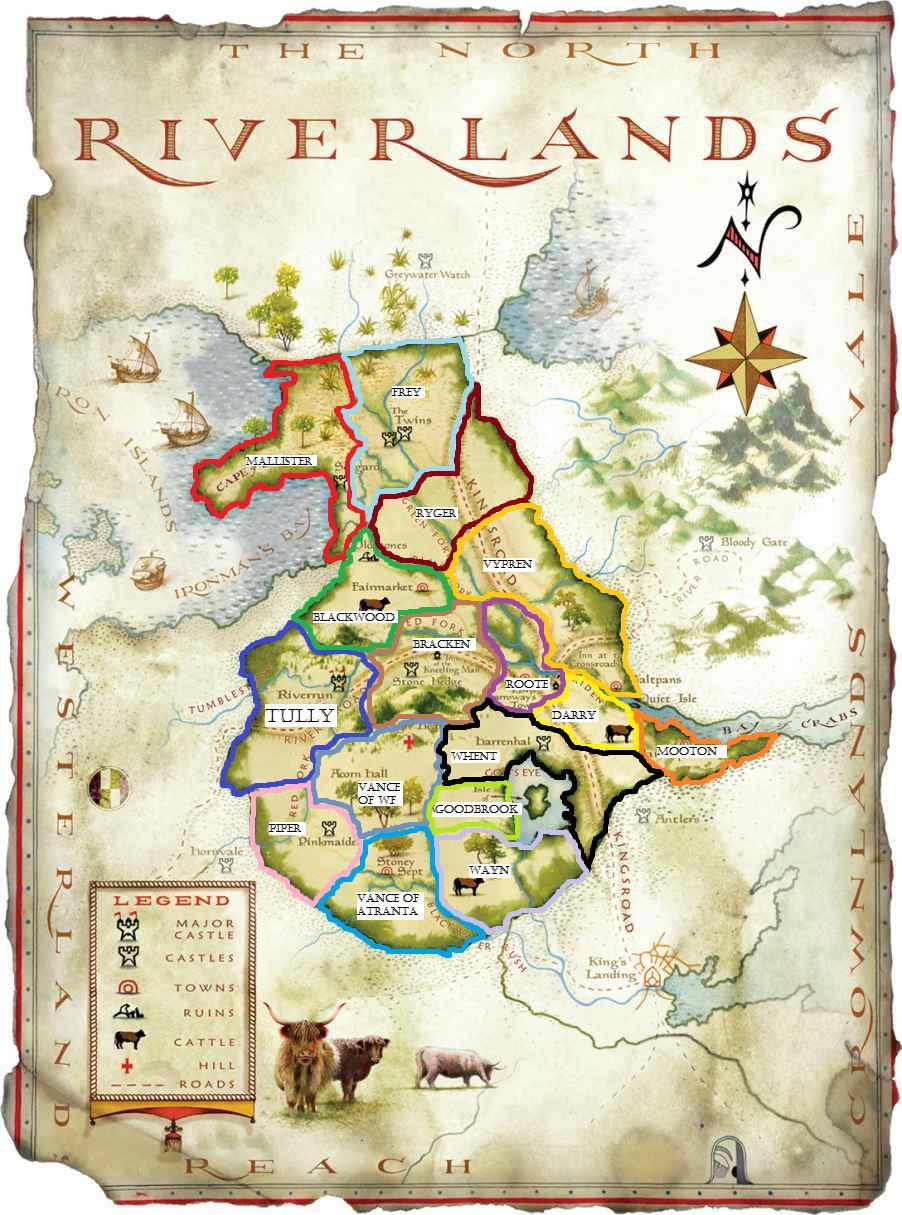
credit to J.E Fullerton/Ser Other-in-Law Introduction: If Part IV of this series was about trying to figure out why the Riverlands, with all its natural advantages, nonetheless became a failed state, and thus come to a better understanding of the dynamics of successful state-building, this essay (and Part VII on the Reach) will be an exploration of what we can learn about the pre-Aegon balance of…
“Ser Davos, and undrowned. How can that be?”
“Onions float, ser.”
Synopsis: “Sing to me, oh muse, of the man resourceful, who, storm-buffeted far and wide…”
SPOILER WARNING: This chapter analysis, and all following, will contain spoilers for all Song of Ice and Fire novels and Game of Thrones episodes. Caveat lector.
(more…)
When we last left off with the political development of the Iron Islands, the Old Way had come crashing down thanks to the arrival of the Andals to Westeros and the ambitions of men with axes. What would fill the void was yet to be discovered…
(more…)
Judging from the WOIAF, we do have some crude systems of regional redistribution of grain in times of crisis, as seen by the fact that Aegon V sent grain up to the North during a particularly bad winter. I would argue that the North’s intense attachment to guest right (and its less frequently mentioned tradition of self-euthanasia during long winters) has a lot to do with a sort of crude welfare state of seeking food and shelter at Winterfell. (We also see the Starks exercising very close control over food reserves, for example)
But in terms of a regular grain dole, we actually have an example from Westerosi history:
“Ultimately, some have wondered if the king’s near death in Dorne did not affect his mind in some way, for as the years of his reign progressed, his decisions grew ever more zealous and erratic. Though the smallfolk loved him—he emptied the treasury regularly to fund his charitable acts, including the year when he donated a loaf of bread daily to every man and woman in the city—the lords of the realm were beginning to grow uneasy.” e
Ultimately, some have wondered if the king’s near death in Dorne did not affect his mind in some way, for as the years of his reign progressed, his decisions grew ever more zealous and erratic. Though the smallfolk loved him—he emptied the treasury regularly to fund his charitable acts, including the year when he donated a loaf of bread daily to every man and woman in the city—the lords of the realm were beginning to grow uneasy.
So Baelor the Blessed supposedly bankrupted the monarchy by (among other things) providing a bread dole for the population of King’s Landing. Now, according to AGOT, a tart costs around three coppers, which I’ve been using as a pre-war price for a loaf of bread. That would suggest that it would cost around 127 dragons a day to buy everyone in King’s Landing a loaf of bread, or 46,355 gold a year.
At that rate, a grain dole for the whole of Westeros would cost 3.7 million gold a year, or 0.7% of GDI, or 7% of total tax revenue. This seems surprisingly affordable, although based on my old estimates of royal income, it would bankrupt the monarchy.
However, you have to keep two things in mind: first, it’s all based on the estimate of how much bread costs. If bread costs more than 3 coppers a loaf as I had originally estimated, the price skyrockets. Second, I could be quite wrong about GDI and thus tax revenue.
So let me see if I can approach it from another angle. I’ve estimated that the average yearly income is between 3-5 gold. During the Ancien Regime, the average worker spent about half their income on bread, although this could spike as high as 88% during crop failures. (That suggests that the average Westerosi spends 48 coppers (or ~1 silver) to 80 coppers (or 1.5 silver) a day on bread.)
In turn, this would suggest that a grain dole would cost 60 to 100 million dragons a year. That’s 11.4 to 19% of GDI, or 114% to 190% of total tax revenue.
So I’m going to go out on a limb and say that either three coppers is the wrong price for a loaf of bread, or the smallfolk of Westeros eat 16 tarts a day, which seems unhealthy.
Credit to J.E Fullerton/Ser Other-in-Law Introduction: If there’s one thing that I hope I have done in this series, it’s to push back against the idea of essentialism – whether it’s the idea that Northmen are inherently honorable, Valemen inherently isolationist, or the Riverlanders inherently divided. Cultures, societies, polities are all too complicated for such simplistic narratives. This is…
I usually don’t ask people for stuff via Tumblr, but this is important enough for me to break my rule. My friend and colleague Scott Kaufman, who you may well remember from our Game of Thrones podcasts on Lawyers, Guns, and Money, is dealing with some really serious medical issues right now.
He’s thankfully getting better, but even with health insurance, the ICU isn’t cheap. If you could help out here, it would make a huge difference.
IMAGE
“They never listened to what he wanted, even though Bran was a Stark and a prince besides, and the Reeds of the Neck were Stark bannermen.”
Synopsis:
Warning
(more…)
Hey folks, if you’d like to read Politics of the Seven Kingdoms, Part IV in one glorious post instead of two separate ones, it’s now up at Tower of the Hand. Check it out!
“In time, the dragons would be her most formidable guardians, just as they had been for Aegon the Conqueror and his sisters three hundred years ago. Just now, though, they brought her more danger than protection. In all the world there were but three living dragons, and those were hers; they were a wonder, and a terror, and beyond price.” Synopsis: On a ship heading to Pentos, Dany talks to…
It’s that time of the week again, folks! Work begins on ASOS again (I’ve got outlines for the next five chapters and quotes plugged in to Dany I and Bran I, so I can start writing those up this weekend), but in the mean-time, what do we have on the Tumblrs? What is a Tyroshi trading cartel? Dany and Xaro’s arguments on slavery: Part I Part II Ironborn vs. Vikings as rulers? Why did Harren build a…




 RFTIT Tumblr Backup