Chapter-by-Chapter Analysis: Jaime II, ASOS

Chapter-by-Chapter Analysis: Jaime II, ASOS

image
“…wolves’ work, or maybe lions, what’s the difference?” 
Synopsis: Jaime, Brienne, and Ser Cleos arrive at the Inn of the Kneeling Man, where everybody knows your name.
SPOILER WARNING: This chapter analysis, and all following, will contain spoilers for all Song of Ice and Fire novels and Game of Thrones episodes. Caveat lector.
(more…)

View On WordPress

How did Robert manage to keep the seven kingdoms together following his rebellion? The 7Ks only became united under the Targaryen dynasty, so once that ended, wouldn’t it be more likely for them to break apart again after the Mad King’s demise? Why didn’t everyone suddenly start declaring independence again, instead of waiting until after Robert’s death?

There’s a couple different reasons:

  1. The Southron Ambitions/Rebel Alliance: Robert had already won the allegiance of the North, the Vale, the Riverlands, and the Stormlands. That’s half the continent right there, and even more so when Robert marries Cersei and gets the Westerlands as well. So it wouldn’t be seven kingdoms again, it would be one massive kingdom and a bunch of smaller states trying to avoid reconquest. 
  2. Institutional Inertia: The Seven Kingdoms have been part of one consolidated monarchy for almost three hundred years, less so for Dorne. That’s three hundred years with very few wars by historical standards, internal trade, law and order, all that good stuff. So people are going to be somewhat wary of going back to being warring kingdoms, especially after a rather bloody civil war which they lost.
  3. Targaryen Legitimism: even if the rest of the Seven Kingdoms wanted to start something, independence is unlikely to be the case because the Targaryens are still kicking around in Essos – as long as their kinsmen are available to be restored to the Iron Throne, the Martells aren’t about to declare themselves independent again.
  4. Internal Politics: This leaves the Reach, and they’re probably the most viable candidate for an independent state given their large army and economy, although it wouldn’t be easy trying to defend themselves on the Westerlands, Riverlands, Crownlands, and Stormlands borders at the same time. But the problem is that the Tyrell claim on Highgarden runs through the Targaryens – if the Reach isn’t part of Aegon’s realm, that claim isn’t good any more and the “Oakhearts of Old Oak, the Florents of Brightwater Keep, the Rowans of Goldengrove, the Peakes of Starpike, and the Redwynes of the Arbor” have every reason to claim the Oakenseat for themselves.

Chapter-by-Chapter Analysis: Davos II, ASOS

Chapter-by-Chapter Analysis: Davos II, ASOS

image

“Ser Davos, and undrowned. How can that be?”
“Onions float, ser.”
Synopsis: “Sing to me, oh muse, of the man resourceful, who, storm-buffeted far and wide…”
SPOILER WARNING: This chapter analysis, and all following, will contain spoilers for all Song of Ice and Fire novels and Game of Thrones episodes. Caveat lector.
(more…)

View On WordPress

POLITICS OF THE SEVEN KINGDOMS: THE RIVERLANDS (PART II)

POLITICS OF THE SEVEN KINGDOMS: THE RIVERLANDS (PART II)

image
Credit to J.E Fullerton/Ser Other-in-Law
When last we left off in the story of the political development of the Riverlands, the grip of the Stormlanders on their province was beginning to slip, and the Ironborn were rowing across Ironman’s Bay, looking to shake it loose for good…
(more…)

View On WordPress

Politics of the Seven Kingdoms: The Riverlands (Part I)

Politics of the Seven Kingdoms: The Riverlands (Part I)

image
Credit to J.E Fullerton/Ser Other-in-Law Introduction In Part IV of the Politics of the Seven Kingdoms, we come to the best example of a failed state in Westeros – indeed, the only region of Westeros to ever lose the status of a Kingdom.  The Riverlands are a perpetual runner-up in the game of thrones, more often a pawn or even the game board than a real player, despite its relatively large size,…

View On WordPress

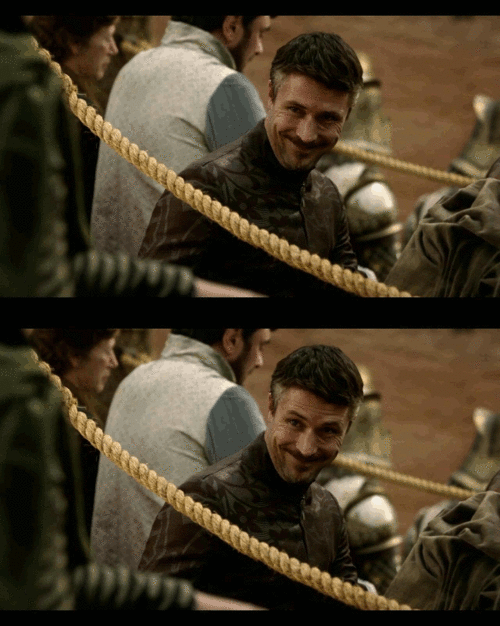
Isn’t littlefinger supposed to seem trustworthy and amiable? He seems to easily befriend people (before betraying them or using them in his schemes) The scowl more than the sword is what seems off to me in that drawing. how cartoonishly evil the show’s version speaks is one of the main things that bugged me (why would ANYONE trust him?!) like he IS evil but he should at least TRY to hide it.

Look at how trustworthy and amiable he looks:

image

No one in King’s Landing likes or trusts Littlefinger: not Varys, not Pycelle, not Cersei, not Jaime, not Stannis, not Renly, not Tyrion, not Tywin, no one. He’s an incredibly obvious schemer who can’t stop monologuing in front of people he’s trying to scheme against or reminding people he’s betrayed that he’s betrayed them. He should try to hide it, but his compulsive need to prove he’s smarter than everyone else won’t let him.

Littlefinger gets away with it because A. most people don’t see him as a threat because he’s got no lands and no armies, B. he’s made himself indispensible as the only person who understands the royal finances, and C. he’s pretty good at hiding his actions.

These naval questions are great! Was there something preventing medieval navies from adding a few ships each year so that you didn’t have huge swings in available forces? It’d seem like it’d be good for both the navy and your shipbuilding industry to have a steady amount of new vessels being ordered rather than huge boom and sink cycles. Thanks!

Glad you like them! 

Basically, it comes down to questions of state capacity – could the monarch tax enough on a regular basis to keep a standing navy and a shipbuilding industry around in peace-time? Usually, the answer was no, because the taxing powers of the monarch tended to be too fixed by tradition, and the revenue service too undeveloped, to collect the necessary funds…in peace time. War, it was generally understood, was an exception to the normal rule, and the powers of the monarch were greatly expanded. 

To use England as an example, the monarch was supposed to fund both their household/court and the government out of their personal incomes plus their “ordinary incomes” (namely, revenue from excise taxes on imported wines, plus incomes from various monopolies) which Parliament traditionally voted them for life. Anything more than that required a vote of Parliament to impose taxation…but during war, the King could impose “ship money” on ports, coastal towns, and coastal shires – in essence, a feudal requirement to provide ships for the navy or enough cash for the king to build or hire additional ships. 

But ship money was only supposed to be imposed in times of war, and when Charles I tried to use it in times of peace to avoid having to call Parliament, it led to a huge legal controversy, a massive campaign of tax refusal, and helped to build up the Parliamentary coalition against Charles I which would lead to the English Civil War. 

So with those kind of institutional structures, you’re not going to get a steady ship-building programme.

Chapter-by-Chapter Analysis: Jon I, ASOS

Chapter-by-Chapter Analysis: Jon I, ASOS

image
“Might be you fooled these others, crow, but don’t think you’ll be fooling Mance. He’ll take one look a’ you and know you’re false…”
Synopsis: Jon Snow meets Mance Rayder.
SPOILER WARNING: This chapter analysis, and all following, will contain spoilers for all Song of Ice and Fire novels and Game of Thrones episodes. Caveat lector.
(more…)

View On WordPress