What type of armour and weapons do the Dornish calvary, knights and master of arms use. I reckon since Dorne is largely desert and very hot, their main use of defence would be mail and plate armour which would allow them move freely in the desert. Much like the mamluks of Egypt and Iran. Swords would most likely be the sabre, giving them more distinct culture. From my understanding the sabre was on common in Eastern Europe then Western Europe. Making them very culturally distinct from rest.

This might be a better question for @warsofasoiaf, but I’ll try my best.

As far as swords go, we don’t have any mentions of sabres or curved swords in relation to Dorne. Curved swords do tend to be associated with Essos, so it’s possible that the Rhoynish brought that tradition to Dorne, but there’s no textual evidence for that. Where Dornish swords have been discussed – Dawn, for example – they’ve tended to be described in similar terms to the straight-bladed swords of the rest of Westeors.

The dominant weapon of Dorne is the spear, but there are a couple different variations:

  • Oberyn uses the long spear – “the spear was turned ash eight feet long, the shaft smooth, thick, and heavy. The last two feet of that was steel, a slender leaf-shaped spearhead narrowing to a wicked spike” – as a two-handed slashing and stabbing weapon. This seems to be a rather unusual way of fighting – probably associated with one-on-one combats – because we don’t see much in the way of Dornish fighting as pikemen.
  • More commonly, the long spear is used in the Rhoynish fashion – “the Rhoynish warrior with his silver-scaled armor, fish-head helm, tall spear, and turtle-shell shield was esteemed and feared by all who faced in him battle” – one-handed with a round shield in close-formation, closer to the classical phalanx than the Macedonian.
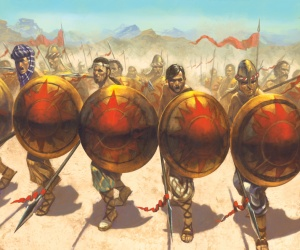
image
  • However, there’s also lighter throwing spears – “the canny Dornishmen rained rocks and arrows and spears from the heights;” “many carried bundles short throwing spears” – which are used as javelins by both infantry and cavalry alike. 

There are some other weapons which are also worthy of mention:

  • The Dornish are known for their recurve bows – “when the Dornishmen saw them coming, they spurred their own mounts, banners rippling as they rode…the double-curved Dornish bows they used so well from horseback” – which are used by infantry and cavalry alike.
  • As we can see from Dornish participation in various tourneys, we know that Dornish noblemen are also trained in the lance like the rest of their Westerosi peers. 

In terms of armor, we have a couple different types used:

  • The Rhoynish smiths were especially adept at creating “suits of scale and plate.” So both heavier and lighter armors are available.
  • Oberyn prefers to wear lighter scale armor (“his shirt was armored with overlapping rows of copper disks that glittered like a thousand bright new pennies as he rode. His high gilded helm displayed a copper sun on its brow, and the round shield slung behind him bore the sun-and-spear of House Martell on its polished metal surface.”) in combination with some plate pieces (”The Red Viper was lightly armored; greaves, vambraces, gorget, spaulder, steel codpiece. Elsewise Oberyn was clad in supple leather and flowing silks. Over his byrnie he wore his scales of gleaming copper, but mail and scale together would not give him a quarter the protection of Gregor’s heavy plate”) to maximize his mobility.
  • Common Dornish soldiers are also known to wear “ring mail and crested helms.”

aspis vs scutum?

These are two forms of shields used by the ancient Romans at various times. The aspis is theshield we think of when we think of the Greek hoplite and (pre-Alexandrian) phalanx: a large round shield, covered in bronze, and largely supported by the shoulder and the Argive grip. Borrowing as they had much of their military technology from the Greek-influenced Etruscans, the early Romans used this kind of shield quite heavily. 

However, the aspis wasn’t that well-suited to the more flexible and less tightly-packed ranks of the maniple (a tactical formation that the Romans borrowed from their neighbors the Samnites) and so the Romans replaced the aspis with the iconic scutum. By contrast, the scutum was a curved rectangle, with iron edging and an iron boss in the center of the shield:

Without all of that heavy bronze plating, the scutum was much lighter, so that it could be wielded easily in one hand without the need for shoulder support, which made it easier to hold up the shield while throwing the pilum or stabbing with the gladius, as opposed to relying solely on spear thrusts. Moreover, the longer scutum did a better job at covering the legs and feet during combat, so that despite being lighter than the apsis, it actually provided more protection. And finally, the scutum’s design allowed for tactical innovations: the testudo formation, for example, wouldn’t really work with the aspis because it would be more exhausting to lock shields and you wouldn’t be able to huddle together closely enough, leaving gaps.

So yeah, scutum all the way. 

Pegging Westerosi technology at mid 14th century – early 15th century depending on location (mail and leather in some places, full plate and armored horses in others) but with a total lack of gun powder. Assuming gunpowder never appears where does military technology and tactics go in the next 100 years? Woud a Renaissance with out gunpodwer resurect roman tactics? Also assuming the others don’t knock them back to the dawn age

That’s a great question! Without gunpowder, you’re not going to get the same movement from medieval armies focused around knightly charges to the pike-and-shotte tactics of the Early modern era, so you’re going to see a different development pattern. 

In the short term, I think the Golden Company’s model of combined arms and disciplined infantry is going to become dominant once someone realizes how much there is to gain from upgrading the quality of Westerosi infantry and having them work in concert with the cavalry rather than independently. 

You might see cavalry tactics shift somewhat if the Dothraki have a big impact on Westeros, similar to how the Byzantine cataphracts adopted the horsebow and hit-and-run tactics from the Huns, the stirrup from the Avars, etc. Westerosi knights are pretty damn effective already – if you could train them to use composite bows, you’d have a really frighteningly effective force on the battlefield. 

And eventually, someone’s going to figure out how to make an effective repeating crossbow with a decent range and penetrating power, and then you’re likely to see a different kind of pike-and-shotte tactics:

image