What type of armour and weapons do the Dornish calvary, knights and master of arms use. I reckon since Dorne is largely desert and very hot, their main use of defence would be mail and plate armour which would allow them move freely in the desert. Much like the mamluks of Egypt and Iran. Swords would most likely be the sabre, giving them more distinct culture. From my understanding the sabre was on common in Eastern Europe then Western Europe. Making them very culturally distinct from rest.

This might be a better question for @warsofasoiaf, but I’ll try my best.

As far as swords go, we don’t have any mentions of sabres or curved swords in relation to Dorne. Curved swords do tend to be associated with Essos, so it’s possible that the Rhoynish brought that tradition to Dorne, but there’s no textual evidence for that. Where Dornish swords have been discussed – Dawn, for example – they’ve tended to be described in similar terms to the straight-bladed swords of the rest of Westeors.

The dominant weapon of Dorne is the spear, but there are a couple different variations:

  • Oberyn uses the long spear – “the spear was turned ash eight feet long, the shaft smooth, thick, and heavy. The last two feet of that was steel, a slender leaf-shaped spearhead narrowing to a wicked spike” – as a two-handed slashing and stabbing weapon. This seems to be a rather unusual way of fighting – probably associated with one-on-one combats – because we don’t see much in the way of Dornish fighting as pikemen.
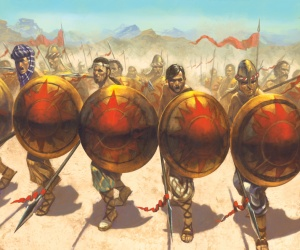
  • More commonly, the long spear is used in the Rhoynish fashion – “the Rhoynish warrior with his silver-scaled armor, fish-head helm, tall spear, and turtle-shell shield was esteemed and feared by all who faced in him battle” – one-handed with a round shield in close-formation, closer to the classical phalanx than the Macedonian.
image
  • However, there’s also lighter throwing spears – “the canny Dornishmen rained rocks and arrows and spears from the heights;” “many carried bundles short throwing spears” – which are used as javelins by both infantry and cavalry alike. 

There are some other weapons which are also worthy of mention:

  • The Dornish are known for their recurve bows – “when the Dornishmen saw them coming, they spurred their own mounts, banners rippling as they rode…the double-curved Dornish bows they used so well from horseback” – which are used by infantry and cavalry alike.
  • As we can see from Dornish participation in various tourneys, we know that Dornish noblemen are also trained in the lance like the rest of their Westerosi peers. 

In terms of armor, we have a couple different types used:

  • The Rhoynish smiths were especially adept at creating “suits of scale and plate.” So both heavier and lighter armors are available.
  • Oberyn prefers to wear lighter scale armor (“his shirt was armored with overlapping rows of copper disks that glittered like a thousand bright new pennies as he rode. His high gilded helm displayed a copper sun on its brow, and the round shield slung behind him bore the sun-and-spear of House Martell on its polished metal surface.”) in combination with some plate pieces (”The Red Viper was lightly armored; greaves, vambraces, gorget, spaulder, steel codpiece. Elsewise Oberyn was clad in supple leather and flowing silks. Over his byrnie he wore his scales of gleaming copper, but mail and scale together would not give him a quarter the protection of Gregor’s heavy plate”) to maximize his mobility.
  • Common Dornish soldiers are also known to wear “ring mail and crested helms.”

While Jon focusing NW on archery is a good idea now, was it really bad for NW to focus on melee weaponry prior to start of the story? Horde of Wildlings attacking the wall is a new development, so likely 99+% of wildling encounters happened on Rangings and the like, where melee is more useful. In addition, practice shooting at horizontal targets 100′ away or so is of marginal benefit when shooting at enemies 700′ directly below you.

One important corrective: “hordes of wildlings attacking the Wall” is NOT a new development:

“Wildlings have invaded the realm before.“ Jon had heard the tales from Old Nan and Maester Luwin both, back at Winterfell. “Raymun Redbeard led them south in the time of my grandfather’s grandfather, and before him there was a king named Bael the Bard.”
“Aye, and long before them came the Horned Lord and the brother kings Gendel and Gorne, and in ancient days Joramun, who blew the Horn of Winter and woke giants from the earth. Each man of them broke his strength on the Wall, or was broken by the power of Winterfell on the far side…”

The Watch is primarily a defensive military force manning a fixed fortification. GRRM’s problems with math aside, it makes a lot more sense to train them in archery and siege weaponry than it does to emphasize hand-to-hand training, given that melee weapons’ arms-length range doesn’t do you much good when you’re on the top of a bloody great wall and the enemy is at the bottom. 

Now, ranging is a different story, but I would maintain that Ser Alliser’s godawful training scheme is still a bad one: emphasizing fighting on foot one-on-one is a very bad idea when the Night’s Watch is badly outnumbered by wildling raiders, who are absolutely going to use their advantage of numbers to overwhelm whatever negligable training in the blade a crow gets in boot camp. 

To the extent that you’d emphasize melee combat at all in the Watch, it should absolutely be focusing on cavalry tactics, which would allow the Night’s Watch to punch above their weight vis-a-vis the mostly on-foot Wildlings. And cavalry tactics emphasize horsemanship over swordsmanship, because you don’t need to be very good with a sword when you’re thundering down on someone at top horsepower. 

Couple Roman military history questions for you. What advantage did the Roman gladius and shield wall have over the Macedonia phalanx that predates it? And, why didn’t the Romans ever train their own cavalry and archers on a large scale, preferring to rely on foreign mercenaries? It seems to me that a loyal cavalry force especially would have come in handy in dealing with the barbarian invasions.

Question 1: Romans vs. Macedonians

Chiefly, flexibility. Because phalanxes fought shoulder-to-shoulder in deep ranks, they were rather slow to move, especially laterally; this meant that they were vulnerable to being flanked. By contrast, the Roman maniple system, being much looser and more decentralized, could respond rapidly to new developments.

image

This difference was famously worked out at the Battle of Cynocephalae, where the Roman legions initially struggled against the weight of the Macedonian phalanx on the left, but the Romans were able to quickly move twenty maniples to take advantage of the withdrawl of the Macedonians on the right and attack the Macedonians from the flank and the rear, causing a complete panic that shredded the phalanx.

Question 2: Roman Cavalry

I think this has to be understood as a matter of opportunity costs. Training good cavalry takes many years training and a not-inconsiderable amount of resources in terms of horseflesh, so you tend to see premodern societies choosing whether to invest their time and resources into cavalry or infantry. (Same principle goes for archers, btw.)

Since the Romans had primarily an infantry culture, it was much more efficient to hire allied cavalry when and if they were needed and rely instead on their infantry to win the day. 

Now this did change over time as the Roman Empire’s borders stretched and came under pressure from horse-riding tribes from outside the Empire, which made the cavalry’s rapid response capabilities more important. 

Ive seen images of bow sheathes, were these used to carry bows? I always thought they were carried unstrung and then strung for battle or in a pack/on the shoulder (maybe this last one is a hollywood trope) rather than having a specialized sheath attached to the waist like with swords. I dont imagine longbows would work well with a sheath but maybe composite bows, so if there were bow sheathes for smaller bows, did longbows also have some large one carried on one’s back or were they unstrung?

  • Yes, they were used, although probably a bit more often with horse archers who needed to have hands free for reins and the like. I’m pretty sure they evolved from an earlier practice of storing the bow in the quiver, as we can see here in the upper-right:
image
  • You’re right about the stringing and unstringing, since keeping a bow strung all the time is bad for the string and thus the power of the bow. However, if you were expecting a battle or an ambush or the like, you don’t want to be in a position of having to stop and string your bow, so you’d string your bow in advance and then you’d need a way to carry it around, hence a sheathe.
  • Carrying them on the shoulder is a really bad idea, because moving around with them that way is very awkward and it’s super-easy to catch the bow or the string on something or someone around you. 
  • Longbows are a bit unusual, because they were long enough to be carried like staves, albeit with a cloth cover over them. But you couldn’t really do that with other kinds of bows. 

What sort of ornament helmets/armor would kings wear to battle? Is there a way it was done without sacrificing functionality?

At least in Medieval Europe, monarchs didn’t really have to sacrifice functionality if they didn’t want to. They were certainly wearing the fanciest surcoats and armor, but so were a lot of the nobility. The main difference was the use of a circlet crown affixed to their helmet, so everyone could tell who the king was:

image

This replica – supposedly of Richard III, who wore a crowned helmet to Bosworth Field, which might have made the whole business of Henry VII finding the crown hanging on a hawthorn bush a bit tricky – shown above is somewhere in the middle of the spectrum. Henry V used both a crowned helmet (for when he was hanging back in command) and a regular greathelm for when he went into the thick of it), which was a good thing, because he got the latter dented pretty badly at Agincourt. On the other end of the spectrum, Casimir III of Poland rocked this number: 

image

Which just seems like a bit of a pain in the neck, to say the least. 

How exactly does slighting a castle work?

To quote Richard Nevell, an archaelogist who did his thesis on the subject:

“One of the key challenges in identifying slighting is that the methods used to slight a castle were the same used while attacking it. For example, mining or undermining was used in siege warfare to bring down outer walls. But you could use the same approach to demolish a castle. This can be seen at Bungay Castle (Suffolk) where excavations in the 1930s identified an unfinished mine gallery underneath the great tower. Documentary sources show that the King had ordered its destruction, but it was evidently reprieved at a late stage.”

Given that the objective is to render the structure incapable of being used as a fortification, the focus would be on those aspects of a castle that give it defensive advantages: 

  • the outer walls, which allow a small garrison to hold off the enemy from a safe distance. 
  • the towers, which provide further height and protection compared to relatively open ramparts.
  • gatehouses, which protect the most important entryways with portcullises, arrow-loops, machiolations, and murder holes.

Depending on how emphatic the slighter wanted to be, they could leave the rest of the structure intact and allow it to continue to exist as a

château

(a non-fortified stately home), or they could render the interior unlivable and let the ruins be subsumed back into nature. 

Generally, slighting would be accomplished by mining at the base of the structure in question and then burning down the props of the tunnel (i.e, undermining). Later on, the process was sped up enormously with the use of gunpowder, which could be straighforwardly detonated in mere minutes. For the destruction of interior elements, pulling down roofs and then firing the interior was usually sufficient. 

How did the greco-roman era galley evolve over time? From what Ive heard the late medieval galleys were rather different/improved compared to them?

So I’ve written a bit about it here and here

From what I’ve read, the galley transformed in a number of ways:

  • Size: galleys tended to get longer and have deeper drafts, which allowed them to hold more cargo (which was important for ensuring that galleys could offset their operating and repair costs) and lots of oarsmen (150-180 on the great galleys of the Venetian Republic). 
  • Decks: galleys shifted from half-decks to full decks, which means you can put more people on the deck to board/repel boarders/launch missiles. Also, galleys tended to add on fore and/or aft-castles, which were very useful for protecting your ranged marines from boarders and giving them the ability to drop missiles on the enemy deck from above. Also, later galleys tended to have higher sides to help deal with very low-in-the-water vessels like the ubiquitious longship
  • Sails: galleys tended to acquire more masts and shifted from square to lateen sails, which allowed them to move faster and more flexibly (as it’s much easier to tack against the wind with that setup).

When foot archers had to fight close up, what do they do with their bows? Would they throw them away or did they have some where to hold it so it wouldnt get in the way? Likewise how did heavy horse archers carry both a lance and a bow?

They’d usually drop them at their feet, because longbows are incredibly awkward to carry –  and stringing it across one’s back as in the movies is a great way to get yourself snagged on something.

Horse archers tended to have much smaller bows, and holsters that hang off the saddle.  

image

As for how they transported the lances, see here

someone asked you earlier what time of day did the battle of the blackwater take place, which got me thinking there’s probably pros and cons of time of day right? renly and stannis’ battle that didn’t happen was supposed to take place at dawn for the sun advantage, but there’s gotta be a stealth advantage to a night battle, yeah? what’s the real world medieval analogue to this question

There is a stealth advantage, definitely, although there’s a tradeoff in that it’s extremely difficult to coordinate the movement of military units at night and it’s very easy to get lost. 

The best historical example of this is the NIght Attack at Târgovişte, masterminded by none other than Vlad Tepes, aka Vlad the Impaler, aka Vlad Dracula. 

image

While formally a subject of the Ottoman Empire – Vlad had been a hostage of the Sultan growing up, had sought refuge in the Empire when his father had been murdered by a usurper, and had twice been backed by the Sultan in invasions of Wallachia to take back the throne – Vlad didn’t want to pay taxes to the Sultan, especially the tax on non-Muslim citizens of the Empire, and rather fancied the idea of ruling Bulgaria, and decided to ram the point home by having tens of thousands of Turks impaled on spikes when he invaded said kingdom.

This naturally angered Mehmed II, who decided to invade Wallachia and annex it to the Ottoman Empire outright – no more half-measures of coddling the local aristos. The war between Vlad and the Ottomans was a brutal counter-insurgency campaign, with the Ottoman’s superior heavy infantry and artillery slowly grinding its way through Wallachian territory while Vlad’s cavalry ambushed them and then retreated, poisoned the wells and food and evacuated the population and livestock, and sent people suffering from tuberculosis, syphilis, and the bubonic plague into the Turkish camp to infect them. 

image

The Night Attack came at the the regional capital of Târgovişte, where the Ottomans were enamped waiting to besiege the city. According to one source, Vlad actually disguised himself as a Turk and walked into the camp looking for the Sultan’s tent – while there, he learned that Mehmet had ordered his soldiers to remain in their tents. Vlad then launched a series of night attacks aimed at killing or capturing the Sultan himself, but got the wrong tent. A chaotic, bloody brawl ensued, and although the Ottoman army was not dislodged and the Wallachians had to withdraw, the combination of casualties and low morale took its toll, and the Turks soon withdrew from Wallachia, although notably both sides would declare victory. 

Moral of the story: do not pick a fight with Vlad Tepes unless you’re ready to fight dirty. 

Hi! Long time fan. Quick question, what’s the difference between a castle and a citadel?

Hi! Glad you’ve been enjoying the work. 

Good question!

Citadel is a word that’s used in a slightly confusing fashion when it comes to fortification. For example, citadel can mean a fortress attached to a city (whereas a castle may or may not be attached to a city) that forms the inner defenses, to which an army could retreat to if the city walls fell. 

image

However, a citadel can also be used to describe a part of a castle: another layer of walls between the outer walls and the inner keep. This is, however, a more rare use of the term.