A People’s History of the Marvel Universe, Week 6: This Man, Magneto!

Face front, true believers!

When it comes to the intersection of politics and Marvel comics, the X-Men’s “mutant metaphor” is justifiably at the forefront. Up until now, I’ve danced around the topic a little because I lost a detailed set of notes that I had made on the original Lee and Kirby X-Men and Claremont’s entire run and am still in the process of reconstituting my research.

This means that my discussion of the “mutant metaphor” will have to build gradually, which is actually rather appropriate because I intend to argue in several succeeding columns that the “mutant metaphor” was something that took a good bit of time to emerge in the X-universe and as a theme ultimately owes far more to Chris Claremont’s work than to Lee and Kirby.

One example of this is the character of Magneto, the X-Men’s original antagonist who is often held up as the Malcom X to Professor Xavier’s Martin Luther King. There’s a lot of problems with this analogy, as I’ll discuss in future issues, but to the extent that there’s any truth to it, it’s entirely the result of Claremont’s run, because the original Magneto from the Lee and Kirby years is unrecognizable from his appearance in X-Men #114 through #161, and is frankly not that great a villain.

To begin with, Magneto’s motivations in the Silver Age are so generic and opaque that he decides to name his mutant revolutionary group the Brotherhood of Evil Mutants. This kind of stuff is the weakest part of the Silver Age, because the adage that “everyone is necessarily the hero of his own life story” speaks to a truth of human nature. Almost everyone, even sociopaths and sadists, feels the need to construct ideological frameworks and narratives which justify and legitimize their actions. But the closest that Silver Age Magneto gets an ideology is a crude Social Darwinism which posits an inevitable race war between humans and mutants in which mutants must rise up and subjugate humanity (which becomes more problematic when you consider the Silver Age depiction of anti-mutant prejudice…more on this in a future issue):

Despite these shortcomings when it comes to motivation, Silver Age Magneto could have been a more impressive antagonist if he was presented as a figure with some dignity (like Doctor Doom) or wit (like Loki). Unfortunately, Lee and Kirby depict the master of magnetism, the would-be messiah of mutantdom, as a straight-up Snidely Whiplash villain. To begin with, Magneto is repeatedly and habitually abusive to his underlings, especially to the cartoonishly obsequious Toad, who he makes wear a metal belt specifically so that Magneto can torture him with his mutant powers.

In addition, he’s also a lousy manager. He shows a blatant disinterest in his subordinates’ safety, makes it blatantly clear that he will throw each and every one of them under the bus the moment it can gain him the slightest of advantages, and repeatedly abandons them in moments of peril to save his own skin:

It’s not that these qualities can’t be part of a villainous background, but it doesn’t particularly fit a villain who aspires to be the leader of an entire race of people. At the end of the day, there’s just not enough Toads in the world who would be willing to follow someone who calls them cannon fodder to their face. The only way that Lee and Kirby explain why anyone would ever follow this guy, especially why they would continue to follow him after the first time that they get foiled by the X-Men, is that he’s a consummate gaslighter and emotional manipulator. Hence his long history of constantly holding over the heads of Quicksilver and Scarlet Witch the one time he “helped” them, as well as pretending to be the father of both (plus Polaris):

Again, this isn’t adding to the portrait of a villain who impresses anyone. Add onto that the way that Magneto compounds this callousness with a sadistic streak that runs to the quasi-genocidal (which I think is where, if we’re in the mood to be charitable, Jeph Loeb got his idea from for Ultimatum), and you’ve got a real heel:

But of all of Silver Age Magneto’s personal behaviors, I find none so foul as the occasion where, to put it bluntly, he decides to pimp out the Scarlet Witch to Namor to gain his support.

There’s not really another way to interpret this scene, especially with the way that Kirby depicts Magneto pawing and leering at a shrinking Scarlet Witch in the manner of a cliffhanger serial villain tying a damsel in distress to the train tracks. All of this is truly despicable on a personal basis, but the reason why I argue that, in all the ways that really matter, Chris Claremont created Magneto as we have come to know him, is that Lee and Kirby’s Magneto is a Nazi (and I don’t make that claim lightly):

As I’ve mentioned before with reference to Captain America, Jack Kirby especially was not a man to make such comparisons lightly or accidentally, given his anti-fascist sympathies and service in the European Theater in WWII. Each visual detail – from the goose-stepping soldiers wearing M armbands and knee-high patent leather boots to the WWII era Stalhellms and forage caps and submachine guns – is meant to evoke not just fascism generally but Hitler specifically. And this is simply not compatible with the identity that Chris Claremont would develop of Erik Lensherr, the Holocaust survivor who bases his belief that humans will inevitably attempt to exterminate mutants on the fact that he saw genocide against supposedly dangerous genetic minorities first-hand. (Arguably there’s an interesting story to be told of a survivor so traumatized by their experiences that they seek to become the figure of their own nightmares, but that’s not a story that Lee and Kirby were telling.)

However, there are a few redeeming virtues of Silver Age Magneto that explains why he was revived when other antagonists like Unus the Untouchable were left in the circular file of history. The costume’s red with purple accents and the distinctive helmet are an iconic Jack Kirby design that would be carried forwards for decades (although in recent years he’s been rocking an all-white variation of same). And while Stan Lee didn’t have that good a fix on Magneto’s political ideology, he did have something that almost made up for it – a complete lack of understanding of how magnetism actually works. This allowed for some truly wacky moments while giving Magneto a useful power set for a powerful villain:

While the Magneto-turning-guns-against-their-wielders trick is a good one (that predates X-Men: First Class and Days of Future Past by several decades), this is basically magnetism-as-telekinesis, which Magneto will use to block Cyclops’ eye-beams or fly through the air. And it only gets goofier from there:

While I’m willing to grant Lee and Kirby that there might be enough dust with a high content of iron or nickle or the like to spell out a giant skywriting message (and the cursive signature is an uncharacteristically dashing touch), Magneto’s hypnosis-by-magnets is clearly a callback to the long-discredited ideas of Franz Mesmer, who believed that you could use magnets and one’s own “animal magnetism” to cure diseases and mental illnesses.

However, a snazzy costume and a lack of understanding of magnets work is a thin reed to build a major antagonist on, which may be one reason why Lee and Kirby kept marooning Magneto on alien planets or de-aging him into baby. To make Magneto something more than a Snidely Whiplash, Chris Claremont would have to do some rewrites…which we’ll discuss the next time A People’s History of the Marvel Universe covers the X-Men!

A People’s History of the Marvel Universe, Week 5: Captain America vs. the 60s

Face front, true believers!

As I mentioned in Week 3, Marvel had a lot of work to do to
update Captain America for the 1960s. That was true enough for the early 60s,
when the U.S Army was the undisputed good guy in the comics, when Professor X
worked with the FBI to track down mutants (more on that in a future issue), and
when beatniks were an easy comedy bit. By 1968, when Captain America graduated
from Tales of Suspense (where he double-billed with Iron Man) and got his own
book, things had changed even more so. The comics industry had to deal with the
counter-culture’s influence on visual media (both through hiring a new
generation of writers and artists influenced by the counter-culture, but also
as older creators like Jack Kirby got interested in surrealism, mixed-media,
and other trends), and at the same time the counter-culture started to show an
interest in comics.

 And what was true for the industry
and Marvel as a whole was even more so for Captain America; as the
super-soldierly representation of all that’s best in
the U.S
, Cap had
to respond to changes in America’s political culture. So how did Cap face the
60s?

To begin with, by experimenting
artistically so that Cap’s image kept pace with the times. Jack Kirby continued
to draw giant robots and intricate machines, but he also pushed his art to
become ever more elaborate and strange – the Cosmic Cube allowed him to bring
in some of the cosmic weirdness that we associate more with his run on
Fantastic Four and MODOK (more on that in a future issue as well) continued his
interest in giant Olmec heads. In addition, Jim Steranko was brought in as a
regular artist and brought with him a new interest in psychedelic art and
surrealism, an emphasis on flowing and contorting movement, and experimental
paneling:

image

Counter-cultural art can only get
you so far when that art is depicting a man literally dressed as the American
flag in the midst of the Vietnam war (more on which in future installments). So
Stan Lee and Jack Kirby (and Jim Steranko, and so on) had to deal directly with
how Captain America was viewed by the new generation:

image

Between Captain America #120 and
#130, Steve Rogers is suddenly made aware of the generation gap, the
counter-culture, and that he himself is viewed as a giant square. But where
most people opining on Captain America go wrong is that Marvel didn’t have Cap
respond to this by becoming a reactionary, lashing out at the damned hippies.
Rather, Lee et al. leaned into their already-established trope as Cap as a man out of time in a different way, as Steve Rogers
takes the critique seriously:

image

This is how Captain America engages
in political analysis. Rather than writing off the baby boom generation, he
draws a direct link between the “injustice, greed, and endless war” that he has
observed in this new world and the rise of the “rebel and the dissenter,”
taking their complaints seriously. Moreover, as a good ally should, Steve
Rogers doesn’t stop at the structural level but also absorbs the
counter-cultural critique on a personal level, asking himself why he hasn’t
been more of an individualist and a dissenter rather than just a soldier.  

 On a meta-level, I think we can also
see this as a kind of generational reckoning as well, with Steve Rogers
standing in for the Marvel staff in their 40s who had spent their youth in the
U.S Army in WWII, confronting a new culture that valorized the “anti-hero”
rather than Marvel’s more straightforwardly earnest style of protagonist. Without
backing down on his insistence that the values he believes in are timeless and
that there is important things that his generation has to offer the youth – in
#122, Rogers will namedrop Martin Luther King Jr., JRR Tolkien, the Kennedy
brothers, and Marshall McLuhan as examples of “establishment” types who have
influenced the youth movement – Cap nonetheless starts to experiment with a
more counter-cultural way of life, suggesting that the counter-culture might be
right about his generation.

Not only will Captain America begin
questioning authority (usually in the form of Nick Fury of SHIELD) more, but
he’ll also take to the road on a motorcycle to carve out an identity as Steve
Rogers apart from the mantle of Captain America, setting up a big part of his
Easy Rider-inspired Nomad persona in the 1970s:

image

When Steve Rogers rides off into his
bike, looking for the Real America, he finds not just open road and existential
quandary but the radical student movement of the 1960s. And both Rogers himself
and his creators interact with the student movement much in the way that
mainstream liberals at the time did, sympathizing with student demands but
viewing radical direct action as dangerous and illiberal:

image
image

Thus, Steve Rogers in his civilian
guise goes into action to protect a professor from being kidnapped by dangerous
radicals, but also takes the campus administration to task for not listening to
their students. Meanwhile, Stan Lee and Gene Colan depict student radicals as
unrepresentative of their peers and threatening the destruction of the larger
institution. At the same time, however, when it comes down to a clash between
campus protestors and the police, we know which side Captain America will come
down on, and it’s not the police:

image

While this might not rise to the
level of Denny O’Neill on Green Lantern and Green Arrow, it’s still an
important symbolic statement. Despite how wildly unpopular the New Left had
made itself by the late 1960s (71% of Americans believed that the “country
would be better off if there was less protest and dissatisfaction coming from
college campuses” in 1968) here’s Captain America siding with the kids against
the cops – as we’ll see, an association that will be enduring across issues.

At the same time though, Marvel also finessed this potential controversy with
some rather strange symbolic politics. That long-haired, pink-panted gentleman
standing next to Mart Baker and the megaphone isn’t actually a bona-fide
student…he’s an undercover agent of AIM. AIM is secretly infiltrating the
student movement and deliberately intensifying conflict in order both to weaken
American society, but also as a cover for the abduction of various professors
in the sciences whose research AIM wants to steal:

image
image

If you strip out the inherent Marvel
wackiness of MODOK’s giant baby head and AIM’s beekeeper helmets, this isn’t
too different from contemporary conservative arguments that the student
movement had been infiltrated by Soviet agents. At the same time, though, Lee
and Colan frame the situation as AIM having seized upon “legitimate grievances”
and show the students as unwitting tools rather than actively disloyal, and
when AIM’s involvement is unmasked, Cap and student radicals team up to take
them down:

image

It’s hard to look at this particular
storyline and not see the whole thing as condescending at best, but Marvel
Comics didn’t leave it at that. Hot off the heels of his intervention in campus
politics, Steve Rogers gets approached to become the TV pitchman for a “law and
order” backlash against the New Left that’s hiding sinister motives:

image

And because he’s Captain America,
and Captain America’s secret super-power is weaponized morality, Cap sees right
through the slogans of “law and order” to the sinister plot of men wearing
white hoods over their faces (not hugely subtle symbolism there, but some anvils needed to be dropped in 1968):

image
image

This is what I mean when I say that
Captain America is a progressive: he’s reframing patriotism and American
national traditions as inherently radical and de-linking the defense of the
status quo from the defense of the values that the status quo supposedly
embodies, while taking a strong pro-non-violence line with regards to protest. It’s also Marvel re-defining Captain America as a dissident, as
someone who will fight for America’s ideals rather than America’s establishment
(which will eventually lead Captain America to go into the belly of the beast
and confront Richard Nixon directly, a topic for a future issue).

So in the 1960s, Captain America
becomes the defender of youth (in a future issue, I’ll discuss how Captain
America saved rock music by fighting the Hells Angels at Altamont). And it’s
just in the nick of time too, because as it turns out, the man in the white
hood pushing for “law and order” backlash politics is none other than actual,
factual Nazi, Baron Strucker of HYDRA:

image

So there you have it, folks. The
political movement behind Richard Nixon and Ronald Reagan is secretly being run
by a Nazi cabal, MODOK is heightening the contradictions, and Cap says the kids
are all right. However, we really can’t talk about Ca in the 1960s without
talking about one Sam Wilson, better known as the Falcon, which we will tackle
the next time A People’s History of the Marvel Universe covers Captain America…

A People’s History of the Marvel Universe, Week 4: The X-Men Fight Stagflation

Face front, true believers!

As is no surprise to anyone who read Week 2’s issue, Claremont X-Men is a huge touchstone for me, one of the few comics runs I re-read annually. However, it took a while for Clarmont’s X-Men to feel like X-Men. Issues #94 and #95 focus on Count Nefaria, who’s really more an Avengers villain than a X-Men villain.[1] Issue #96 gives us the demonic N’Garai, and while I love the Cthulhu references, it feels a bit like Claremont borrowed them from a Doctor Strange spec script.

Where it really starts to feel like X-Men is issue #98 (April 1976), where the Sentinels return and ruin the X-Men’s Christmas in order to abduct them to Stephen Lang’s space base. To begin with, the Sentinels are one of the only explicitly and specifically anti-mutant threats that the original X-Men fought, so a lot of the mutant metaphor is grounded in those wonderful purple and pink Kirby robots. And Claremont sharpens the analysis by having these genocidal robots be built by a racist lunatic working within the U.S military (which is something that the U.S Army-aficionado Stan Lee wouldn’t have allowed back in the day), giving added emphasis to the “world that hates and fears them” part of the X-Men’s story that was largely lacking in the original 93 issues: 

image

Second, the Sentinel attack sets up the disastrous space shuttle landing that turned Jean Grey into the Phoenix, the first example of Chris Claremont’s epic long-form storytelling that will define the X-Men for 18 years.

But the other reason that this issue stuck with me is that, far more than anything in the original X-Men’s run, this issue made the X-Men feel like a part of New York City. The issue opens with the X-Men at the ice-skating rink at Rockefeller Center on Christmas Eve, which is a little touristy, but before the sentinels attack on page X, we get to see the X-Men out on the town:

image

And critically, the town is there for more than window-dressing. A lot of ink has been spilled in the years since Fantastic Four #1 about how Marvel’s decision to have their comics be located in New York City made it a more realistic shared universe, how it reflected a generation of post-WWII second generation immigrant/“white ethnic” artists and writers, and so on.

In this panel, however, we can also see that it  also created a keyhole through which real-world politics could enter. Claremont’s word balloons set the scene of New York as a place grappling with “default and layoffs and garbage and politicians who couldn’t care less” – referring to New York City’s fiscal crisis that brought the city to the brink of bankruptcy in 1975 and led to the layoffs of tens of thousands of city workers, an eleven-day garbage strike that took place in December of 1975 and led to “70,000 tons of trash, most of it lining mid-Manhattan curbs in piles as high as six feet,” and Mayor Abe Beame, the hapless and hated mayor whose one term included both the 1975 fiscal crisis and the 1977 blackout and who was the model for the hated mayor who can’t set foot outdoors without getting booed in The Taking of Pelham 123.

These are the worries that the X-Men are trying to put out of their minds with a night on the town, and by extension it implies that one of the real daily annoyances that New Yorkers had to deal with in the 1970s  – along with the 1973-1975 recession, the oil crisis, and skyrocketing inflation – was Sentinel attacks in Midtown. In fact, we know that these were real problems for New Yorkers because Issue #98 shows us that Jack Kirby and Stan Lee exist within their own Marvel universe and have run into the X-Men[2]:

image

In turn, it also suggests that the same real-world problems facing the X-Men are also some of the problems facing Marvel Comics in the 1970s. And indeed, if you’ve read Sean Howe’s excellent Marvel Comics: The Inside Story, you know that one of the big 70s issues that affected Marvel was 70’s inflation. Comic books, after all, were bought primarily by young people without a lot of disposable income who might respond to 1975’s 9% inflation rate by cutting back on non-essentials. Hence, the cover of X-Men #98 prominently displayed that this issue would still cost only 25ȼ (or $1.05 in 2015 dollars, which is a steal, compared to $3.99 an issue today).

image

However, even Mighty Marvel couldn’t resist the forces of stagflation forever. By October of 1976, when Jean Grey emerged from the waters of Jamaica Bay as “now and forever – the Phoenix,” an issue of X-Men was up to 30ȼ an issue; and when Jean Grey was buried in October of 1980, the regular price went up to 50ȼ an issue, double what it had been four years ago. To try to hang onto their readers, Marvel enlisted the Incredible Hulk to sell subscriptions that came with discounts:

image

No wonder then, that Chris Claremont started coming up with some unusual solutions to New York City’s economic policy woes:

image

A People’s History of the Marvel Universe, Week 3: Making Cap Marvel

image

Face front, true
believers!        

Welcome back to A People’s History of the Marvel Universe, where I explore how real-world politics (and weird bits of pop culture) was presented in some of my favorite bits of classic Marvel comics. In this issue, I’ll be discussing how Captain America made the transition from his Timely Comics incarnation to the Marvel era.

image

Timely Comics’s
version of Captain America was (to be kind) rather crude, still in that stage
where superheroes as a genre are still emerging from pulp, so there’s a lot of
repetitious scenes where Cap and/or Bucky get tied to chairs because that’s the
only way the author can think of to get to the plot exposition, most of the
villains are pretty generic mobster types, and so on. However, Kirby and Lee
were able to go back and sift through the old material to find the stuff that
worked – Steve Rogers as Captain America, the uniform and the mighty shield,
the Red Skull, Agent 13 – while ditching the stuff that didn’t work (the secret
identity, Bucky to an extent, etc.).

image

At the same time,
there were a number of strategies that Marvel used to make the transition work.
First, in the very act of updating Captain America from the 1940s to the 1960s,
Kirby and Lee made Steve Rogers a man out of time, giving a previously rather
thinly-sketched individual a rich source of Marvel-style pathos and
interiority. The Steve Rogers who emerged in the pages of the Avengers, Tales
of Suspense, and Captain America is a veteran haunted by the memory of his
losses during WWII, a rare example in which PTSD is given its place in that
conflict. (Indeed, a lot of stories from this era involve Cap having vivid
flashbacks or hallucinations that make him question his sanity.)

 However, with Kirby
there as the keeper of the sacred flame
to ensure that the original spirit of Captain
America wasn’t lost, Steve Rogers’ status as a man out of time was never an
excuse to position him as a conservative or reactionary
figure
. Rather,
Captain America’s position was that he would embrace these changes and fight
for the same progressive change that he had back in the New Deal:

image
image

And that’s what I
think people often get wrong about Captain America: while he was born into the
“Greatest Generation,” he’s not an old man. Rather, because of his variable
number of decades frozen in the ice, he’s a young man who’s traveled through
time, bringing the passion and idealism of youth into a new era.

Second, Kirby and
Lee kept much of the political edge of the original comics by making a
foundational element of the new Cap comics that Nazism was not dead, but had
continued into the present day as a hostile force that threatened liberal
values, often hidden beneath reactionary causes and movements (hence the
usefulness of HYDRA as a dark mirror through which to question and explore the
national security state in Captain
America: Winter Soldier
). For example, early on in Tales of Suspense, they
posited that Nazi agents were at work in modern Germany:

image

To argue that
Nazis were hidden in German society, as if Himmler’s Operation
Werwolf
had
really come to pass, was a pretty bold political statement in a Cold War world
only five years past the construction of the Berlin Wall and in which the
Western German government had yet to publicly grapple with the legacy of the
Holocaust. But Kirby’s political acumen shines in these issues, grounding these
stories in contemporary politics, as with this reference to West German laws
banning the display of Nazi iconography:

image

Third, another
thing that Marvel could bring to the table is a fully matured Jack Kirby. As I
mentioned above, the Timely Captain America comics were too close to the pulp
era to really be distinctively superheroic. But by the 1960s, Kirby was Kirby.
And so what the Red Skull’s sleeper agents were out to awaken was not merely a
coup against the Federal Republic of Germany, but a giant Nazi robot:

image

The Timely Comics
version of the Red Skull had been a petty saboteur and sometimes assassin, very
much within the wheelhouse of pulp antagonists. The new Red Skull (who’ll be
explored in future installments) was reimagined as a full-on supervillain with
a flair for giant robots, doomsday devices, world conquest, and grandiloquent
speeches complete with cigarette holder. And so Kirby gave the world not just a
giant robot menacing the free world, but a Nazi Voltron:

image
image

This was the
secret alchemy that brought Captain America into the contemporary world of
Mighty Marvel Comics: on the one hand, Jack Kirby’s larger-than-life visuals and
Marvel’s attention to interiority gave Captain America new life, but on the
other, the original political spirit of the Timely Comics was carefully
preserved, so that what made Captain America unique is a superhero is that his
power is essentially weaponized progressive ideology:

image

A People’s History of the Marvel Universe, Week 2: John Byrne’s Hatred for Pierre Trudeau

Face front, true believers!

Welcome back to A People’s History of the Marvel Universe, where I explore how real-world politics (and weird bits of pop culture) was presented in some of my favorite bits of classic Marvel comics.

Today, I’ll be exploring how real-world politics intersected with Chris Claremont’s classic run on X-Men. Now, Claremont X-Men is some of the richest source material imaginable, given the way that the mutant metaphor has been used to address contemporary social issues facing different minority groups.

So what ripped-from-the-headlines issue will be looking at this week? Canadian politics from the 70s!

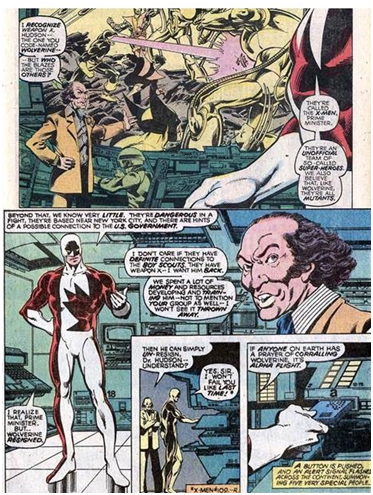
As many Marvel fans know, long-time X-Men artist John Byrne was a huge Wolverine fan who lobbied to keep him in the X-Men because he wanted to keep a Canadian superhero in the group, and who created Alpha Flight, Canada’s own superhero team.

What you might not know is that John Byrne really did not like Pierre Trudeau, who served as Prime Minister of Canada from 1968-1979 and 1980-1984. Indeed, I would go as far as to say that, judging from his artwork in X-Men #120 from April of 1979, he hates the man:

Start with the visuals – from the orange leisure suit/striped open-collar shirt combination (while Mr. Trudeau was a bit more of a “swinging young bachelor” than your average Canadian prime minister, I’ve yet to find any images of him in that ugly of a suit) to the rapidly-retreating hairline to the fearsome conk, the suggestion of the buck tooth and the Hapsburgian jaw, this is less the somewhat naturalistic Marvel house style (especially when contrasted against the Marvel house styled Guardian to his left) than a political caricature.

But let’s move on to the text, where the Prime Minister of Canada, a country that abolished slavery in 1833, is arguing that (because Wolverine’s adamantium-laced skeleton was funded by the Canadian government, or the US and Canadian governments) Logan should not be allowed to resign a commission in the Canadian military (even though James MacDonald Hudson’s response suggests that he should be able to). Following his orders, Alpha Flight basically kidnaps a commercial aircraft transiting between Alaska and the continental U.S, assaults a number of foreign nationals in the middle of Calgary International Airport and downtown Calgary, all to put Wolverine into a literal cage (X-Men #120-121).

So why is Canada so evil that John Byrne depicts Canadian military backing up Alpha Flight in the same uniforms as the Death Star technicians? If I had to guess, I’d say that John Byrne was among those who objected to Pierre Trudeau’s decision to invoke the War Measures Act during the October Crisis in 1970, where Canadian military were put on the streets of Montreal and almost 500 people were arrested and held without charge.