In terms of the MCU, I think he hits a nice sweet spot, as I discuss above. You can use him in lots of different kind of stories: he could fit just as easily into a Doctor Strange movie as he could into an Avengers movie or an Iron Man movie, whereas Thanos really only works on the cosmic-sci-fi level and Ultron only works vs. Avengers or component parts thereof.
Likewise, unlike Thanos who’s obsessed with Death or Ultron who’s obsessed with revenge, Doctor Doom has a more varied range of motives, so you can throw him into most any plot: he’s bound to be interested in any macguffin that promises power, he’s always up for an invasion or conquest, and he loves deeply petty personal grudges.
Indeed, I would argue that Doom works rather well for an MCU that’s expanding: he could fight the Avengers, he could fight Iron Man, he could fight Spiderman, he could fight Ant-Man, and if Marvel ever gets back the FF…fish gotta swim, Doom gotta fight that fool Richards.
I don’t think Thanos really counts, yet, given that he’s barely been on-screen in the MCU. He’s really more an inciting event/force, albeit a highly-built-up one. We’ll see in Infinity War whether Marvel pulls off a good Thanos.
If you go back and take a second look at Age of Ultron, Ultron himself has some rather good stuff – although you have to pay attention to the AI montage sequences to really grok where he’s going. However, he’s in an overstuffed movie that doesn’t really give him enough time to develop.
What has historically made Ultron an effective Avengers villain in the comics is that he’s like the Terminator – he keeps coming back after you kill him, and this time he’s made some upgrades, so that rather than decaying as a threat as time goes on, he becomes more of a threat. And while Age of Ultron uses that within the film to a degree with the infected Starkbots through to the Adamantium Ultron, it doesn’t really land with the emotional weight it should have because a billion things are happening at once and there’s no time for anything.
So you don’t really get the atmosphere of increasing tension and danger that you should have, and then by the end of the movie all the Ultrons are gone – which misses the point of the whole Terminator-by-way-of-Frankenstein’s-monster that is Ultron. Perhaps this is because they’d gone all the way up to planet-killing with Ultron and didn’t have any space left to go forward (an argument perhaps that they should have kept Ultron’s ambitions at the level of “kill the Avengers b/c they’re a threat to world peace, also parental rejection issues” as opposed to “glass the planet”).
I talk about this in greater detail here, but the more accurate description is that social progress on mutant rights gyrates wildly, depending on the direction that the writing and editorial staff want to take with the X-Men. So for example, you have a story where all of the sudden 70s America reacts to mutant-hunting robots tearing up midtown Manhattan by suddenly engaging in a wave of anti-mutant hysteria, as opposed to a wave of anti-robot hysteria. Later on, you’ll have incidents – the X-Men saving Dallas in full view of the TV cameras in Fall of the Mutants, X-Factor saving New York from Apocalypse – that significantly reduce anti-mutant hysteria.
What you don’t have is much consistency about how social progress is going, because the X-Men hasn’t historically been a book about social movements. As I’ve discussed in that link, the X-Men engage in a particularly elite form of politics, primarily centered around debates, trials, and press conferences, and we don’t really get to see much in the way of social movement organizing. The 1970s were an era of massive social movements of both the right and the left, you’d think you’d see some mutant rights groups organizing on college campuses, liberal big cities, protesting the Registration Act, pushing for a Genetic Equality bill, arguing in the courts that the 14th Amendment covers mutants, etc. Hell, you don’t even get mutant neighborhoods or mutant culture until Grant Morrison’s run.
Now, related to this is the problem of Marvel and the future. Especially in the case of the X-Men, Marvel has a hard time imagining a future that isn’t dystopic – either anti-mutant dystopic or mutant-supremacist dystopic or Terminator-by-way-of-Apocalypse dystopic – which I admit makes the Dream seem a bit futile, but only really due to a failure of imagination. I’d be really curious to see someone clever take a run at a future America where the majority of the population are X-positive, where superpowers are so common that the distinction between superhero and civilian breaks down – and before anyone says that won’t work, let me point you in the direction of Alan Moore’s Top 10.
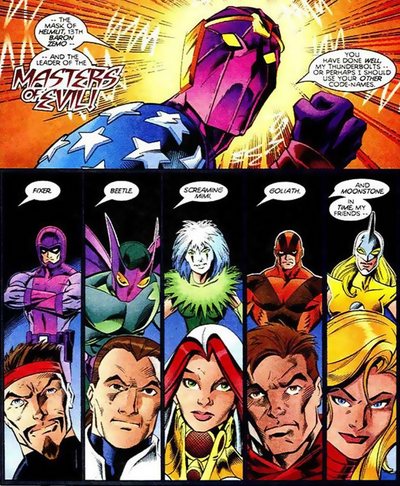
Heinrich Zemo is an important villain in Captain America history, being the man who was responsible for Cap going into the ice (in the comics). He does have one of the most ridiculous villain origin stories ever: he hates Captain America specifically because Cap got his balaclava stuck to his face.
His son, Helmut, is a bit of a basket case. He tried to kill Cap in disguise as the Phoenix – I would advise Jean Grey to sue, personally – and then managed to fall into a vat of the same adhesive that disfigured his dad, proving that idiocy runs in the family. Then he got married to a woman who claimed to be a reincarnation of his father, which is so bizarrely reverse-Freudian I can’t even.
I will give Helmut one thing: he’s really good at getting people to think that his villain team is actually a superhero team – because he’s done it more than once, using the exact same superhero team name.
Overall? They’re serviceable Cap villains. Not quite as classic as the Red Skull, lacking the panache of Baron Strucker, and unlike Arnim Zola they don’t have their faces on TV screens in the middle of their robot bodies.
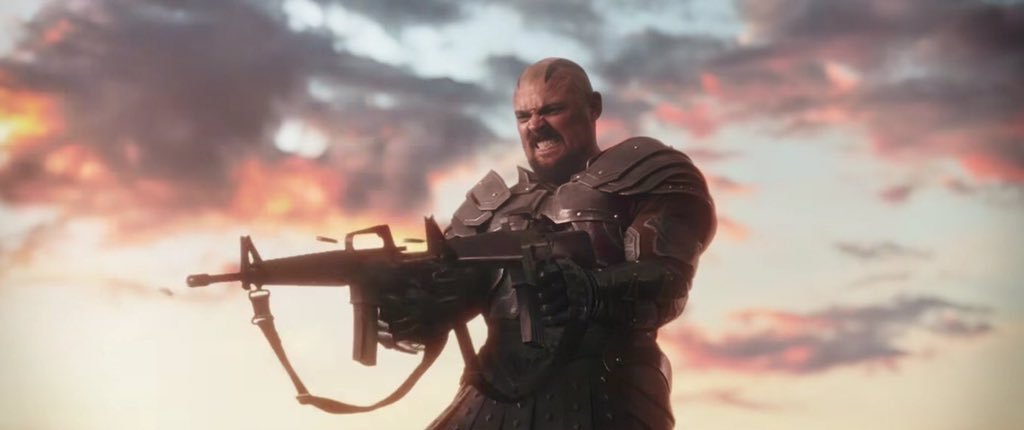
Best deep cut from the Thor: Ragnarok trailer. I will fight anyone who disagrees.
Bad. And I’d explain why, but I’ve just had my post eaten twice so I’m going to take a break before I hulk out.
What we heard was that people didn’t want any more diversity. They didn’t want female characters out there. That’s what we heard, whether we believe that or not. I don’t know that that’s really true, but that’s what we saw in sales. We saw the sales of any character that was diverse, any character that was new, our female characters, anything that was not a core Marvel character, people were turning their nose up against. That was difficult for us because we had a lot of fresh, new, exciting ideas that we were trying to get out and nothing new really worked.
As smart people on Twitter and CBR have pointed out, this is total malarkey, a classic case of cherry-picking statistics to support a pre-existing narrative (in this case, blaming poor sales of new/female/diverse books on “diversity” while not extending the same analysis to the many “core” books who sold just as badly) while carefully avoiding a comprehensive analysis that might point to more systemic problems.
Systemic problems like launching and relaunching too many titles, poor marketing practices especially given the frankly insane structure of the direct market, the loss of a lot of their writing talent to Image (which gives creators much better terms when it comes to IP rights), some really boneheaded editorial decisions, and way too many crossovers.
See the thing is, people have known since the 80s that crossovers and big events boost sales – which is why editorial keeps doing them, because like management in many industries, while they might talk about innovation they tend to gravitate to strategies that work in the past. But the thing about crossovers/events back in the day is that they were like summer blockbusters: they came around once, maybe twice, a year.
Recently, though, Marvel has been accelerating the pace of their crossover events. It hasn’t been a smooth upward curve – you get years like 2010 with 9 crossovers and then 2012 only has one, then it spikes up in 2014 to 8 and then in 2014 it’s back down to 2 – but the trend has been consistently going upwards since 2009. (My source doesn’t have the number of main and tie-in issues by event, but I’d bet that’s also going up.)
As people have pointed out, this is bad for two reasons. On a business level, this many events this quickly in succession burns out existing readers who get tired of having to fork over all this money just to keep up with continuity and it discourages potential new readers who can’t find an entry point because the status quo is getting blown up every five seconds.
On a creative level, writers and artists have been complaining about crossovers being terrible from the beginning (see the image at the top, which dates back to 1989). Writers and artists who are working on the crossover get slammed with high expectations, short (and often blown) deadlines, and editorial-mandated storylines of wildly varying quality. Writers and artists who are working on regular books have their storylines put on hold to service the crossover and then get handed a new status quo which might not work at all with the stories they were telling before. Now imagine that happening five or six times a year, and it’s no wonder that talent is jumping ship.
The two things also intersect: as quality of these events decline, people are less likely to want to buy them. As the events effect the quality of regular books, people are less likely to want to buy them, especially if the most recent event featured that character doing something horrible. And the more events there are in a given year, the less any of them have any impact or stand out – it’s just like anything else, variation is the key.
Some thoughts: first, as with previous trailers, it does a great job making Spiderman a teenager who goes to a high school (no offense to the Raimi Spiderman films, but you’ll notice Peter Parker barely interacts with anyone who isn’t plot-relevant), and establishing him as a person we care about. This new one also does a decent job giving us a motive for Michael Keaton’s Vulture that we can understand even if we don’t agree.
But I also want to say, I’m impressed by how good a job the trailer did at basic storytelling. I could go up to anyone who’s seen this on youtube and ask:
This is a tricky one, because you need to start from a place of understanding Jewish subtext in film and other media, so I’m going to do a very TLDR version of this history:
Back in the 1920s and 1930s, the Hollywood studio system was dealing with a “family values” backlash, and one of the ways in which the “family values” crowd liked to bash Hollywood was to bring up the fact that a lot of the people who ran Hollywood were Jewish immigrants and were thus alien to the values of the American heartland (which of course got revived during the Cold War with the Black List and the McCarthy hearings).
One of the ways that Hollywood dealt with this, in addition to instituting the Hays Code was to really de-emphasize Jewishness in its products. Not that Hollywood didn’t continue to make products that came out of Jewish theater – the Marx brothers, for example – they just didn’t identify characters as Jewish and used circumlocution and veiled metaphor to discuss Jewish themes. Hence, even when you could fight the caution of the studio bosses to get them to greenlight an anti-Nazi picture like Casablanca (as late as 1942!), the screenwriters and directors had to smuggle in Jewishness under the radar:
So in 1941, when Jack Kirby and Joe Simon introduced us to Captain America and the name of the scientist who gave him his powers was Professor Reinstein at a time when the most famous Jewish emigre scientist in the world was Albert Einstein, the subtext was clear: Captain America’s serum is the result of Jewish emigre science, here to save us from the threat of Nazism. And while it’s changed somewhat in the last 60-70 years, the fact that the 2011 film has Doctor Abraham Erskine be both a scientist and a quasi-rabbinical figure, the subtext is still there:
Let me start by directing you to this essay here where I talk about how Jack Kirby and Stan Lee turned the Red Skull from a rather shaky pulp villain into a pretty damn good supervillain with a penchant for cigarette holders, giant Nazi robots, doomsday devices and improbable escapes.
They also gave him a rather interesting backstory in Tales of Suspense #66: Johann Schmidt was a penniless orphan, bullied and robbed because of his physical weakness, who couldn’t find regular employment (although as Steve Rogers points out, “my early years were no bed of roses, either”), who was working in a hotel when Hitler came into town, and the rest was destiny:
And that’s the core of the character – he is Hitler’s very own Nazi, his hand-crafted avatar of hate. But at the same time, you can see the personality defects – the self-hatred (especially centered around physical weakness), the adoration of power and strength, the “envy, the jealousy” – that would make him such an eager convert. In a way – and there’s a reason why they named him John Smith – he’s a perfect stand-in for any of “Hitler’s willing executioners.”
That’s what makes him such a good “dark mirror” for Steve Rogers – because the two of them have virtually identical backstories as poor, physically impaired orphans, but they reached such diametrically opposed ideological conclusions. Long before he volunteered for Project Rebirth, Steve Rogers had chosen the path of solidarity, and before Johann Schmidt got his mask/face, he chose the opposite. Hence why this moment works so well:
The Red Skull needs there to be some inherent, almost biological reason, why Steve Rogers succeeded where he failed, because otherwise he has no way of understanding his life. And it’s a big part of the reason why so many of his plans revolve around trying to break down Captain America – drive him crazy, take over his body, putting NYC in a bubble unless Cap gives in – to find that reason and overcome it.
That being said, one major mistake I think people make with the Red Skull is that they try to make him too smart (he’s not a Batman-level strategic genius – he’s a monologuer, a gloater, a fan of the easily-escaped-death-trap and the explosion-prone-giant-robot) or too powerful (the Cosmic Cube should always be something he’s reaching for, but which always slips between his fingers).
To start with, I would give Spiderman villains who’ve been done before – the Green Goblin, Doc Ock, Venom, the Lizard, etc. – a bit of a rest, unless some creator has a distinct enough vision for them to warrant their use so close to the ASM movies. Hobgoblin and Jack O Lantern kind of bite the Green Goblin’s style a bit too much, so hold off on them.
Chameleon would be a great insiduous villain, not your main physical threat but a great social/mental threat. Ditto Mysterio, if you can figure out how to make his signature costume work on screen. Vermin would work as a more physical/horror threat.




 RFTIT Tumblr Backup