A People’s History of the Marvel Universe, Week 3: Making Cap Marvel

image

Face front, true
believers!        

Welcome back to A People’s History of the Marvel Universe, where I explore how real-world politics (and weird bits of pop culture) was presented in some of my favorite bits of classic Marvel comics. In this issue, I’ll be discussing how Captain America made the transition from his Timely Comics incarnation to the Marvel era.

image

Timely Comics’s
version of Captain America was (to be kind) rather crude, still in that stage
where superheroes as a genre are still emerging from pulp, so there’s a lot of
repetitious scenes where Cap and/or Bucky get tied to chairs because that’s the
only way the author can think of to get to the plot exposition, most of the
villains are pretty generic mobster types, and so on. However, Kirby and Lee
were able to go back and sift through the old material to find the stuff that
worked – Steve Rogers as Captain America, the uniform and the mighty shield,
the Red Skull, Agent 13 – while ditching the stuff that didn’t work (the secret
identity, Bucky to an extent, etc.).

image

At the same time,
there were a number of strategies that Marvel used to make the transition work.
First, in the very act of updating Captain America from the 1940s to the 1960s,
Kirby and Lee made Steve Rogers a man out of time, giving a previously rather
thinly-sketched individual a rich source of Marvel-style pathos and
interiority. The Steve Rogers who emerged in the pages of the Avengers, Tales
of Suspense, and Captain America is a veteran haunted by the memory of his
losses during WWII, a rare example in which PTSD is given its place in that
conflict. (Indeed, a lot of stories from this era involve Cap having vivid
flashbacks or hallucinations that make him question his sanity.)

 However, with Kirby
there as the keeper of the sacred flame
to ensure that the original spirit of Captain
America wasn’t lost, Steve Rogers’ status as a man out of time was never an
excuse to position him as a conservative or reactionary
figure
. Rather,
Captain America’s position was that he would embrace these changes and fight
for the same progressive change that he had back in the New Deal:

image
image

And that’s what I
think people often get wrong about Captain America: while he was born into the
“Greatest Generation,” he’s not an old man. Rather, because of his variable
number of decades frozen in the ice, he’s a young man who’s traveled through
time, bringing the passion and idealism of youth into a new era.

Second, Kirby and
Lee kept much of the political edge of the original comics by making a
foundational element of the new Cap comics that Nazism was not dead, but had
continued into the present day as a hostile force that threatened liberal
values, often hidden beneath reactionary causes and movements (hence the
usefulness of HYDRA as a dark mirror through which to question and explore the
national security state in Captain
America: Winter Soldier
). For example, early on in Tales of Suspense, they
posited that Nazi agents were at work in modern Germany:

image

To argue that
Nazis were hidden in German society, as if Himmler’s Operation
Werwolf
had
really come to pass, was a pretty bold political statement in a Cold War world
only five years past the construction of the Berlin Wall and in which the
Western German government had yet to publicly grapple with the legacy of the
Holocaust. But Kirby’s political acumen shines in these issues, grounding these
stories in contemporary politics, as with this reference to West German laws
banning the display of Nazi iconography:

image

Third, another
thing that Marvel could bring to the table is a fully matured Jack Kirby. As I
mentioned above, the Timely Captain America comics were too close to the pulp
era to really be distinctively superheroic. But by the 1960s, Kirby was Kirby.
And so what the Red Skull’s sleeper agents were out to awaken was not merely a
coup against the Federal Republic of Germany, but a giant Nazi robot:

image

The Timely Comics
version of the Red Skull had been a petty saboteur and sometimes assassin, very
much within the wheelhouse of pulp antagonists. The new Red Skull (who’ll be
explored in future installments) was reimagined as a full-on supervillain with
a flair for giant robots, doomsday devices, world conquest, and grandiloquent
speeches complete with cigarette holder. And so Kirby gave the world not just a
giant robot menacing the free world, but a Nazi Voltron:

image
image

This was the
secret alchemy that brought Captain America into the contemporary world of
Mighty Marvel Comics: on the one hand, Jack Kirby’s larger-than-life visuals and
Marvel’s attention to interiority gave Captain America new life, but on the
other, the original political spirit of the Timely Comics was carefully
preserved, so that what made Captain America unique is a superhero is that his
power is essentially weaponized progressive ideology:

image

A People’s History of the Marvel Universe, Week 2: John Byrne’s Hatred for Pierre Trudeau

Face front, true believers!

Welcome back to A People’s History of the Marvel Universe, where I explore how real-world politics (and weird bits of pop culture) was presented in some of my favorite bits of classic Marvel comics.

Today, I’ll be exploring how real-world politics intersected with Chris Claremont’s classic run on X-Men. Now, Claremont X-Men is some of the richest source material imaginable, given the way that the mutant metaphor has been used to address contemporary social issues facing different minority groups.

So what ripped-from-the-headlines issue will be looking at this week? Canadian politics from the 70s!

As many Marvel fans know, long-time X-Men artist John Byrne was a huge Wolverine fan who lobbied to keep him in the X-Men because he wanted to keep a Canadian superhero in the group, and who created Alpha Flight, Canada’s own superhero team.

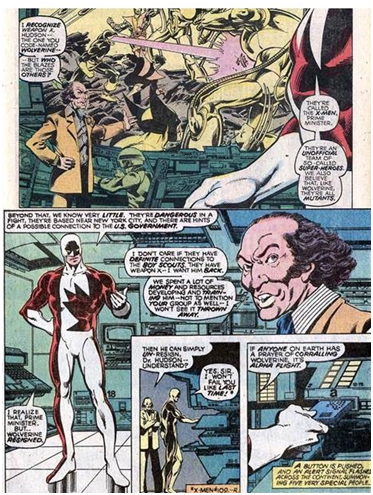
What you might not know is that John Byrne really did not like Pierre Trudeau, who served as Prime Minister of Canada from 1968-1979 and 1980-1984. Indeed, I would go as far as to say that, judging from his artwork in X-Men #120 from April of 1979, he hates the man:

Start with the visuals – from the orange leisure suit/striped open-collar shirt combination (while Mr. Trudeau was a bit more of a “swinging young bachelor” than your average Canadian prime minister, I’ve yet to find any images of him in that ugly of a suit) to the rapidly-retreating hairline to the fearsome conk, the suggestion of the buck tooth and the Hapsburgian jaw, this is less the somewhat naturalistic Marvel house style (especially when contrasted against the Marvel house styled Guardian to his left) than a political caricature.

But let’s move on to the text, where the Prime Minister of Canada, a country that abolished slavery in 1833, is arguing that (because Wolverine’s adamantium-laced skeleton was funded by the Canadian government, or the US and Canadian governments) Logan should not be allowed to resign a commission in the Canadian military (even though James MacDonald Hudson’s response suggests that he should be able to). Following his orders, Alpha Flight basically kidnaps a commercial aircraft transiting between Alaska and the continental U.S, assaults a number of foreign nationals in the middle of Calgary International Airport and downtown Calgary, all to put Wolverine into a literal cage (X-Men #120-121).

So why is Canada so evil that John Byrne depicts Canadian military backing up Alpha Flight in the same uniforms as the Death Star technicians? If I had to guess, I’d say that John Byrne was among those who objected to Pierre Trudeau’s decision to invoke the War Measures Act during the October Crisis in 1970, where Canadian military were put on the streets of Montreal and almost 500 people were arrested and held without charge.

New Weekly Series: A People’s History of the Marvel Universe

Hey folks, because this is the sort of thing I do for fun, I’ve decided to do some shorter pieces on the intersection between politics and comic books.

In A People’s History of the Marvel Universe, I’ll be exploring how real-world politics (and weird bits of pop culture) was presented in some of my favorite bits of classic Marvel comics, starting with Claremont’s run on X-Men and Captain America from the Timely Comics through the 80s. And thanks to my friends Brett and Elana over at Graphic Policy, which covers comic books from a progressive viewpoint and which you should be reading regularly, I’ll be posting them both here and there.

Today, I’ll be talking about the politics of Captain America, something I’ve discussed before. Political nerds and Marvel fans are probably aware that the original Captain America comics from the 1940s were explicitly political, as Joe Simon and Jack Kirby took an explicitly anti-fascist and anti-Nazi position in March 1941, ten months before the U.S was attacked at Pearl Harbor.

What they might not know is that that Captain America was also explicitly political – and progressive – on domestic politics as well. As proof, I present this panel from the very first page of Captain America #2:

Meet the villains of the very first story to feature Captain America’s now-iconic round shield – two corrupt bankers trying to evade Federal corporate income taxes. Now, yes, Benson the corrupt banker on the right happens to use “Oriental giants” he discovered in Tibet who are impervious to everything but sonic weapons to “raise havoc with the city – the nation! I want money-money!” but at the end of the day, he’s still a corrupt banker who kills people to hide his income tax evasion.

Joe Simon and Jack Kirby’s point couldn’t be clearer – wealthy businessmen who avoid paying corporate income taxes (and these would be FDR’s “Soak the Rich” taxes, specifically) damage America’s ability to wage war on fascism and require the same two-fisted justice that Captain America deals out to “Ratzi” spies, storm troopers guarding a concentration camp in the Black Forest, Adolph Hitler himself, and the evil Wax Man (who kills people with wax masks of themselves for some reason).

Then again, it’s also the issue where Captain America cross-dresses…to fight fascism.