



why-i-love-comics:

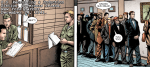
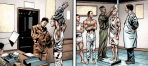
 Captain America: First Vengeance #2 (2011)

written by Fred Van Lente
art by Luke Ross & Richard Isanove

I have no personal animus whatsoever against any of the people involved in making this comic, but as someone who has thought WAAAAAAAAAAAAAY too much about Captain America, this is a very particular pet peeve of mine. 

It’s the date. Discreetly tucked away in the upper left, saying “December 24th, 1941.” While it being Christmas Eve is a bit schmaltzy even for a character who is done best with a good helping of schmaltz – looking at you, Joe Johnston you genius you – it’s the 1941 that bugs me.

Because Steve Rogers did not join the U.S military because of Pearl Harbor.

One of the reasons we know this is that Pearl Harbor hadn’t happened when Captain America #1 came out in March of 1941 with a big picture of Cap punching Hitler on the jaw on the cover. Jack Kirby and Joe Simon had come up with Captain America to argue that America needed to get into the fight against fascism, which they saw as a threat at home and abroad

So then why did Steve Rogers join the military, if the United States hadn’t been attacked and his country was at peace? Because Steve Rogers was a “premature anti-fascist.”
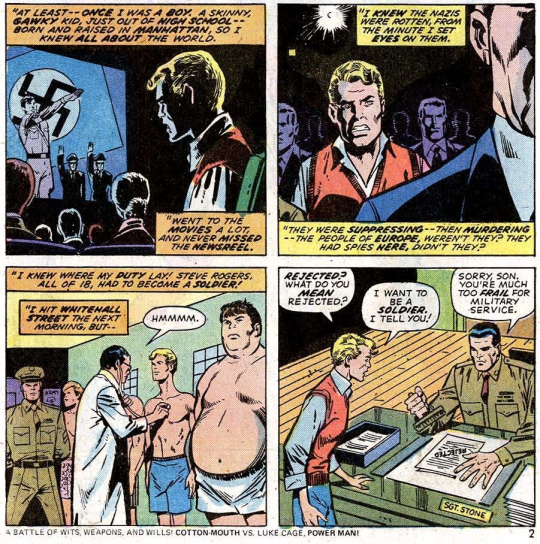
And this is what sets him apart from the deluge of patriotic superheroes from the 1940s like American Eagle, Captain Battle, Captain Comamndo, Captain Courageous, Captain Flag, Captain Freedom – no, comics have never had a problem with plagiarism, why do you ask? – the Fighting American, the Fighting Yank, and on and on. Steve Rogers had a very specific political point-of-view, one that only could have come from New York City in the 1930s, and it went way beyond a sanitized patriotism.

The specificity of Captain America’s politics is something that Marvel haven’t always been willing to talk about in recent years, but it’s what makes him genuinely interesting.  

So please, can we have a moratorium on post-Pearl Harbor origin stories? They miss the point completely.
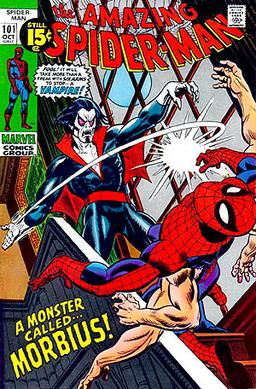
How do you feel about Morbius the vampire?

I actually read some Morbius comics when I was a kid. He’s a weird character. 

image

Some interesting things about Morbius:

  1. Morbius isn’t his super-hero name, it’s his actual name. Like Otto Octavius, Michael Morbius is one of those Marvel characters doomed by uncaring parents to a name of destiny
  2. Morbius is called “the Living Vampire” because he is not, technically speaking, one of the undead. He was never bitten by a vampire or drank their blood. Morbius became a “pseudo-vampire” by injecting himself with vampire bat DNA and electro-shocking himself in order to cure himself from a rare blood disorder…and in the process, scientifically reverse-engineered the quite real and supernatural vampirism that exists in the Marvel Universe. The ontological implications are fascinating.
  3. Morbius is originally a Spider-Man sympathetic villain, in the vein of the Lizard, although he’s since spent more of his career as part of the Midnight Sons, a supernatural team of horror-themed second stringers plus Ghost Rider plus Black Cat for some weird reason. 

While I love Morbius as an example of how 70s Marvel’s fad-chasing could sometimes result in a wonderful alchemy of cheese, that’s also why I’m really skeptical of the upcoming Sony film even if it wasn’t starring Jared Leto. In a similar but distinct way to the problems with a Venom movie, I have reservations both that the main character can sustain a movie because he’s not really built to be a main character (Morbius is kind of a one-note emo boy, and when he’s worked in the past it’s usually in an ensemble), and that he’s absolutely the wrong character to do a dark n’ gritty anti-hero movie with.

What is novel and unique about Morbius is that he is inherently ridiculous. He’s not a real vampire, he’s a mad scientist who thought that VAMPIRE BAT PLUS LIGHTNING = CURE. He’s a world-reknowned scientist who also voluntarily goes out of doors with a deep v-neck popped collar and underarm wings, because clearly the good doctor built his costume out of his old disco jumpsuit. He spends half of his time bemoaning that he must drink blood out of the necks of an attractive young woman from the cover of a Mills and Boon novel and the other half doing medical rounds as the only doctor in Monster Metropolis.

If this project was going to be done at all, it would have to be done in a deliberately campy and tongue-in-cheek fashion. And that’s not how Sony rolls. 

Thoughts on the Punisher? I find it interesting that such a small-time character (relatively speaking) has had not one, not two but three unrelated films that all flopped and were critically panned to boot. And yet, the Punisher was given a major role in Daredevil season 2 and now has his own series. Not to mention his numerous appearances in cartoons, and video games starring him. What I’m trying to say is that the character sure gets a lot second changes and I find it curious.

The Punisher gets used a lot because the character is very cheap. Because the character’s inspiration is from revenge thrillers – he predated the Death Wish and Rambo movies, but not the novels they were based on – Frank Castle is just a guy with a lot of guns who goes around killing people in familiar urban environments. 

Which means you don’t need colorful costumes or special effects for super-powers, you don’t need elaborate sets to stand in for alien planets, you don’t even need particularly good acting, because the audience’s interest is in the gunplay. Which means you can get by with the quite modest budgets that action movies used to be associated with.  

I’m not a fan of the character, personally. The danger of falling into some really reprehensible territory on race, guns, criminal justice, etc. is particularly intense, but even when writers avoid those traps, I find that the stories get very samey – Punisher goes up against bad guys, Punisher shoots bad guys, rinse and repeat – without the scope for innovation or whimsy that comes from the clever use of superpowers. 

Bottom line, I don’t think there’s much there to a character whose core conceit could be undone by a single sentence. 

Thoughts on J. Jonah Jameson as a character?

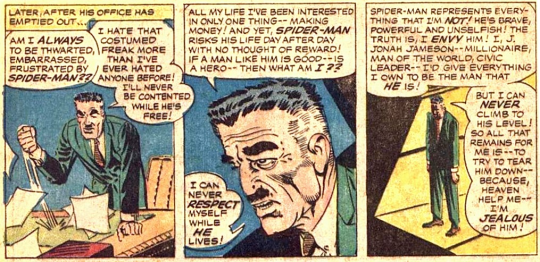
J. Jonah Jameson is a great character, who somehow is both absolutely classic – you could do a silhouette carictature of the toothbrush moustache, the flattop haircut, and the stogie and I think you could get most people on the street to guess his identity – but also incredibly mutable. He can be Spider-Man’s most enduring hater or his biggest ally; an amoral scandal-monger who cares about selling papers not the truth or a tough-but-fair newspaperman of the old school who won’t tolerate spin and who will back good investigative reporting to his last breath; the Mayor of New York City or a conspiracy theory podcaster. 

image

Jameson’s original version of him is a Steve Ditko original, steeped in Ditko’s own brand of Objectivist philosophy, a tormented, small man hiding behind bluster and bravado, consumed by ressentiment towards those who stand above the crowd, who fans the flames of the mob’s hatred in order to salve his own ego. But somehow this jacket couldn’t quite stick; Jameson has too much roaring energy, too much snappy cigar-chewing banter, too rich of a Falstaffian mix of hypocritical humor and human frailty, to go down as a Randian cardboard cutout. 

https://youtu.be/mhDBWiTfNCU

So over the years, writers have looked for a deeper and more sympathetic motivation for Jameson, and his character changed as a result. I would call him Spider-Man’s Loyal Opposition, undoubtedly an irritant and an obstacle, but one whose constant pressure pushes Spider-Man to be a more selfless, more “responsible” hero, if only to get one over on the old man. 

So, thoughts on Coates’ Captain America #1?

Took a second to get my hands on it, because Comixology is bad at carrying over subscriptions when teams change, but yeah, I have some thoughts.

So far, it reminds me a lot of Brubaker’s run, that emphasis on the paranoid thriller style. 

The two main threads of the issue are:

  • Cap and Bucky working together to try to shut down “HYDRA nostalgics” while dealing with “resisters with shady pasts” who’ve got a foothold in the new government, what with Thaddeus Ross hiring Sharon Carter on the one hand, but also suggestion that Selene’s in the U.S government and Von Strucker somehow managed to get himself on the good list.
  • Bringing Russia into the HYDRA narrative with Selene (the former Black Queen of the Hellfire Club) liberating a mysterious Alexa in Russia, demonstrating how Russia reacted to HYDRA’s world conquest and their more hardcore attitude to the aftermath.

Not quite sure how they link together in the end, with the exception of Selene being both active in Russia and in the U.S government, and the way that the issue frames Steve’s street level helping ordinary people against Selene’s exemplary punishment of a HYDRA holdout. 

I’d say what I liked best in the issue is the Cap and Bucky rapport, the perspectives of the two of them as “a warrior who hates war” (which makes sense for a man who’s made a shield his signature weapon) vs. someone “who’d seen the worst of human nature” and knows how to take the shot in the meantime. 

The cyborg Nukes being used as “lone gunmen” on the National Mall are certainly a scary thought, and combined with the discussion of protesters and counter-protesters, very much getting a “ripped from the headlines” vibe out of that particular plotline.  

How do you feel about the varying power levels of characters in the MCU between films, and indeed within films? Justified by the Rule of Drama?

It’s not just fine, it’s absolutely necessary. I’m a firm believer that variation is at the heart of all great storytelling, and I think that applies to superpowers as much as anything else. 

image

Take the airport fight sequence in CA: CW, for example. 

Part of what makes the fight so much fun is that you have all kinds of different power levels going on – non-powered spies like Hawkeye and Black Widow, supersoldierish folks like Cap and Bucky, tech-suited guys like Iron Man, War Machine, and Falcon (to a lesser extent), Black Panther is somewhere in the middle of those last two categories, then you’ve got Vision and Ant/Giant-Man and Scarlet Witch doing all kinds of crazy shit, and then you’ve got Spiderman somewhere in between those last two categories. 

Thus, as the various fighters pair off in different combinations, you can show all kinds of different power dynaimcs: Ant-Man crawling inside of Iron Man’s suit or suddenly turning giant and grabbing War Machine and then getting ESB’d by Spider-Man, or Cap and Spider-Man having a shield vs. webs battle, or Scarlet Witch throwing a parking garage’s worth of cars at Iron Man, etc. 

Now imagine that same sequence if everyone had Superman’s power set. Imagine how boring and repetitive it would get, with all of these flying bricks punching each other through buildings over and over again. 

Both Ben Grimm and Steve Rogers grew up in the Lower East Side in the comics, but this was changed to Brooklyn for both of their movies. Is this just a funny coincidence, or is there some reason why Brooklyn is better for movies?

I think it has to do with the way that the passage of time shapes our mental maps of New York City (although the same process happens with all cities). 

Jack Kirby was born at 147 Essex Street – which is just south of Houston, and two blocks away from where the modern Tenement Museum stands – which was at the time a Jewish immigrant neighborhood, and he used his childhood experience to create a background for both Ben Grimm and Steve Rogers. (One can see this most clearly in the case of Ben Grimm and the Yancy Street Gang, where Yancy Street stands in for Delancey Street, which is about a block and a half south of Kirby’s boyhood address.)

image

However, over time Kirby’s childhood neighborhood changed dramatically: from the 40s to the 60s, Jewish and Eastern European immigrants and their kids moved out and African Americans and Puerto Ricans moved in; then from the 1980s to the early 2000s, gentrification spread from the East Village down to the Lower East Side, as students, artists, and yuppies who were finding the East Village now a bit too expensive went looking for cheaper rents, and brought trendy restaurants and art galleries with them, and by the mid 2000s, development started to shift to luxury condos. The point of this is that in the minds of younger writers, the Lower East Side isn’t a working-class immigrant neighorhood, because working-class people can’t afford to live there any more.

However, Brooklyn still has something of a more working-class cachet to it, especially in the minds of the broader movie-going public, if only for the moment. And thus writers looking for a backstory for characters who are the children of

working-class

immigrants (Jewish and Irish, respectively) shift their origins from the Lower East Side to Brooklyn. 

And who would the Avengers root for? And if there are differences who would MCU Avengers root for? And I find Jean Grey’s rooting amusing considering the actresses.

What if the Avengers came across ASOIAF? Who would like whom?

Hah! Sure, why not. Might as well finish out the set. 

Iron Man – Tyrion, kind of over-determined. 

War Machine – Bronn, because he too has to put up with Tyrion.

Spider-Man – Bran Stark, because the kid who develops powers and great responsibility because of an accident hits home. 

Vision – Bloodraven, because mysticism and being part human part something else.

Scarlet Witch – Daenerys, because struggling to control firepower(s) hits home.

Black Widow – Arya, also over-determined. 

Captain America – a Davos fan at the beginning of Winter Soldier, but more of a Beric Dondarrion fan by the end of Civil War. 

Falcon – Thoros of Myr, because he too has to put up with Beric Dondarrion.

Bucky –  Sandor, because all angry boys are secretly sad boys underneath.

Thor – Gendry, because he too appreciates hammers. 

Hulk – Sandor, because all angry boys are secretly sad boys underneath.

Hawkeye – Anguy, because no one else appreciates longbows. 

So I see people suggest Kang the Conqueror as the next Big MCU Villain (especially since the Fox thing hasn’t gone all the way through yet). This might be tough to answer until we have a post Avengers 4 status of the universe, but how would you bring him in?

Good question!

To be honest, it depends on where things stand with Phase Four and how that interacts with the Fox/Disney deal. I could see Marvel Studios going with Doctor Doom in Phase Four, since Doom works equally well as an Avengers villain, a Fantastic Four villain, an X-Men villain, or a Spider-Man or Doctor Strange villain. (He’s sort of the universal adaptor of supervillainy.)

To be honest, Doom kind of does everything that Kang does with time travel and faked deaths and the like, but with a lot more flair, and I could see Marvel going with Doom out of a desire to show off that they could succeed with him where others had failed so often. 

I did also see a tease from the Russo brothers that they might do a Secret Wars, which is a very simple way to get all of their new and old characters together and have them fight, and the Beyonder isn’t a bad pick for Big Bad as long as one stays away from his completely insane Secret Wars II incarnation:

image

We’’ll have to stay tuned, true believer. 

So Captain Marvel is going to involve the Kree-Skrull War. Can you explain what this war is about in the comics cause I have no idea (other than Skrulls are shapeshifters which has caused issues and Ronan is a Kree)?

The Kree and the Skrull are two galactic empires, the former tending to very good with artifical genetic evolution, nanotech, and power generation, whereas the latter are shape-shifters who are incredibly good at infiltration, espionage, and copying the powers of their enemies. One way to think of them is that the Kree are very much about hard power, whereas the Skrull are very much about soft power. 

The idea of the Kree-Skrull War is that these vast galactic powers, locked in war, threaten to come to blows with Earth as the battlefield, “the cosmic equivalent of some Pacific island during World War II.“ The Kree see Earth as an important outpost because of their connection to the Inhumans, and indeed Ronan attempts to devolve earth back to prehistoric days so that it can be better used as a military base. The Skrulls, meanwhile, want to capture the original Captain Mar-Vell and disrupt the human superhero teams they believe to be Kree allies (the Fantastic Four and the Avengers, primarily). 

Eventually, the good guys save the day and stop the Kree-Skrull War, resulting in them agreeing to leave Earth out of their conflicts.