That’s a tricky question. We know that virtually all the Houses of the Reach claim descent from Garth Greenhand, hence why the authority of House Gardener was so strong. (Interestingly, though, the Manderlys are not counted among the descendants of the leading children of the Greenhand, whereas the Peakes are.)
Descent from the Gardeners we have less comprehensive information about: we know the Gardeners and the Hightowers wed in both directions from the time of Garland the Bridegroom; we know Garth Goldenhand wed his daughters to the heirs of House Lannister and House Durrandon, so the Lannisters and Baratheons have some Gardener blood through the female line. And from the conflicts between the Tyrells and their bannermen, we know that the Oakhearts, the Florents, the Rowans, the Peakes, and the Redwynes have “closer blood ties to House Gardener” than the Tyrells do.
As far as the Manderlys go, we know that Garth X married one of his daughters to the Lord Manderly of his day (and another to the Lord Peake). But as to whether there were more connections between the Manderlys and the Gardeners, it’s not clear.
Well, Garth Greenhand wasn’t really a ruler per se, more of a nature/fertility god who does seem to have been venerated across the whole of the Reach. It was his eldest son Garth the Gardener who was the first King in Highgarden, and based on what we know about subsequent Gardener Kings, yes his kingdom was small by later standards (keep in mind, power is relative; if everyone else is a petty king…).
Hey folks! If you’d like to read my essay on the politics of the Reach collected together in one place, it’s now up on Tower of the Hand here. Check it out!
credit to ser-other-in-law Introduction: Last time, we saw how a succession of frighteningly single-minded and capable monarchs turned the Kingdom of the Reach from a petty kingdom ruled from a hillfort into a powerful and dynamic state that could reshape the map of southern Westeros and defeat its regional rivals singly and in combination. In this part, we shall see how this state confronted the…
So, when Aegon I started up, Harren Kingdom of the Isles and Rivers was clearly on the offensive:
“…but the most belligerent kings of Aegon’s time were the two whose realms lay closest to Dragonstone, Harren the Black and Argilac the Arrogant. From their great citadel Storm’s End, the Storm Kings of House Durrandon had once ruled the eastern half of Westeros from Cape Wrath to the Bay of Crabs, but their powers had been dwindling for centuries. The Kings of the Reach had nibbled at their domains from the west, the Dornishmen harassed them from the south, and Harren the Black and his ironmen had pushed them from the Trident and the lands north of the Blackwater Rush… North of the Blackwater, the riverlands were ruled by the bloody hand of Harren the Black of House Hoare, King of the Isles and the Rivers. Harren’s ironborn grandsire, Harwyn Hardhand, had taken the Trident from Argilac’s grandsire, Arrec, whose own forebears had thrown down the last of the river kings centuries earlier. Harren’s father had extended his domains east to Duskendale and Rosby. Harren himself had devoted most of his long reign, close on forty years, to building a gigantic castle beside the Gods Eye, but with Harrenhal at last nearing completion, the ironborn were soon free to seek fresh conquests. No king in Westeros was more feared than Black Harren, whose cruelty had become legendary all through the Seven Kingdoms.”
Hence why, when Aegon started, Argilac Durrandon and Sharra Arryn both approached Aegon about an anti-Harren alliance, with Argilac hoping to “establish the Targaryens along the Blackwater as a buffer between his own lands and those of Harren the Black,” and Sharra looking for “all the lands east of the Green Fork of the Trident for the Vale’s support against Black Harren.” Although if you want a good sense of how crab-bucket politics the Great Game could get, consider that Princess Meria of Dorne approached Aegon with a plan to gang up on the Stormlands…So you have two dynamics at once: a bunch of players wanting to pounce on the declining Stormlands to get what they can while they can, but also a number of players seeing the Ironborn as the new threat that needs to be jumped on with both feet lest they win the Great Game.
With no Aegon, I would imagine Harren would keep pushing south as the Durrandons ran out of steam…up until a crucial point, probably during a siege of Storm’s End. Then you’d see a couple things happen: first, the Vale would launch an invasion of the eastern Riverlands to “liberate their Andal brethren from the heathens.” Second, the Rock and the Reach will announce that “Harren the Black is a threat to all of Westeros,” and promptly invade the Riverlands from the west and the south…although maybe they’ll do something weird like launching a joint naval invasion of the Iron Islands at the same time. Third, Harren will be forced to pull back, and everything turns into a blood bath in the Riverlands.
And the Great Game would shift, likely with the Iron Islands reduced, the Riverlands divided (probably with the Westerlands grabbing Riverrun and the Trident, the Reach trying to grab everything from Stony Sept to Lord Harroway’s Town to Maidenpool and overreaching, and the Arryns fighting the Reachermen for Crackclaw Point and the Westermen for the Ruby Ford), and everything in chaos. The Durrandons might luck out with a rump state against fierce Dornish pressure – although who knows, maybe a Gardener decides to get their own back for Garth X by burning Sunspear or something, and that gives them enough breathing room to rebuild their fortunes. Oh and I’m sure that a Gardener will start talking about “saving the Stormlands from the Dornish” and the claims of Garth VII’s daughters.
So yeah, there’s plenty of ways to redraw the map to build multi-national states – the problem is the Great Game makes all of this unstable as hell, because it’s designed to prevent anyone from winning.
credit to ser-other-in-law
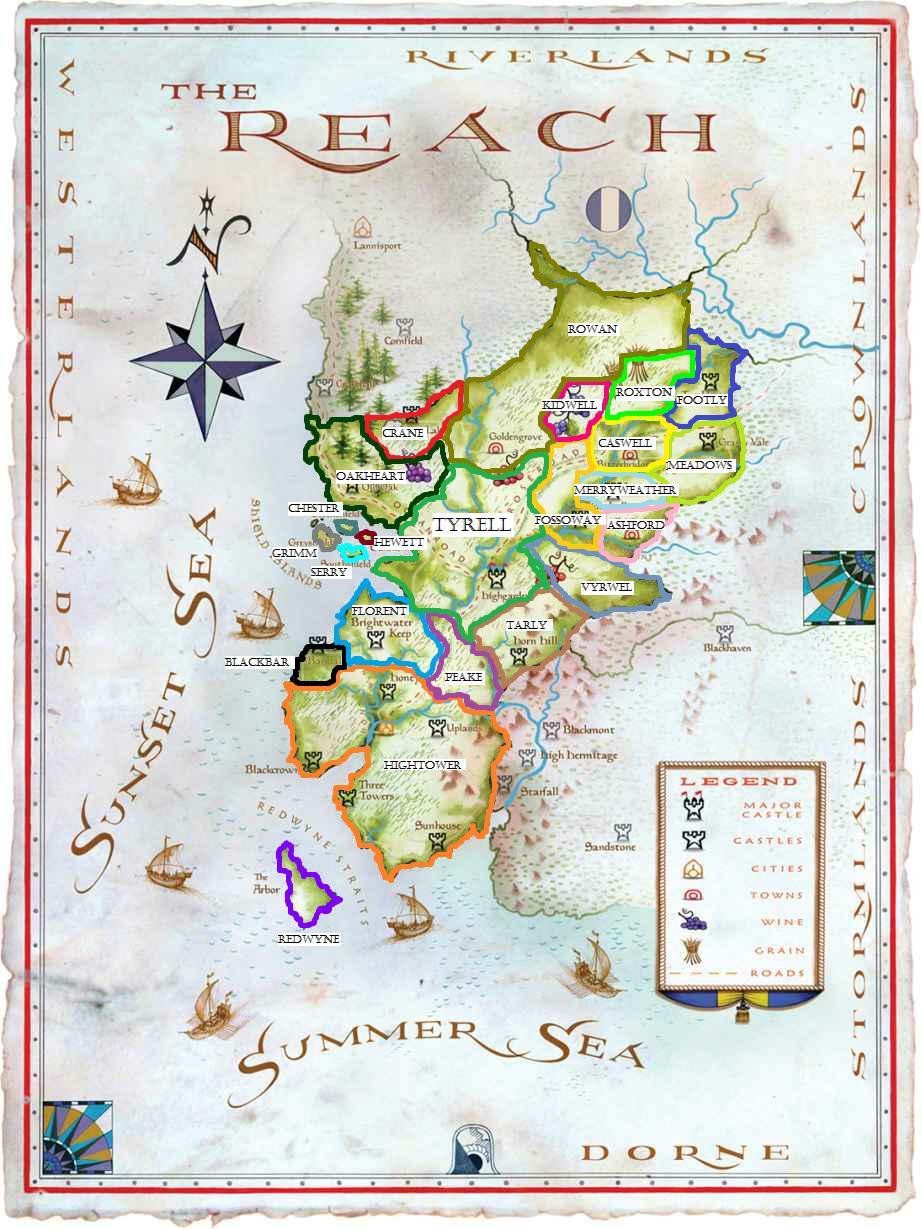
Last time, we discussed the geography of the Reach, and the pre-history of Garth Greenhand and how it structured the polity that House Gardener would build. In this essay, we’ll look at how House Gardener went from ruling a fortnight’s ride from the walls of Highgarden to the masters of the Reach.
(more…)
I find the Arthur comparison to Garth Greenhand surprisingly apt. As you point out, GG exists as a number of different characters. With ASOIAF, I’m never sure what to do with Martin’s coy in-world-historical-skepticism, but I can imagine a Maester trying to tease apart the threads of the legend, and if you asked him: “was there a historical Garth Greenhand,” he might answer: “depends what you mean.”
GG is supposedly: the founder of House Gardener, the leader (or a leader) of the First Men, the father of a lot of other heroes, and a fertility god. The first three (and maybe the fourth!) are all things that definitely happened in Westerosi history – someone was the first Gardener, the First Men into Westeros surely had leaders, the great heroes had fathers (whether or not they were all the same man). From this much material you could spin out a thousand different guesses at a “historical” GG … you could even question whether any of them actually had to be named Garth.
Thus with Arthur. If there was anything like Geoffrey’s version – “King Arthur”, ruling much of Britain and fighting Saxons – then his absence from the historical record is astonishing. (But if you were going to lose a guy like that, 5th-6th c. Britain is where you’d do it.) The earlier references to Arthur present one of two themes: a warleader (not necessarily a king) fighting foreign enemies, or a culture hero akin to Finn McCool or Paul Bunyan. One is part of the historical narrative about Romano-British resistance to foreign incursions, and the other rides around the countryside lopping the heads off giants, sometimes being a giant himself, and having bits of landscape named after where his horse stopped for a drink.
Given that even the nature of the historical context in which Arthur-warleader is found is up for debate, “was there a real Arthur” is up for infinite re-definitions, most of which have to land on “maybe” for an answer. I only see two ways to get a “no” – one is to insist that anything short of Geoffrey doesn’t count, the other is to argue that Arthur was a purely fictional culture hero, who was eventually historicized and attached to a bare minimum of historical events but not to any one man’s deeds (because then you could say that he was the “real” Arthur). At the extreme you wind up with cranks doing bad history and worse linguistics telling you that the REAL Arthur was prince of some valley in Wales or Scotland, not named Arthur, and never fought anybody except other princes of valleys in Wales or Scotland, and ohmygod who cares.
But I still want to know: who was the historical Garth Greenhand?
Good question!
I guess I’d say that I see a couple key differences between Arthur and Garth Greenhand.
as far as we can see, there isn’t the same problem of non-contemporaneous sources – the legends of Garth Greenhand are really, really old and the Citadel has preserved runic records that go all the way back to the arrival of the First Men in Westeros, so we’re not relying on, say, post-Andal sources as we might have thought prior to WOIAF.
there’s a relative consistency about Garth. Man or God, pretty much all of the sources say Garth was one of the luminaries of the Age of Heroes, that he had the green clothing, the association to agriculture and fertility, that he was the father of kings and lords and heroes. Indeed, one of the things that I find most interesting that @goodqueenaly brought up is that there’s not even any debate about the birth order of Garth’s kids – no rival ever thought to argue that their ancestor was actually the oldest kid, and everyone seems to agree on who the main kids of the Greenhand were.
there’s an immediacy of the claims of descent. Again, as @goodqueenaly reminds us, it’s not like there weren’t royals who claimed descent from King Arthur, but we don’t really see that happening until almost a millenia after and those claims are pretty clearly modelled after Geoffrey of Monmouth and much later sources. But in House Gardener we have a case where we have heirs of Garth Greenhand from very early on – judging by regnal numbers, there must have been at least 23 generations of Gardeners before the arrival of the Andals.
So who was the historical Garth Greenhand? I’m not sure. Could be him:
credit to ser-other-in-law Hey folks, so this essay is looking like it’s going to be as long as the Westerlands essay if not longer, so I decided to pre-emptively break it up into pieces so it’s easier to read (and write, to be honest). Part I covers the geography and prehistory of the Reach, Part II will cover the rise of House Gardener and the construction of the Reach as a polity, Part III…


 RFTIT Tumblr Backup