Is there a Watsonian reason for Westeros being stuck in medieval stasis for several milennia now? Or is it just George being beholden to some very traditional fantasy tropes?

Oh no, you said the s-word…

image

This is one of my major pet peeves in ASOIAF fandom. I’ve talked about it here and here and here and here, but I’ll repeat myself here: Westeros is not in medieval stasis

Rather, what we have is a story of technological change from the Paleolithic through the Neolithic through the Bronze Age through the Iron Age through the Early, High, and Late Middle Ages, with the Free Cities sitting firmly in the Renaissance. 

The reason why we think there’s medieval stasis is that Westerosi historians, much like medieval chroniclers, have re-interpreted pre-medieval history in medieval terms, so that warriors become knights, chieftains become kings, and gods become heroes. 

Hi Steven! I’m currently trying to worldbuild for a story & was searching thru your blog for money & economics for the middle ages. It’s been v helpful (more so than my wiki searches) but I’m still not quite grasping how they decide the worth of coins. I know the more gold in supply effects the worth but how do they decide gold is X value? Also if you know of any resources/links that would be v helpful, since I don’t want to keep bothering you w/ questions. Thank you so much for your time!

The way that medieval coinage would generally work is that a decision would be made about how many coins would be struck from a given weight of metal, which would therefore indicate the value of the individual coin.

So to take the pound as an example, starting with King Offa of Mercia, the Anglo-Saxons established that 240 silver pennies would be struck from one pound weight of silver, and further than one penny was worth four farthings and twelve pennies were worth 1 shilling (which meant that twenty shillings were worth one pound). Offa in turn was borrowing from Charlemagne, who established that one pound of silver was equal to one livre, which was worth 20 sous/sols, which in turn were worth twelve deniers. Keen eyed observers will note that the notations for the different currencies – l, d, s – are the same in the British and Frankish systems. The reason for that is that Charlesmagne and his copiers in England, Italy, Spain, etc. were in turn copying Roman currencies: the “l” stands for “libra,” the “d” for “denarius,” and the “s” for “solidus.”  

In other words, tradition and culture matters. Rome was associated with a commercial, currency-based economy and even after the fall of the Roman Empire, the memory of that economy was still strong, so associating your coins with theirs went part of the way towards ensuring that people thought your currency was good.

So for gold coins, you’d figure out how many coins would be struck from how much gold. Again, to take the English example, the “noble” was the first English gold coin to circulate widely. Originally, the noble was 138.5 grains or 9 grams of gold, so that one pound of gold would produce 453 or so nobles. 

However, one thing to keep in mind is that, with a metallic standard, the government has to be careful that the cost of the coin doesn’t exceed its value (which means you’re actually losing money by making it), and there’s always an incentive to exercise the right of seignorage by declaring the face value of the coin to be greater than the actual metallic content of the coin (which means you’re making money by making money). Combined with the constant problem of private individuals producing counterfeit coins by clipping, sweating, or plating, the actual weight and purity of the currency in circulation tends to change over time. 

Excuse my ignorance but could you explain to me the term ‘pit and gallows’ and what it means. I think it mean the power of the lord to dispense justice but I am not sure.

You’re right about the overall meaning. More specifically, in Westeros the “right of pit” part describes the lord’s authority to imprison people, and the “right of gallows” part describes the lord’s authority to execute people. 

Interestingly, there was a right of pit and gallows, or “furca and fossa” in Medieval Scotland. However, the meaning was slightly different: instead, it refered to the right of a lord to execute people for crimes, the gallows being reserved for hanging men, and the pit being used to drown women. 

image

How often did medieval commoners migrate from place to place? Like, say the North had developed booming textile and lumber industries and a commoner from a different kingdom wanted to move there for the work, how likely would it be they could do that?

Scholars seem to disagree, with some saying that most people never traveled further than ten miles from their birthplace, and other people pointing to the popularity of pilgrimage and other examples of medieval migration.

What I would say is that because most migration tended to be local and regional rather than long-distance, it would be unlikely that you’d see commoners moving to the North from Dorne. Rather, I think you’d see a lot of internal migration by Northerners and external migration from the northern Riverlands and the Vale. 

Chapter-by-Chapter Analysis: Jon IV, ASOS

Chapter-by-Chapter Analysis: Jon IV, ASOS

Game-of-Thrones-3x06-The-Climb

“In the Seven Kingdoms it was said that the Wall marked the end of the world. That is true for them as well. It was all in where you stood.”

Synopsis: Jon Snow and Ygritte climb the Wall.

SPOILER WARNING: This chapter analysis, and all following, will contain spoilers for all Song of Ice and Fire novels and Game of Thrones episodes. Caveat lector.

(more…)

View On WordPress

I’m curious about where the idea for a system of canals in your Westerosi economic development plans came from. The only IRL historical example of such a system that I can think of was in China, and that one kinda broke down in government corruption and general infrastructure decay after a thousand years or so. I guess I’m curious about how you would manage the upkeep of these canals, and also how you would counteract corruption in trading ports and port cities in general.

Great question!

image

You’re not the first person to bring this up, but no, the Grand Canal of China is not the only example of premodern canal-building as an economic development strategy, only the biggest and most extravagant example.

Indeed, the reason why I put canals at the center of my Economic Development plans is that canal-building was a quite common part of Early Modern European economic development, as the Commercial Revolution offered enormous advantages to European states that could move goods faster than their competitors:

  • In France, canal-building was a major part of the economic policy of more than a few monarchs and finance ministers: you had the Briare Canal (35 miles long) built to link the Loire to the Seine, and most impressively you had the Canal des Deux Mers which connected the Atlantic to the Medittarnean (270 miles long). 
  • In Germany, the Prussians were absolutely mad for canals, so you had a series of canals built by zarious Hohenzollerns to link the Elbe to the Oder to the Weser.
  • Due to the nature of their geography, the Dutch and the Belgians were huge innovators in canals going back to the 13th century, building canals to protect their cities from armies and floods but also to encourage water-based commerce, and to connect Amsterdam to Haarlem, Haarlem to Leiden, and so on and so forth.
  • While most English canals were built during the “canal mania” of the 18th and early 19th centuries, there are quite a few canals built during the Early Modern period (the Exeter Canal in 1566, the Oxford-Burcot improvements to the Thames between 1605-1635, the River Wey improvements in 1653, the Stamford Canal in 1670, etc.)

In general, I opted for canals because you can build them with existing technology (they mostly involve a lot of manual labor, and various forms of simple locks were well within the technological capacity of Medieval Europeans) which means that the plan doesn’t rely on the discovery of new technology, they have a broad economic impact across a wide area by reducing transportation costs and lowering the price of bulk goods, and because Westeros has a lot of major river systems that almost, but don’t quite, connect so that relatively short canals can have an outsized impact on travel. 

I took a Renaissance class recently, and I was told that coffee shops in the past were looked upon with suspicion, as they apparently were areas ripe for insurrection and other naughty things. Have you heard anything about this? Thanks!

Absolutely. Coffee houses were a hotbed of social and political change from the 17th century through the 19th century, because they were places where people read and talked about newspapers, handbills, pamphlets, banned books, gossip, stock market prices and bank failures, and other subversive things, all while hopped up on caffeine. A good place to spread insurrectionary ideas, or spark a bank run, or a brawl or a riot.  

image

However, because they were associated with finance, they were also places where you got a lot of white collar crime: lots of fraud and confidence schemes, especially because there’s no regulation of the financial sector or the stock market, lots of counterfeiting and forgery, lots of insider trading and watering of stocks (here, go watch this about the South Sea bubble), etc. And wherever you’ve got lots of people with liquid capital in one place, you’re going to get pickpocketing and mugging and fencing of stolen goods, you’re going to get prostitution and blackmail (see the second act of Hamilton).

No wonder people needed to drink all that coffee, sounds exhausting. 

Speaking Ill of Kings: The Influence of Maurice Druon on ASOIAF (Part I)

Speaking Ill of Kings: The Influence of Maurice Druon on ASOIAF (Part I)

Image result for rois maudits

Introduction

Especially when discussing the more controversial aspects of ASOIAF, George R.R Martin will often point to history as a legitimizing factor – saying in essence if not outright that “this is how it was back then” – which has led to quite a few arguments from medievalists who point out that Martin’s world is far from the historical norm when it comes to some important issues.

To a…

View On WordPress

Why was the scattered land holdings system favored historically when the contiguous route seems much easier?

Well, it’s more efficient from a production standpoint – which is one reason why families did try to marry neighbors when possible – but it’s not necessarily easier. There’s no guarantee that neighbors will produce children at the right time and right gender sequencing for those marriages to take place, there’s always the tradeoff between marrying into a smaller neighboring landholding vs. a bigger landholding that’s not contiguous, and there’s neighbors on more than one side, and so on. 

image

However, I’d say the biggest issue is the variable quality of land.

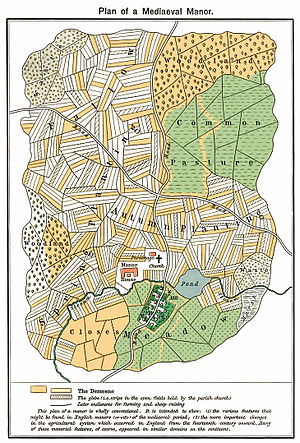
One of the reasons why manors divvied up land in strips as opposed to any other shape or configuration is they were trying to make sure that every family got a share of “bottomland” and upland, so that you didn’t have a situation in which some families couldn’t support themselves on their assigned plots. 

Well, the same issue applies when it comes to marriages: your neighbor’s land might not be of equal quality to your land, whether that’s because it doesn’t get as much water or the soil pH is off or it’s rocky or whatever. In that case, it’s better to marry into a famiy that’s non-contiguous but has high-productivity land. 

And the same principle goes all the way up the class scale, just on different issues: your neighbors’ manors might not bring in as much of an income as manors on better land somewhere else, and so on.