Why was the scattered land holdings system favored historically when the contiguous route seems much easier?

Well, it’s more efficient from a production standpoint – which is one reason why families did try to marry neighbors when possible – but it’s not necessarily easier. There’s no guarantee that neighbors will produce children at the right time and right gender sequencing for those marriages to take place, there’s always the tradeoff between marrying into a smaller neighboring landholding vs. a bigger landholding that’s not contiguous, and there’s neighbors on more than one side, and so on. 

image

However, I’d say the biggest issue is the variable quality of land.

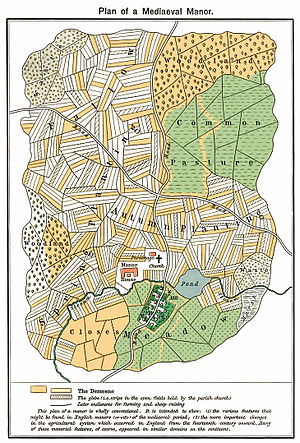
One of the reasons why manors divvied up land in strips as opposed to any other shape or configuration is they were trying to make sure that every family got a share of “bottomland” and upland, so that you didn’t have a situation in which some families couldn’t support themselves on their assigned plots. 

Well, the same issue applies when it comes to marriages: your neighbor’s land might not be of equal quality to your land, whether that’s because it doesn’t get as much water or the soil pH is off or it’s rocky or whatever. In that case, it’s better to marry into a famiy that’s non-contiguous but has high-productivity land. 

And the same principle goes all the way up the class scale, just on different issues: your neighbors’ manors might not bring in as much of an income as manors on better land somewhere else, and so on. 

Concerning the noveau riche and fashion; wouldn’t their status preclude good taste regardless of how “in fashion” or “fashion forward” they are? I can’t help but picture a merchant’s wife wearing the queen ‘s brand new style and the style being immediately declared out of fashion, the bourgeoisie making it bourgeois.

That can happen, but it’s more of a gradual thing:

“Anne the queen wears yellow, as she did when she first appeared at court, dancing in a masque: the year, 1521. Everyone remembers it, or they say they do: Boleyn’s second daughter with her bold dark eyes, her speed, her grace. The fashion for yellow had started among the wealthy in Basle; for a few months, if a draper could get hold of it, he could make a killing. And then suddenly it was everywhere, it sleeves and hose and even hair-bands for those who couldn’t afford more than a sliver. By the time of Anne’s debut it had slid down the scale abroad; in the domains of the Emperor, you’d see a woman in a brothel hoisting her fat dugs and tight-lacing her yellow bodice.” 

Hillary Mantel, Bring Up the Bodies

If the nouveau riche instantly devalued fashion, they wouldn’t be a social threat to the old aristocracy – the terrifying thing for the nobility was the way that they could blur the lines between noble and commoner, pass among the former while still being the latter, confusing what ought to be the most basic (and to people’s thinking, natural) visual distinction. 

But the ability of the nobility to fight back to declaring things out of fashion is that time and distance conspire against them: there’s no group DMs or Slack channels or (going prehistoric here) email listservs to coordinate these decisions – eventually, there will be women’s magazines and the like, but that comes along a bit later and has a bit of a problem of needing to sell to mass, and thus, common audiences – you have to write letters and for a lot of this kind of stuff you really need to get everyone together in person, and that can be difficult. (Versailles was such a help in that regard.) 

Because of this, there was this liminal space, whereby a sufficiently fashion-forward/culturally capitalled bourgeois could penetrate aristocratic spaces and snatch up titled husbands and wives before being detected, which is why it became such a major topic of literature. 

Hello, Do you know any “rules” about wealth that make a noble person seem cultured/refined/ect? What would be considered nouveau riche and garish? Things with jewelry, food, clothing, horses would be nice to know. I mean this in context of ASOIAF/medieval and not today’s standards. The Lannisters are ridiculously wealthy, but since they are an old money family would they make big displays of wealth like the Tyrells? The Tyrells seem to use their wealth to deal with people who covet Highgarden.

The tricky thing is that there were different fashions for this kind of thing that changed dramatically over the course of the Middle Ages, the Early Modern period, etc – especially when you factor in the complicating factor of commoners getting richer than nobles by getting their hands dirty “in trade,” which makes the dividing line harder to enforce. 

So for example, big displays of wealth could be very “on-brand” at various times, because nobles are supposed to be “magnificent.” This fashion obviously works in a context in which commoners either can’t afford to keep up with their betters, or aren’t legally allowed to due to sumptuary laws. At other times, understatement and the display of refined aesthetic might be considered the mark of true nobility – this fashion works in a context in which merchants, the rising bourgeoisie, etc. have tons of money but don’t have the social and cultural capital to know the “right” way to display it. 

In general, I would say that some good rules of thumb for refinement are:

  • Don’t Talk About the Price Tag: regardless of what the fashion is about the degree of opulence at the moment, one of the key attitudes of the nobility w/r/t money is that you don’t care how much stuff costs, because you’re supposed to be stupendously wealthy, generous and open-handed, and more concerned with refined aesthetics than commercial calculation. It’s not an accident that one of the oldest tropes about “nouveau riche” is that they constantly talk about how much various things cost, because they’ve still got that bottom line mentality going on.
  • Know the Fashion, Know the Scene: one of the advantages of being a wealthy parasite who doesn’t work for a living is that you have a lot of spare time to do things like keep up with what’s in fashion and what’s not, what the trends are, who the best craftsmen are, etc. Especially in an aristocratic context where what’s fashionable is less decided by manufacturers and specialized press and more about what important individuals (the monarch, the monarch’s immediate family, the monarch’s mistress/mister, various long-time fixtures at court) are wearing, a lot of this knowledge is very personal and having a grasp of it is a sign that you’re close to the right people. 
  • Making Fashion, Not Just Taking It: of course, one of the clearest signs of refinement is that the noble in question doesn’t merely follow the latest fashions but makes them, bending it to their personal aesthetic. To give an example, “Beau” Brummell was a leading aesthete of his day and, thanks to his close connections with the Prince of Wales and his own personal force of charisma, changed the dominant well-to-do men’s fashion of the day from the fop (powdered wigs anf faces, knee britches, stockings, and buckled shoes, tailcoat, lace cravats, etc.) to the dandy (hair worn naturally, clean face, long trousers, white linen cravats, frock or morning coats). 

If the king and his entourage came to stay with one of his vassals, would the vassal be expected to foot the bill or would the Crown pay some? What about one lord staying with another?

The king would absolutely not pay the bill. Indeed, half of the point of the king going on royal progress and crashing at his vassals’ houses was to gently bankrupt them so they didn’t have enough cash on hand to rebel against you.

I’m not familiar with sub-infeuded examples of the same process. I’m guessing it depends on the terms of the feudal contract, because some of them could be very specific about the responsibilities of the vassal to provide various services and goods when the liege lord came to visit:

Moreover I acknowledge that, as a recognition of the above fiefs, I and my successors ought to come to the said monastery, at our own expense, as often as a new abbot shall have been made, and there do homage and return to him the power over all the fiefs described above. And when the abbot shall mount his horse I and my heirs, viscounts of Carcassonne, and our successors ought to hold the stirrup for the honor of the dominion of St. Mary of Grasse; and to him and all who come with him, to as many as two hundred beasts, we should make the abbot’s purveyance in the borough of St. Michael of Carcassonne, the first time he enters Carcassonne, with the best fish and meat and with eggs and cheese, honorably according to his will, and pay the expense of shoeing of the horses, and for straw and fodder as the season shall require…

(Feudal Contract of Bernard Atton, Viscount of Carcassonne, 1110 CE)

So if there’s a similar clause as the one bolded above, then the vassal would be obligated to provide those services, but otherwise probably not. 

It seems like a lot of people, myself included, mix up medieval taxes with medieval rents as the source of the nobility’s wealth due to our modern conception of the private vs. public sphere whereas medieval forms of governance mix the two. Can you talk about how the intersection of the public vs. private spheres in medieval times differed from modern times? Was tax money nobles collected treated differently than the money they got from contractual rent?

Great question!

One of the reasons why libertarians have had a suspicious admiration for the Middle Ages is that feudalism turned what we think of today as the state/public sector (which is different from the public sphere b/c Habermas) into personal property rights.

In a feudal contract, the king gives taxation power, judicial authority, etc. over a geographically-defined area to an individual leasee, in return for that leasee providing a certain amount of military service. (Which in turn means that these leasees are also exercising significant amounts of military power, so there goes the monopoly on force.) And as I’ve discussed before, this grant changes over time from what we might call an outsourcing contract that can be reassigned to an inheritable estate, which makes it ever more propertyish than before. And when, over time, people are allowed to sub-lease parts of their grant to other people, it becomes more propertyish still.

This blurring of the public (taxation, military power, judicial authority) and the public goes all the way up the chain. For a long time, there wasn’t a clear distinction made between the king’s personal household and the state: we can see this from the fact that a lot of the offices of the privy council use the same names as offices on private estates, or from the fact that there wasn’t for a long time a clear separation between the personal income of the monarch and the revenue of the state (see for example the long bureaucratic struggle over whether the Office of the Wardrobe (which was supposed to pay for the king’s household but ended up paying for wars) or the Exchequer would be dominant in finance).  

This begins to change in the Early Modern period, where you see the emergence of professional bureaucracies who can more efficiently collect taxes, keep accounts of moneys received and spent, so that ever-growing armies can be outfitted, supplied, and paid promptly enough to keep them from deserting. (This is all very much a work in progress.) 

Not coincidentally, the growth of these large royal armies coincides with a period of struggle between monarchs and the nobility over the boundaries of the public and the private: whether the king’s courts could overrule local manorial courts, whether nobles could fight private wars, fortify manors without royal permission, keep more men under arms than their feudal service allowed, and whether royal tax collectors could directly extract revenue from their fiefdoms without the lords’ being able to intervene. 

To answer your second question, there was a distinction between various income streams: in addition to feudal rents, the use of monoplies on mills and the like were called banalities (great name, imo), chevage or chiefage was a poll-tax paid by villeins, income generated for lords from fines in local courts was called the third penny, the sales tax on livestock was called the toll tax, and then there were a large number of what were called feudal incidences (fees paid when a peasant got married, inherited land, or died, etc.). And to go back to the paragraph above, one of the reasons why so much conflict arose over judicial reforms was because the king was often muscling into revenue streams that the lords considered their personal property right as opposed to public finance. 

When did kings start allowing land to be bought and sold?

It’s a bit complicated. To quote myself:

In Medieval England, for example, the feudal principle of “Nulle terre sans seigneur” (no land without a lord) meant that selling land outright, known as “alienation of lands by will,” was actually legally impossible until the late 12th century. (The Magna Carta, for example, says that “No free man shall henceforth give or sell so much of his land as that out of the residue he may not sufficiently do to the lord of the fee the service which pertains to that fee.”) Selling land was legalized by the Statute of Quia Emptores in 1290, although the buyer was “required to assume all tax and feudal obligations of the original tenant,” so the land remained under the same lord as before. It wasn’t until the Tenures Abolition Act of 1660 that those feudal obligations were eliminated.

I think there are arguments you could make for either 1290 or 1660 as “when…kings start allowing land to be bought and sold,” although more accurately it was a gradual process, owing as much to decisions about enforcement and legal fights over whether feudal obligations once allowed to lapse could be invoked later on, that spans the two dates. 

Re: peasant land holding. What do you mean that the lord could give peasants land they hold personally within their manor. I thought the whole manor was the lord’s land personally already and peasants served their lord by working the land in exchange of protection

It’s kind of complicated, and it ultimately comes down to the relationship between land and labor forces. 

Unless you were literally a slave, and slaves did exist under feudalism although it had mostly died out by the 10-11th century, you didn’t spend 100% of your time working for the lord. Even the lowest serfs, villeins, cottagers, etc. only worked part of the week on lands held by the lord in demesne, and the rest of the time they would work on their own fields which they had been given a lease to as part of the feudal agreement. 

You can think of this arrangement as a balance of the needs of the landowner and the needs of the workforce: the lord couldn’t and wouldn’t farm their entire manor themselves, and didn’t need the whole of the manor to provide food for their household and personal servants. At the same time, the number of workers who would be needed to farm the whole manor have to be fed and clothed and housed somehow.

Trying to hold the whole of the manor yourself would mean that you’d need to maintain and manage a large workforce of either slaves or wage workers, which would require large up-front ouflays (slaves have to be bought and then fed and clothed and housed sufficiently to prevent them all dying, wage workers have to be paid enough to buy those things themselves) and a lot of management to ensure that people who had no personal stake in the output of their labor would work more than the bare minimum to avoid beatings or firings (respectively). 

And one of the things that the Middle Ages lacked was large amounts of capital and managerial capacity. It was much, much easier for a lord to lease out land to peasants who would then feed, clothe, and house themselves (thus freeing you from the cost of doing it yourself), then collect rent and taxes from them (without having to manage them yourself), while making sure you got enough free labor to do the work on the lands you kept for yourself. 

Medieval peasants and serfs could have differing size land holdings on the same manor. How did they acquire more land such that differences in holdings arose? Cultivate new land? Bribe the lord of the manor for a land grant?

Good question!

There’s a couple ways that that could happen:

  • Marrying the neighbors. Dynastic alliances and marriages based on landed dowries wasn’t just for the nobility; very frequently, peasants would seek strategic marriages for their children with their neighbors, which would allow the children to merge the two holdings into one larger farm with better economies of scale.
  • Cultivating new land…sort of. It’s not that you could just clear forested land or drain fenland by yourself and get a title on the land via homesteading, because that land probably existed within someone’s demense. More commonly, what you’d have happen is lords or churchmen looking to increase the profitability of their fiefdoms by paying people (often younger sons recruited from either nearby areas or foreign lands) to clear or drain the land in part by offering them tenures on the new land, with usually some sort of tax or rent holiday as additional incentives. 
  • Redistribution on failure of succession. While people of all social classes were incredibly defensive of their succession rights and would react badly to anyone trying to redistribute land that they felt was their inheritance, there were circumstances in which land tenures would become vacant. For example, if someone died without an heir or were convicted of a felony, under the law of escheat, the tenure reverted back to the lord and could be redistributed. If the heir could not pay their feudal relief (a one-time tax paid by the heir upon inheriting the tenure), the land would also revert back and could be redistributed. Etc.
  • Bribing the lord for a land grant. Depending on the size of the lord’s land vis-a-vis the local agricultural labor market, it might be in the interest of a lord to lease out some of the land they held personally, if for example they didn’t have enough serfs to perform the labor for free or there weren’t enough workers in the area to work for wages, relative to the size of the lord’s personal land. 

Feudal Manor asker, yes it was a broad question. I’ve found it hard to zero in on specific things with the word limit. What id like your take on is about as much about management and politics as about economic specifics. You mentioned the oppressive taxes/ evasion vicious spiral causing unrest and economic disruption. How would lord, or really any authority escape or mitigate this and create psychological landscape that would allow for long term development and prosperity. The variations of 1/2

2/2 this can pretty easily be seen in history where regions with many of the same qualities and resources either advance and grow in wealth and development or remain stagnant. You had touched on some of this in your regional development pieces, “In Dorne we all band together…”, something like that. I know its very vague and has to do with symbols and emotional stats and so on. Still seems important in relation to how states and so on grow or don’t. Thanks

Ultimately the management of feudal manors was a political process by which relations between lord and peasant were worked out, and it could be a very antagonistic or a more symbiotic one depending on the political skills of both sides (or even mediators like royal judges or local clergymen). 

While law and political culture gave lords the upper hand (although not entirely), pushing too hard and too fast would cause unrest and disruption, so a lot of aspects of noble culture were designed to give noblemen the skills necessary to manage their tenants and workforce without provoking resistance: adhering to noblesse oblige was a good way of gaining popular goodwill through symbolic displays of generosity (donating hand-me-downs to the poor, or conspiciously giving alms/tithing at church, etc.), being able to gracefully condescend to your lessers was important to ensure that social interactions between noble and peasant didn’t give rise to contempt or resentment.  

On the flip side, peasants had one important trump card that made up for some of their massive disadvantages when it came to legal, political, and sociocultural status: they were the only workforce around. Peasants could use various means of direct action to resist actions of their landlords: they could strike as workers by refusing to labor on the lord’s land, they could strike as tenants by withholding their rent payments, they could get violent (often by setting gathered crops or fixed improvements on fire, or breaking fences and other symbolic violations of noble prerogatives, or beating the crap out of the bailiffs and reeves or burning down the manorial court), or they could turn to the courts. There were quite a few cases where individual peasants and whole village would hire lawyers and sue their landlords, especially in cases where there was a dispute over whether tenants were free peasants or serfs

But on both sides, there were always important tensions between peace and profit, and between tradition and innovation. To quote myself for a second:

Almost by definition, the major source of income of a noble family is rent income from their lands, and rents were overwhelmingly set by custom and tradition. This meant that most nobles were living on something like a fixed income, which meant they were very vulnerable to changes in prices. Crop failures, rebellious peasants demanding wage increases, competition from foreign countries, all of these things could seriously negatively affect the bottom line.

This meant that attempts to raise rents could be resisted by peasants through the law, pointing to manorial rolls or copies of tenancy agreements (or even the memory of the oldest person around) as proof that their lord was violating their ancient rights. At the same time, there were also examples of lords who went looking for feudal taxes, privileges, or labor that had been previously waived (a strategy that lords could and often did use to decrease tensions), and insisting on enforcing their ancient rights. 

So, how do lords pursue economic development in that situation? Well, if one had the capital, one could invest in infrastructure: draining fenland or clearing forest would give the lord additional land that they could now settle with new tenants (and since these were legal blank slates, the lord wasn’t bound by the old terms of service), building mills or other processing industries would create new ways to extract income from one’s tenants and increasing the value-added of the good produced by the manor, investing in new farming techniques on the lord’s land (as opposed to the land that was leased to tenants) would increase the productivity of that land. 

In addition to techniques, the most historically significant change a lord could make would be to change what they grew. In the early modern period, with the advent of the commercial revolution, many English landlords shifted from growing traditional cereal crops to pasturing sheep to export their wool to the Netherlands, despite the massive disruption to agricultural labor markets. To quote from Utopia:

But yet this is not only the necessary cause of stealing. There is another, which, as I suppose, is proper and peculiar to you Englishmen alone. What is that, quoth the Cardinal? forsooth my lord (quoth I) your sheep that were wont to be so meek and tame, and so small eaters, now, as I hear say, be become so great devourers and so wild, that they eat up, and swallow down the very men themselves. They consume, destroy, and devour whole fields, houses, and cities. For look in what parts of the realm doth grow the finest and therefore dearest wool, there noblemen and gentlemen, yea and certain abbots, holy men no doubt, not contenting themselves with the yearly revenues and profits, that were wont to grow to their forefathers and predecessors of their lands, nor being content that they live in rest and pleasure nothing profiting, yea much annoying the weal public, leave no ground for tillage, they inclose all into pastures; they throw down houses; they pluck down towns, and leave nothing standing, but only the church to be made a sheep-house.

See, along with the shift to wool exports came a legal movement in the 16th century to enclose the formerly common lands of manors (one of those pesky traditional rights that peasants kept insisting upon) and turning them into the lord’s property. This was so hugely disruptive that it led to riots starting in the mid-16th century, but lords with a sturdy enough backbone and quiet enough conscience were able to bull ahead despite resistance from King, Parliament (from 1489 to 1639) and their own people, so lucrative were the profits. 
did feudal lords ever have to worry about farmers cheating their taxes by cutting grain with sawdust or padding sacks of oats with gravel to make it look like they paying more than they really were?

Yes! In fact, it was a major problem in estate management, and a lot of what the stewards, reeves, bailiffs, and other officials had to deal with was peasants cheating their taxes by misrepresenting the number and health of their livestock, or agricultural products like cheese. The problem was that, as they added more officials to oversee their peasants and prevent this kind of tax fraud, they opened themselves up to being embezzled by their household and estate staff, especially because there was something of a custom of staff taking various bribes, kickbacks, and small-scale theft as perks to make up for the relatively small fixed salaries that came with those positions. 

In addition to direct management, lords had two other means for capturing value from their peasants. The first was local monoplies: lords would invest in some improvements on their land, like a mill to turn grain into flour or a weir to encourage river travel or a bridge to encourage road traffic, and then they would require people to use them and/or pay for their usage. To take the example of a mill, if you had peasants who were trying to cheat their taxes by stuffing all of the chaff from their weight into the sacks they owed the lord, you could require them to take their grain to your mill, where not only you could charge them a fee for the use of your mill, but you could also fine them for adulterating their product. And if you were crooked, you could also cheat them by cutting their grain yourself (thus keeping more wheat for yourself) or fixing the scales so that they’d have to give you more to make weight. 

The other was the manorial courts: you use the law to extract every rent and privilege you can from your peasants, whether that’s extracting additional feudal labor that might have been allowed to lapse in the past but could now be enforced, or equally common, by turning up the enforcement on taxation, labor, and feudal privileges to eleven and extract additional income in fines where you can’t in rent

So you can see something of a back-and-forth process, where the nobles try to squeeze every last drop of wealth from their peasants, while the peasants try to cheat their overlord at every turn, and the balance of power depended a lot on organization, force of personality, and broader legal and political circumstances (this is a big part of why royal courts were so important in the centralization of monarchy). If managed incorrectly, you got tyranny and oppression, peasant rebellions and bloody repression. If managed correctly, you got economic development and growth.