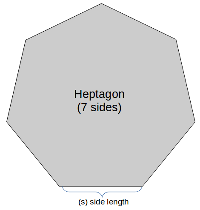
In a church that has seven sides, each of them significant, which God has to host the door to get in?

Good question!

image

My guess is that you probably have the three male gods on one side and the three female gods on the other, and the entryway is the Stranger (symbolizing the whole death and rebirth thing). 

In terms of ordering, I would guess that if the bottom side is the door/Stranger, and then going around the room on the right hand side, it probably goes Smith, Warrior, Father, Mother, Maiden, Crone. 

Thus, symbolically, the Smith and the Crone are in the back (because who cares about peasants and old women), the Warrior faces the Maiden he’s supposed to protect, and the Father and Mother are side-by-side.

How much land would the faith own?

It’s hard to say, because the historical context by which the Faith of the Seven came to Westeros is entirely different than the context by which the Catholic Church became hegemonic across Western Europe. A very quick example: there’s no Westerosi equivalent of the Donation of Pepin and thus no equivalent of the Papal States.

Notably the Faith seems to have relatively little political authority even where it has physical structures – the Hightowers rule the land on which the Starry Sept is located, and the Kings of Westeros rule the land on which the Great Sept of Baelor stands, but we can see this even on a more modest level. Despite the fact that Stoney Sept’s economy is probably based around it being a religious center, the septons don’t rule the town – rather, there’s a knight of Stoney Sept. This suggests that the Faith’s landholding hasn’t extended to lordship, which is an important point.

On the other hand, if we look at the septries we encounter in the series, they do have property, both real estate and otherwise: the Quiet Isle has “terraced fields, with fishponds down below and a windmill above…sheep grazing on the hillside,” and has orchards and vineyards besides; the sept where the Brotherhood Without Banners corners Septon Utt was quite large: “Before the war we were four-and-forty, and this was a prosperous place. We had a dozen milk cows and a bull, a hundred beehives, a vineyard and an apple arbor.” And given this is a feudal society, there has to be some sort of formalized relationship that underpins it – but whether that tenure is freehold or something else, we don’t know.

Finally, there is a cryptic comment in WOIAF that “many lords complained of unscrupulous septries and septons making free with the wealth and property of their neighbors and those they preached to,” prior to the Reconciliation of Jaehaerys. So it may well be that the Revolt of the Faithful and the Reconciliation severely curbed the position of the Faith compared to the medieval Catholic Church. 
As to why there’s no center of Faith in Vale that tried to compete with Starry Sept, maybe the Arryns & Graftons couldn’t ( or maybe wouldn’t) match the amount of money that the Hightowers & Gardners could sink into the Starry Sept ? Add to it the fact that Oldtown is far easily accessible & the routes doesn’t involve braving barbarian raids, masses must have increasingly turned to the Starry Sept as their Mecca ?

I understand why the Starry Sept would have become the center of the Faith eventually, but there was a period of 300 years when the Vale was all the Andals had, then came the conquest of the Riverlands, and the Andals didn’t come to the Reach until “generations had passed” since the conquest of the Riverlands. 

In that intervening period, you’re going to get a major center of faith in the Vale. There’s no way the Arryns aren’t going to use some of that Vale to raise up a Sept to glorify Ser Artys Arryn and his gods-ordained victory over the First Men, and by extension to emphasize their authority over the lesser Andal kings of the Riverlands. And with hundreds of years of pilgrimages and donations from guilty-conscienced knights and lords looking to buy their way into Heaven, that Sept is going to be very, very fancy and the Septon who runs it is unlikely to tug their forelock to some lackey of the Hightowers without a fight. 

How do you think the Faith of the Seven is institutionally organized across the Andalized kingdoms? Does the High Septon appoint ‘bishops’ to administer the Faith’s affairs in each region? Could the Most Devout actually just be these bishops in conclave? Do you imagine local rulers exercising a Gallican veto over appointments to ensure local religious authorities support secular power?

These are excellent questions! 

So the Most Devout are a council (or conclave) of the highest ranking Septons. How they are chosen is unclear – so it could be the High Septon appointing, or it could be a more presbyterian system. 

Now, historically, the Most Devout chose the High Septon from among their ranks, although that’s not a necessity. After Jaehaerys’ peace with the Church, the Crown claimed the right to name the High Septon, although this seems to have been carried out by the King nominating a candidate who would always be elected no matter what. 

I find the pre-Targaryen period a fascinating mystery – I can’t imagine the rulers of Dorne or the Stormlands or the Westerlands or the Riverlands being particularly happy with the idea that the head of the Faith is so intimitately connected with House Hightower, even if that doesn’t always mean connected with House Gardener. So I would imagine there would have to be a fairly Galician system, and some very Renaissance lobbying during the choosing of new High Septons. 

Why do you think that destroying the Sept of Baelor would be worse than the Red Wedding? What would the consequences of destroying the Sept in Westeros?

Because for anyone who believes in the Seven, and indeed the majority of Westerosi do, the Great Sept of Baelor has been the center of the Faith for ~150 years. It’s associated with the closest thing the Faith has to a saint, Baelor the Blessed, who is known to the smallfolk as Baelor the Beloved. 

The Red Wedding is an attack on men, albeit one that violates the laws of both gods and men. The destruction of the Great Sept would be an attack on the gods themselves, the most impious action imaginable. And everyone inside is going to be a holy martyr.

As for the consequences, I think they’d be absolutely lethal to the legitimacy of the regime. You’re probably going to see a new revolt of the Faithful, as all of the Poor Fellows and Warrior’s Sons who survive the explosion (and keep in mind, there’s a lot of them out in the Riverlands atm) rise up, probably spearheaded by Bonifer Hasty’s Holy Hundred in command of Harrenhal. And you’ll likely see substantial defections to any alternative monarch. 

Why does Randyll Tarly mete out a far more severe punishment to a thief for “stealing from the seven” one moment, and then disparage the authority of the Seven’s emissary, the High Sparrow, as the “twitterings of sparrows” the next? Is he merely towing the Tyrell line?

At bedrock, Randyll Tarly is a fundamentalist when it comes to the very specific worldview of the military aristocrat, and everything else subordinates to that. Hence why he would brutally execute a kinslayer, but still threatens to murder his own son because he thinks he’ll be a weak lord. 

So Tarly is definitely a follower of the Seven – the Smith is at the bottom, the Warrior on top of him, in obedience to the Father, and the rest handle women’s matters and death – but he’s not particularly pious, because that’s what septons and women are supposed to do while he’s busy chopping people’s heads off. 

When he looks at the High Sparrow, he sees an up-jumped commoner who took the title by force from men from the right class, who’s overturned hundreds of years of tradition and royal authority in assuming powers that rightfully belong only the King, and who’s encouraging rebellion and the disruption of the feudal system. So he’d happily cut the man’s head off, make the next High Sparrow absolve him of the sin, wash his hands, and consider himself entirely in the right. 

Dear maester Steven, in the past you’ve talked about creating new Great Septs in Westeros, but do you have any architectural designs in my mind for these that contrast the white and black marble septs in King’s Landing and Oldtown? For example, what would you think of a Sept that is seven septs in one (similar to how Saint Basil’s cathedral is eight churches in one)?

Well, I think @joannalannister and others have correctly called it that there would be a Golden Sept in Lannisport. (I’m imagining the walls and ceiling in gold mosiacs like St Marco’s in Venice with tons of candles to make the whole thing but larger-than-life grandiose statues in full-blown Baroque style, like Bernini but in gilded bronze) 

The Vale’s Sept would probably be called the First Sept or something like that to emphasize their love of tradition and ancestry – given the Vale’s marble industry, the whole things going to be in gleaming white marble and quite grand but austere, with the main feature being huge statues of each of the seven in different colored marble. I’m also guessing that because of when the whole thing would have been built, the Warrior and the Father would be most prominent. 

Similarly, I’d guess that the Stormland’s Sept would be made all in glorious, gleaming polished hardwoods and have beautifully carved wooden statues of the gods. I’m guessing the Smith is probably depicted as a woodcarver or lumberjack. So maybe looking  like Russian Orthodox Churches made of wooden with onion domes and the like? 

Dorne’s Sept would have to be rather unusual, given the ways that their Rhoynish culture clashes with the Faith’s normal attitudes about gender roles, sexuality, and so on and so forth. So I’m guessing hardcore Marianism, but with more of a focus on fertility and sexuality, and also a bunch of former Rhoynish gods reinterpreted as saints and the like. Basically I think of some of the more colorful Hindu temples.