What type of armour and weapons do the Dornish calvary, knights and master of arms use. I reckon since Dorne is largely desert and very hot, their main use of defence would be mail and plate armour which would allow them move freely in the desert. Much like the mamluks of Egypt and Iran. Swords would most likely be the sabre, giving them more distinct culture. From my understanding the sabre was on common in Eastern Europe then Western Europe. Making them very culturally distinct from rest.

This might be a better question for @warsofasoiaf, but I’ll try my best.

As far as swords go, we don’t have any mentions of sabres or curved swords in relation to Dorne. Curved swords do tend to be associated with Essos, so it’s possible that the Rhoynish brought that tradition to Dorne, but there’s no textual evidence for that. Where Dornish swords have been discussed – Dawn, for example – they’ve tended to be described in similar terms to the straight-bladed swords of the rest of Westeors.

The dominant weapon of Dorne is the spear, but there are a couple different variations:

  • Oberyn uses the long spear – “the spear was turned ash eight feet long, the shaft smooth, thick, and heavy. The last two feet of that was steel, a slender leaf-shaped spearhead narrowing to a wicked spike” – as a two-handed slashing and stabbing weapon. This seems to be a rather unusual way of fighting – probably associated with one-on-one combats – because we don’t see much in the way of Dornish fighting as pikemen.
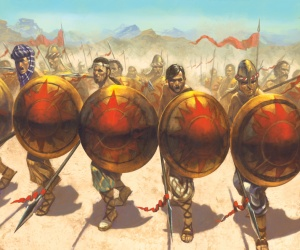
  • More commonly, the long spear is used in the Rhoynish fashion – “the Rhoynish warrior with his silver-scaled armor, fish-head helm, tall spear, and turtle-shell shield was esteemed and feared by all who faced in him battle” – one-handed with a round shield in close-formation, closer to the classical phalanx than the Macedonian.
image
  • However, there’s also lighter throwing spears – “the canny Dornishmen rained rocks and arrows and spears from the heights;” “many carried bundles short throwing spears” – which are used as javelins by both infantry and cavalry alike. 

There are some other weapons which are also worthy of mention:

  • The Dornish are known for their recurve bows – “when the Dornishmen saw them coming, they spurred their own mounts, banners rippling as they rode…the double-curved Dornish bows they used so well from horseback” – which are used by infantry and cavalry alike.
  • As we can see from Dornish participation in various tourneys, we know that Dornish noblemen are also trained in the lance like the rest of their Westerosi peers. 

In terms of armor, we have a couple different types used:

  • The Rhoynish smiths were especially adept at creating “suits of scale and plate.” So both heavier and lighter armors are available.
  • Oberyn prefers to wear lighter scale armor (“his shirt was armored with overlapping rows of copper disks that glittered like a thousand bright new pennies as he rode. His high gilded helm displayed a copper sun on its brow, and the round shield slung behind him bore the sun-and-spear of House Martell on its polished metal surface.”) in combination with some plate pieces (”The Red Viper was lightly armored; greaves, vambraces, gorget, spaulder, steel codpiece. Elsewise Oberyn was clad in supple leather and flowing silks. Over his byrnie he wore his scales of gleaming copper, but mail and scale together would not give him a quarter the protection of Gregor’s heavy plate”) to maximize his mobility.
  • Common Dornish soldiers are also known to wear “ring mail and crested helms.”
Hi !! Great work with politics of Seven kingdoms. I have a question on the dornish question : What is the role of dorne in the Great game ? In the essays i have not found this section

Thanks!

The role of Dorne in the Great Game was twofold:

  1. to act as a check on the Reach and the Stormlands – neither could “win” by permanently absorbing one of their neighbors because every time they focused their efforts in that direction, Dorne would hit them with raids that would either force them to pull back to keep what they had or weaken them to the point where they would be become too weak to hold on to what they’d grabbed. 
  2. to act as a scavenger in times of weakness – hence invading the Reach during the reign of Garth X or attacking the Stormlands repeatedly when the Stormlands are on their way down – although this isn’t unique to Dorne.

Politics of the Seven Kingdoms: Dorne (Part III)

image

credit to ser Other-in-law Politics of Dorne Part III With the arrival of Aegon I Targaryen to the Westerosi mainland, we get the most detailed section of Dornish history, with extensive coverage both in the Dorne chapter and the various chapters of the roll of Targaryen monarchs and their foreign policy towards the only foreign kingdom on their content. All the same there are some frustrating…

View On WordPress

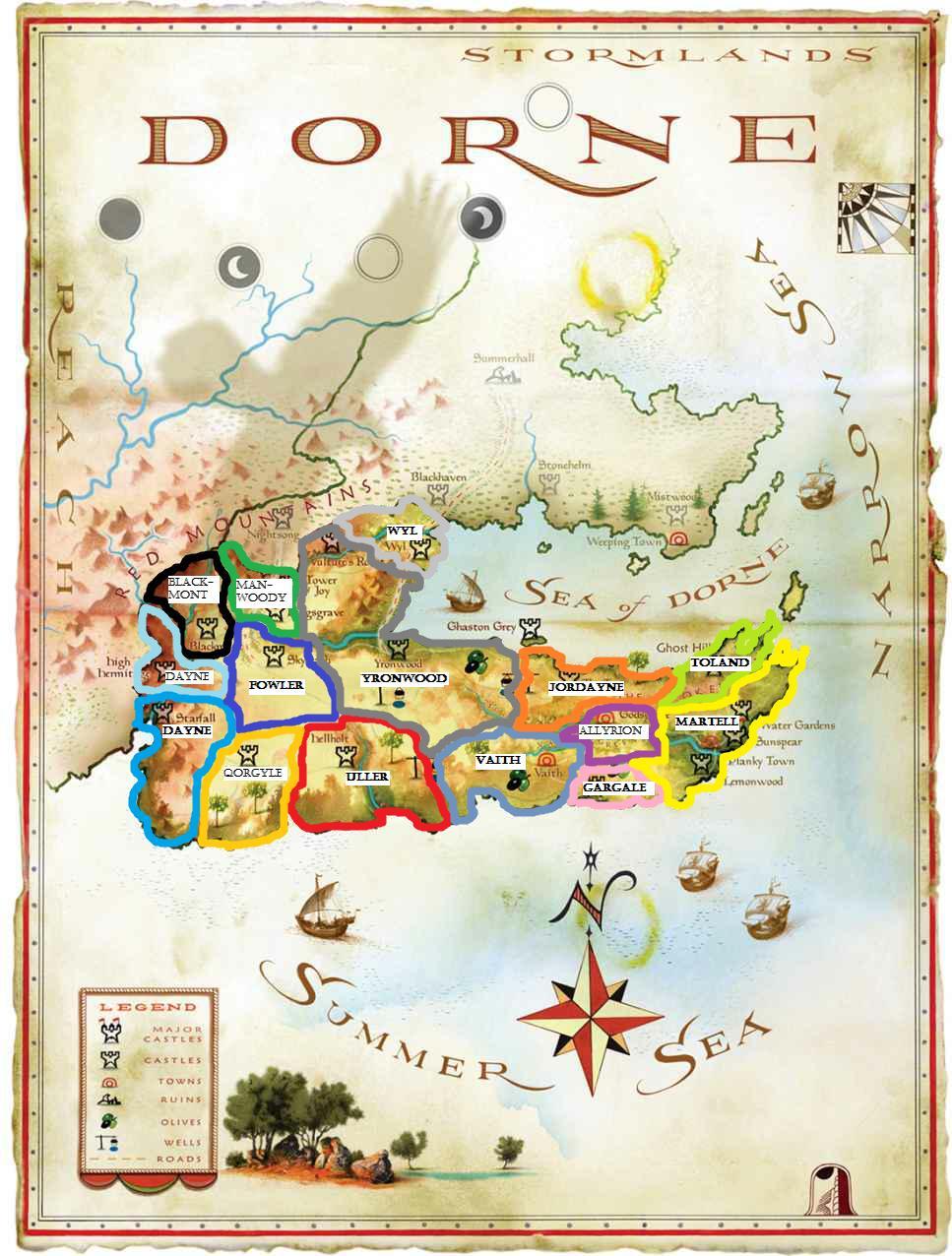
Different anon jumping off of the last Dornish ask: Would a less ambitious ‘conquer Dorne’ plan that just seeks to annex the Red Mountains (since that seems to be where most of the raiding comes from) have a good chance of success? If so, why do you think no Storm King or Reach King (especially pre-united Dorne) ever tried it, or if the tried it it didn’t work?

I think a less ambitious strategy would definitely increase the odds of success – it prevents over-extension, allows you to concentrate your forces in a more defensible location and keeps your supply lines much shorter and less vulnerable to attack, and means you can avoid the hazards of the open deserts.

I do think it has been tried in the past, but the reason why it hasn’t worked very well is that they weren’t able to divide the enemy against itself. The Yronwoods aren’t about to ally with the Dondarrions, because after thousands of years of war between the two Houses, they’re not going to trust one another. Likewise, I would imagine there’s a lot of bad blood between the Gardeners and the Daynes and Fowlers. 

Politics of the Seven Kingdoms: Dorne (Part II)

Politics of the Seven Kingdoms: Dorne (Part II)

image
credit to Sir Other-in-Law If in Part I, there was a crippling lack of information about the history of Dorne, with the arrival of Nymeria and the Rhoynar we go from drought to flood. While I would argue that the full story of Nymeria’s odyssey to Dorne is one of the best additions to WOIAF, providing a great and sweeping drama of storms, pirates, haunted lost cities, plagues, and finally a safe…

View On WordPress

Politics of the Seven Kingdoms: Dorne (Part I)

Politics of the Seven Kingdoms: Dorne (Part I)

image
Introduction: The Dorne chapter of World of Ice and Fire is one I feel profoundly ambivalent about. On the one hand, of all of the kingdoms chapters it provides the most vivid portrait of a people, which does go to some lengths to giving Dornish culture more depth and variety. On the other hand, it is the least historical of any of the chapters, providing only a few snapshots of the very recent…

View On WordPress

Since Sylvana Sand was supposed to have inspired Gaemon Palehair’s edicts, do you think that in Dorne wounded veterans are supported by their Lords ? Would such a practice have been viable & implementable in the medieval times ? Any precedents for such moves in our world?

That seems to be the case, according to the WOIAF:

“An example of the differing Dornish laws and attitudes due to the influence of the Rhoynar may be found, curiously, in the last days of the Dance of the Dragons. From Archmaester Gyldayn’s history concerning Gaemon Palehair’s brief reign.”

So it probably is the case that Dornish veterans have to be supported by their lords, or that “the poor be given bread and beer in times of famine,” since we definitely know that in Dorne it’s definitely the case that “girls [are] equal with boys in matter of inheritance.”

Now, specifically on the point about veterans and real-world medieval practice…it’s hard to say, and it depends on how systemic a practice we’re talking about, and how many veterans survive their wounds vis-a-vis the capacity of the state. It’s certainly true that the medieval Catholic Church ran huge networks of hospitals that were as much about providing people with food and shelter as any form of medical care. And sometimes, you did have monarchs who would go out of their way to care for their veterans – after the failure of the Spanish Armada, for example, Phillip II provided medical care to the 10,000 survivors in attempt to expiate God’s wrath. On the other hand, Elizabeth’s government coldly refused to care for the sailors who had helped to save England purely for financial reasons. 

On your Dornish economic plan, how long would it take to pull the Torrentine into that valley and make it fertile? One generation, two? Your plans are great but can be undercut by having stupid kids (Quellon, Viserys II, etc) seeing the desert bloom and a forest of acacia rising up agaist the red sands has a dramatic effect.

At least a generation, and likely more than one, although it’s likely an iterative process where you’re gradually diverting more and more water and pushing it out further and further, so it’s not like you only receive the benefits at the end of the process. 

But yes, that’s always a danger with elite-directed reform, especially in systems where political power is inherited. Unlike more broad-based systems, where you have institutions that can provide continuity of policy far longer than the span of a human life, you get these sudden and often wrenching changes when there’s a change in personnel (as it were). 

Concerning Dorne’s Export Commodities: What’s the deal with Sandsilk? Why are they the only westerosi nation in the silk fabric sector? They obviously don’t grow the raw silk themselves, meaning they have to import it from the east. This puts them in competition with the 3 Daughters, yet we never hear of the Dornish being pulled into their endless trade wars. Could you please give your thoughts on the matter? Thank you.

Why do you assume the Dornish don’t produce their own silk? If mulberry can grow in India, South Africa, Iran, etc. it can probably grow in Dorne. Given that Dornish silk techniques are distinctive enough to be recognized on sight – “painted, not sewn. The Dornish paint their silks, I’ve heard” – and have their own distinct name, I’d lean towards them producing it. 

So I don’t think they’re competitors with the Free Cities, I think they’re business partners. Dorne sells wine, peppers, citrus fruit, and sand-silk and they buy dyes, spices, textiles, etc. from the Free Cities. 

As to why the Dornish are the only Westerosi who have a silk industry, my guess would be that, as silk is otherwise found in Essos (it can be bought in Qarth but given the city’s commercial focus is likely a middleman, it’s manufactured in Naath, and given that the Silk Road is one of the roads that connect western Essos with Yi Ti is likely also manufactured there), it was brought over by those Rhoynar artisans we hear of from Nymeria’s Conquest.