Due to a combination of listening to some of @jewishdragon‘s sea shanties and reading Xanathar’s, I decided to build myself a pirate by combining the Bard College of Swords (swordplay and shanties for my spellcasting focus, natch) and the Rogue Swashbuckler Archtype, and of course Sailor Background.
I’m liking how this looks: I’ve got some really fun combat potential with Booming Blade, Blade Flourish, Fancy Footwork, and Rakish Audacity, I’e got Vicious Mockery for the Curse of Monkey Island style points, Expertise in Acrobatics and Stealth for whether I want to be flashy or sneaky, and the classic Bard spells.
The only thing remaining is picking my character’s race, and Tiefling just fits too well…
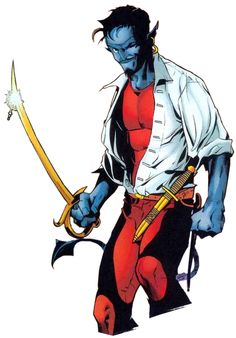
At which point I realize that I’ve basically reverse engineered Nightcrawler.
Now all I need to do is get a DM to agree to let me use Misty Step as one of my Tiefling Infernal Legacy spells and I’m set.
impress your friends with your pronunciation of unfamiliar Welsh phonemes
it’s your campaign, so you can retcon druids as having never been exterminated by the Romans because they had magic
druids and bards are not just character classes but actual social roles
many good opportunities for NPCs to say “What have the Romans ever done for us?” and “Strange women lying in ponds distributing swords is no basis for a system of government!”
no need to come up with your own map; Google has you covered
Cons
horrify Welsh people with your extremely bad pronunciation of common Welsh phonemes
extremely sparse contemporary literary sources for the period; what little we have is problematic in its reliability
the druid class in Dungeons & Dragons is laden with two or three centuries of ahistorical baggage
NOT ACCORDING TO GEOFFREY OF MONMOUTH, WHOSE HISTORIA REGUM BRITANNIAE HAS ARTHUR FIGHTING IN GAUL AND PREPARING TO MARCH ON ROME ITSELF, ONLY TO BE DISTRACTED AT THE LAST MINUTE BY HIS USURPATION BY MODREDUS (BETTER KNOWN TODAY AS MORDRED).
oh well if we’re listening to monmouth then anything goes
Hey, he’s still better than T.H White, whose Arthur is not just post-Roman, but post-Norman.
If you’re looking for good sourcebooks for such a campaign, TSR put out some historical sourcebooks for AD&D 2nd Edition (reading them as a kid helped to start me down to the road to a history PhD, so watch out, you might get hooked).
The Celts sourcebook has some more “grounded” Druid and Bard classes, and there’s some useful stuff for the sub-Roman period that you can cobble together between the Vikings sourcebook, the Rome sourcebook, and the Charlesmagne sourcebook.
Yes, I’ve DMed D&D before, although I’ve spent much more of my tabletop RPG career as a player character than as a DM. So the advice I’m about to give is the same advice I’m looking for as I prepare for the next campaign I’m running, and the advice I wished I’d had when I DMed my first game having not done any of this and struggled like hell as a result:
Look for Resources Online: unlike when I started playing D&D in the early 90s, there are a lot of really good free resources available on the web to guide novice players. A quick google search for “DM advice” pulls up resources from Wizards of the Coast themselves, gaming news sites like Kotaku or the Escapist, blogs and podcasts, forum threads, youtube videos, etc.
Learn To Manage Information: one of the hardest things a DM has to do is manage information, especially in combat. Every DM struggles with keeping track of initiative order (just saw a cool thing the other day where someone used clothespins labelled with the PC’s names and “Monster #X” or “NPC #Y” etc. arranged in order and then rotated 90 degrees to indicate who’s turn it is), so find a system that works for you. Ditto with monster and NPC vital statistics like HP and AC, Saving Throws and Attack modifiers, spells, etc.
Learn to Manage Your Players: another difficult thing is how to manage your players, finding that middle path between railroading and total chaos, moderating personality conflicts, making sure that people aren’t talking over each other or invalidating one another’s actions, making sure everyone’s engaged and happy. I strongly recommend bringing character creation together with campaign creation, so that players feel involved in the story and their characters mesh well with the setting, and so that you can figure out ways to incorporate your player character’s backstories and character drives with the campaign. This will save a lot of headaches later.
Learn to Tell a Story.You can do everything I’ve discussed above and not make it further than being a merely workmanlike DM if you don’t spent an equal amount of time thinking about how to tell stories. Tabletop RPGs are an exercise in collaborative storytelling, where the DM has the lion’s share of the work bringing the world to live by describing the environment, voicing all of the non-player characters, and arbitering the results of the players’ actions. The key thing is that the DM’s job isn’t to “win” the game by defeating the players, but rather to get the players to feel emotionally engaged in what’s going on in the game, and everything else is secondary to that. Presenting a challenge is only important enough in so far as it makes the players feel a rush of accomplishment when they win. Likewise, the effort that you put into plotting intricate mysteries or showy setpieces is only important to the extent that it makes the players feel emotionally engaged in the world you’ve built. Hence why I suggested above incorporating your player characters’ backstories and character drives into your campaign – treat them as levers for emotional engagement that you can flip to make a story beat “land.”
But the number one piece of advice I can give:
RUN A PUBLISHED ADVENTURE AND/OR MODULE FIRST. There are almost 50 years worth of published adventures out there, and a lot of the classic ones have been adapted for whatever edition you’re using. These published adventures are the perfect set of training wheels and/or safety nets for a first-time DM, because someone’s already done the heavy lifting of writing out the descriptions of all the characters and environments, of working out all the combat encounters and traps and puzzles and putting all the of the stats in front of you in one place.
Running one of these adventures means that you can gain the experience you need without having to sweat the details as much, allowing you to focus your limited time/attention on the harder aspects of managing information flow, player group psychology, and storytelling. Once you’ve got that under your belt, you can start improvising on top of the foundations of the written materials, and applying the lessons learned to your own ideas.
Remember, even Griffin McElroy started out The Adventure Zone with a straightforward run of “Lost Mines of Phandelver,” the adventure that comes with the Starter Set for D&D 5th edition….
Didn’t realize you could go onto Heroforge and model your character online.
“With a stellar Persuasion check, Tomas carefully explains that he was attempting a non-lethal takedown of the guard, while at the same time using a superb Deception check to explain that the padlock on the cellar door was unlocked when we got there.”
Canonically, though, Tomas Rhymer can’t lie.
I don’t know what you mean, “Honest Tomas” has never told a lie.
EDIT: Technically speaking, when we got there, the padlock was un-locked (as in, made to no longer be locked).
I feel like Tyrion is a Charisma/Int Mastermind Rogue.
Sam’s a Bard who might be mutliclassing into Wizard if Marwyn’s accepting students.
Cersei, Catelyn, Sansa are Aristocrats from 3.X I guess?
Arianne might be a Bard from the College of Whispers, or maybe a Charisma/Int Mastermind Rogue, but she’s underleveled.
Asha is a Swashbuckler Rogue with Sailor Background.
Jaime is a Fighter who’s having to respec from Battlemaster into a more Warlord style.
Barristan Selmy is a Paladin.
Aerys Oakheart is a Paladin who broke his Oath.
Areo Hotah is a Protection Greataxe Battlemaster Fighter.
Aeron Damphair thinks he’s a Cleric, but he’s actually a Prophet Priest Kit from AD&D 2nd edition whose Wisdom is too low to cast spells.
Victarion is a Champion Fighter with a Sailor Background who super min-maxed for combat, so Wis, Int, and Cha are all dump-stats.
Missed a few, b/c there are a lot of POV characters:
Ned Stark is a Fighter/Aristocrat.
Davos is a Thief Rogue with a Sailor Background.
Brienne of Tarth is a Battlemaster Fighter verging on Paladin.
Theon Greyjoy is a Dex-Based Archery Fighter who thinks he has a Sailor Background but really has a Noble Background, also thinks he has higher Cha or Int than he really does.
Incidentally, would people be interested in hearing about the adventures of “Honest Tomas” Rhymer, purveyor of arcane antiquities and in no way a rogue/warlock on the run from the Archfey?
Well, people asked, so here it is:
I know I said I’d be heading back to real policyblogging soon (and I have a blog post on health care stuff handwritten, I just need to type it up), but since everything’s horrible and the world’s on fire, I thought it would be nice to do something fun for a change.
As you may remember, a while back I put up a series of “GM-Blogging” posts chronicling my time running “Masks of Nyarlathotep.” Unfortunately, due to circumstances beyond my control, that game went on hiatus.
Fortunately for fans of reading about roleplaying sessions, one of the members of my original group decided that they would like to try running a game as DM. So we’ve moved over from Call of Cthulhu to the new Dungeons & Dragons 5th Edition for an urban investigation-focused game set in a Fantasy version of San Francisco (complete with an overbearing Magitech sector and skyrocketing inequality). Our party consists of:
“Honest Tomas” Rhymer (played by yours truly), a half-elf rogue/Fey pact warlock. Inspired by Moist von Lipwig from Terry Pratchett’s Discworld series, he’s a mostly pacifist con artist who got on the wrong side of a powerful Archfey, the Duchess of the Dark Side of the Moon. As a result, his soul has been hidden somewhere in the world and he has a year and a day to get it back (before unspecified bad things happen to him)…but to make things interesting, he’s been unwillingly declared the Duchess’ judicial champion, so that any spats she gets into with her fellow powerful supernatural beings means he gets unexpectedly attacked by horrible monsters to settle the dispute and is suddenly finding himself possessed of strange magics to help him win these fights. If he wins the fight, the Duchess sometimes sends him a clue as to where his soul might be…
Telfer, the Fantasy Catholic Cleric who’s also a closeted Sorcerer who can’t help his obsession with Wild Magic no matter how much the Church condemns it. Currently on “sabbatical” from the Church for undisclosed reasons, brought into the group by Tomas, who’s suddenly very interested in the subject of his immortal soul. While his god may be sending him visions that his sabbatical quest is to save Tomas’ soul in the non-metaphysical sense, his obsession with forbidden (i.e, Wild Magic and Warlock Pact Magic) sorcery is also growing. Which will win out?
Sarah One-Horn, Tiefling Bard/Warlock and Rock Goddess. Sold her soul to the original party fiend Rockus in exchange for the Power of Rock, which she shows off every other knight at the Rancid Goat. Something of a local celebrity as a result of her hit single “Orkf*cker,” which has proven to be something of a crossover hit between the goth crowd, the preppies, and the orks who are hoping the lyrics aren’t metaphorical or ironic in any way. Helping Tomas come to terms with his new lifestyle change, and trading tips on how to sneak successfully and use a rapier effectively for Hexing lessons.
Lysander, Lawful Good Paladin working with the City Watch…Arts and Antiquities Division. Essentially Simon Pegg’s character from Hot Fuzz, Lysander is one of the few honest elves in the Braxtonshire City Watch and surprisingly avoids Lawful Stupidity through bringing in CIs/Consultants/Deputized Watchmen like the three idiots above, who he met through Tomas in Tomas’ guise as a mostly-honest merchant of arcane antiquities. Undergoing rapid promotion due to a series of successful cases which all get solved in a 24 hour period, despite a shocking amount of property damage although surprisingly few casualties.
Come join us, won’t you?
Our first session begins with Tomas having 363 Days Left to find his soul. He’s currently hanging out at the Rancid Goat, trying to simultaneously pump Telfer for information about Sukkoth (the Lawful God of mending and order)’s views on the immortal soul while trying to get some information from Sarah about how this whole warlocking business works. Sarah, fresh off a kickass set that ended with a command performance of “Orkf*cker,” begins to think that there might be something up with this half-elf.
As we’re all at the table, Telfer is bullied by three classmates from Cleric Academy, Chad, Brad, and Thad. While Lysander successfully intimidates the bigoted preppy clerics into going to the bar, Tomas’ decides to screw with them a little and cheerfully introduces himself to Chad with the old two-handed shake (despite Chad’s ineffectual bigotry) and relieves the cleric of his gold and his class ring in the process. (Nat 20!) Tomas orders a fresh round for the table with Chad’s money and this time they can afford the top shelf stuff.
Perhaps in some sort of Karmic retribution, it is at this point that Tomas’ Bond activates, and he’s suddenly faced with a judicial duel as a small gnome in bamboo armor comes up to him and introduces himself as the Judicial Champion of the 666th Viceroy of the Para-Elemental Plane of Birdshit, and then tries to stab Tomas to death with knitting needles. Tomas instinctively blasts him into unconsciousness, suddenly learning that he can cast Eldritch Blast, and the bouncer carts the gnome away. As that’s happening, though, Tomas suddenly experiences a vision from his Patroness and gets a Clue that his soul is…not floating in water. (DM’s are about as inscrutable as Fey, in my experience. Previously, Tomas has received a Clue that his soul is in a wooden jewelry box/phylactery with an unknown symbol on the clasp, and knows that the phylactery will open for me if I find it. Where that box is, is anyone’s guess.)
Meanwhile Lysander is approached by a half-orc City Watch sergeant, O’Shag Hennessey. She reassigns him from Arts and Antiquities to Narcotics, tasking him with a mission of tracking down the mysterious “Hangtooth,” a drug dealer who’s been selling magical drugs to the Halfling community, without dropping any bodies – this point is emphasized quite strongly. Which means the rest of us are now Deputized Watchmen, although at least we get paid.
The next day, the group heads out to the Halfling Quarter (aka Tinytown), which is a Deadwoodesque shantytown out in the suburbs of the city, where we quickly realize that a party consisting of a half-elf (Tomas), an elf (Lysander), a human (Telfer), and a Tiefling (Sarah) rather stand out in a crossroads market where the median height for adults is about 3’0”.
We persevere, however: Tomas takes a spin around the whiskey tents and is pointed in the direction of a local crack house, Sarah is busking and finding that there’s a bit of cultural miscommunication between the more folk-loving halflings and her heavy metal stylings, and Telfer fruitlessly looks for books on forbidden magic and ends up noticing addicts going into a local crack house. (Telfer’s player took a Feat that gives him a bonus to Perception checks and makes it impossible for him to be Surprised.)
Tomas sneaks up to the crack house and overhears the password, but Lysander makes the call instead that we’ll go in through the basement. Sarah conjures up some illusionary barrels to help the rest of the party pass their Stealth checks as I crack the lock and we all sneak down into the basement. Unfortunately the barrels couldn’t help Sarah’s Stealth check once inside the basement, who knocks over a jar with her tail and starts a small fire, which alerts the half-orc guard who drops the folding stairs down into the basement to see what’s going on.
At this point, we go into combat for the first time. While Lysander and Tomas hide behind the folding stairs, trying to respectively handcuff and Charm into surrendering the guard, Sarah unsuccessfully tries to use Tasha’s Hideous Laughter. Telfer, being a bit of a high-strung naïve person, racially profiles the half-orc in the midst of a Wild Magic surge and ends up critting on a Fire Bolt, which burns a hole through the half-orc (there’s the first body) and the side of the house, setting it on fire.
In the ensuing chaos, Lysander heroically tries to put out the fire while Tomas books it out of the basement to watch from a safe distance. Sarah more pragmatically robs the corpse, finding a vial (of what turns out later to be Fantasy HGH) stamped with Hangtooth’s logo, then steps out of the crackhouse to play some bardic music in the hopes of distracting the crowd, but really because a burning building makes for a hell of a set dressing. Wracked with guilt, Telfer summons water to put out the fire and begins to reckon with the fact that he’s just killed someone for the first time. Meanwhile, safely hidden in the market square, Tomas examines the bottles he stole from the basement.
The Halfling crowd, having been lulled by Sarah’s music into not rioting over a Season 1 Episode 2 of the Wire-esque poorly conceived police raid gone horribly wrong, begins to disperse and Tomas rejoins the group. As we gather around the smouldering remains of this shack, we are approached by a Halfling teenager, Checkum Threenuts, who offers information on Hangtooth if we help him trash his parent’s house (which has an alarm system, he notes) to cover up the fact that he totaled his pony while suffering from affluenza.
The group now decides on what our plan of action will be: Lysander insists that we need to stay at the basement until a wagon from the City Watch arrives to cart away the drugs, so that we can at least present dope on the table to explain why there’s a dead half-orc in a burned-out crack house (actually, it turns out that the throw rugs and other accoutrements means that this is really more of a crack home). Tomas and Sarah are down with the idea of robbing the kid’s house in exchange for information on Hangtooth, especially since there’s probably more info somewhere in that house. The decision is made that we’ll send Checkum to the local City Watch station with a message to send a wagon, while Lysander guards the crime scene, and the Rogue and the Bard case the Threenuts household.



 RFTIT Tumblr Backup