Hey Dany during her wedding that that if Daario had loved her he would have taken her at sword point like Rhaegar took Lyanna. That implies that she does believe that Rhaegar kidnapped Lyanna rather than running off with her but she still seems to have a high opinion of her brother that doesn’t seem to me can you explain it?

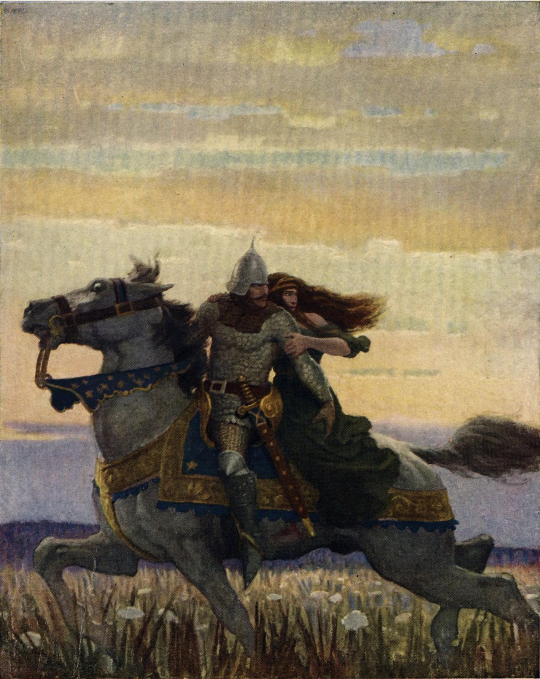
Well, this has to do with the idea of abduction as a trope in chivalric romance. In these stories, there really wasn’t a big difference between “running off with her” and “kidnapping.” Whether it’s Lancelot and Guinevere or Tristan and Iseult of chivalric romances, or the earlier Celtic sources whether Welsh or Irish (there’s a very similar story that’s part of the legend of Finn Mac Cool), the lady is married and is carried off by the knight against the wishes of her husband (hence why it’s called abduction/kidnapping and not elopment). 

Moreover, in a lot of these stories, there are very weird parallels between the very-much-married lady being kidnapped by a mysterious knight and spirited off to a strange castle in the Land of Summer or the Twisted Woods – and if all of this is starting to sound a lot like Faerie, you’re not wrong – from which she is rescued by the gallant knight (which is the spark for their falling in forbidden love) and the lady being rescued by the gallant knight from her husband’s wrath when the adultery is discovered, and spirited off to another castle, which is equally strange.
image

To bring this around to Rhaegar and Lyanna, the name of the castle that Lancelot takes Guinevere back to is Joyous Gard/Joyeuse Garde. Gard/garde means a keep, a keep is a fortified tower, and thus we get the Tower of Joy. However, Joyous Gard has a deeper significance than just the name: in the beginning of the story, it’s known as Dolorous Gard because the castle has been put under an evil enchantment; Lancelot takes the castle and breaks the spell, but finds within the castle a tomb with his name on it, and knows that he is going to be buried there one day. When Guinevere visits his castle – at a time when she’s still with Arthur and Lancelot and Guinevere are holding to a chaste romance – Lancelot changes the name of the castle to Joyous Gard in her honor. When Lancelot and Guinevere give in to their passion and their adultery is discovered, the castle becomes Dolorous Gard again, suggesting a Fisher King-like situation where the purity of chaste love has become the impurity of carnal love, dooming the land just as their adultery has caused the fall of Camelot, even as the castle becomes the refuge of the lady and her knight. 

The point is there’s a lot of doubling: the good knight and the evil knight, the lady fair and the adulterous queen, the good castle and the evil castle, and thus (to get all the way back to your ask) the kidnapper and the rescuer. 
Hi, different anon. About Rhaegar and Lyanna, don’t you think that Barristan’s account that “Prince Rhaegar loved his lady Lyanna”, is reliable?

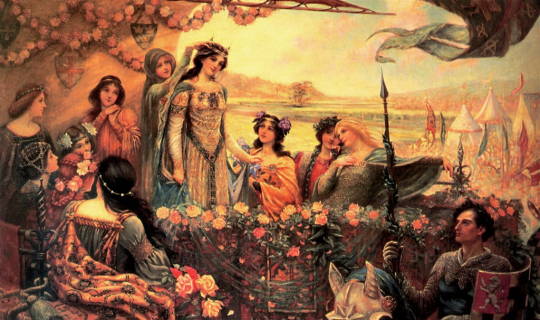
This is a tricky subject, because I think it’s an area where modern fandom and medieval literature have almost perpendicular perspectives. Let’s take the case of Lyanna and Rhaegar at the Tourney of Harrenhal, as seen below: 

image

Oh no, wait. That’s actually a painting of Lancelot and Guinevere from 1890, a classic love story that involves adultery, murder, toxic relationship dynamics, and everyone dying horribly. And a lot of chivalric romance is like that – Tristan and Isolde, Gawain and the Green Knight, Percival and the Loathly Lady – they’re not about healthy relationships, they’re about DRAMA and TRAGEDY. 

Now that doesn’t mean we can’t find something interesting/redeeming in them; a lot of feminist scholars have pointed out that the mechanics of courtly love at the heart of these chivalric romances (which often found their dramatic tension in the conflict between masculine-coded chivalry and feminine-coded courtly love) kind of results in this weird dom-sub thing where the lady is in charge of the relationship and spends a lot of time punishing the knight for not being impossibly faithful to her or thinking about anyone but her at any point. 

image

(I mean, I can’t be the only one who sees something in all these paintings of men kneeling in front of women, right?)

But wrt to Rhaegar specifically, the knock on him is that he abandoned his wife and kids to run off with another woman in an unequal power dynamic. But if you shift the marriages around in any of these chivalric romances – so Lancelot is abandoning his wife to run off with Guinevere, or Tristan from his wife to run off with Isolde – you’d wind up with the same dynamic. Including the necessity of both of the adulterers to die in the end to restore the stability of patriarchial marriage. 

And I think that’s what GRRM did, he took these stories that he’d grown up on and switched it around so that it was the prince running away from his wife instead of the queen from her king. 

So does that pass muster with modern fandom’s conceptions of a healthy relationship? No. It’s not meant to (if only because unhealthy relationships are easier to mine for drama and tragedy). 

A Romantic story is not the same thing as a romantic story. 

How can martin be a romantist at heart, given that there are never any happy times in a song of ice and fire, that lasts more than a chapter before getting drowned in misery and death?

Because Romantic and romantic don’t mean the same thing. The Romantic movement of the first half of the 19th century (

think Byron, think Mary Shelly, think Coleridge, think the Bronte sisters) loved it some misery and death as long as said misery and death was appropriately extra, melodramatic, and over-the-top, because the point was achieving emotional instensity and extremes. Thus, as I’ve said before, GRRM plumbs the depths of “misery and death” so that the “happy times” are that more intense. 

image

Moreover, I want to point out that the idea that “romantic” stories should involve happy endings is pretty damn new in the historical scheme of things. Coming out of the tradition of chivalric romance – where the point was about the purity and intensity of longing *from afar* not its consummation, which threatened the social order and had to be punished with a tragic end – a lot of the classic romances are cases of “star-crossed” love, whether we’re thinking about Guinevere and Lancelot, Tristan and Isolde, or Romeo and Juliet. 

Do you think the reason Martin made Brienne so devoted almost pathetically to Renly was due to him wanting her to not seem perfect?

No, I don’t think that’s it. In chivalry, devotion to your liege lord is a sign of virtue; in chivalric romance, devotion to your love is likewise. Brienne’s case is rather efficient in that the two are one.

image

I think GRRM made Brienne devoted to Renly was to set up the idea that Brienne’s purpose in life is to protect others to the point of laying down her life in the approved fashion (”all his other knights wanted things of him, castles or honors or riches, but all that Brienne wanted was to die for him”), but that Renly wasn’t actually worthy of her service. Hence why Brienne spends all of AFFC looking for a maiden in need of defending, while slowly forgetting Renly and developing a deeper connection to Jaime. 

Now, I have a darker guess about what Brienne’s endgame is than some people would like, but I think it’s definitely grounded in the rules and forms of chivalric romance and thus in Brienne’s character…