



why-i-love-comics:

 Captain America: First Vengeance #2 (2011)

written by Fred Van Lente
art by Luke Ross & Richard Isanove

I have no personal animus whatsoever against any of the people involved in making this comic, but as someone who has thought WAAAAAAAAAAAAAY too much about Captain America, this is a very particular pet peeve of mine. 

It’s the date. Discreetly tucked away in the upper left, saying “December 24th, 1941.” While it being Christmas Eve is a bit schmaltzy even for a character who is done best with a good helping of schmaltz – looking at you, Joe Johnston you genius you – it’s the 1941 that bugs me.

Because Steve Rogers did not join the U.S military because of Pearl Harbor.

One of the reasons we know this is that Pearl Harbor hadn’t happened when Captain America #1 came out in March of 1941 with a big picture of Cap punching Hitler on the jaw on the cover. Jack Kirby and Joe Simon had come up with Captain America to argue that America needed to get into the fight against fascism, which they saw as a threat at home and abroad

So then why did Steve Rogers join the military, if the United States hadn’t been attacked and his country was at peace? Because Steve Rogers was a “premature anti-fascist.”
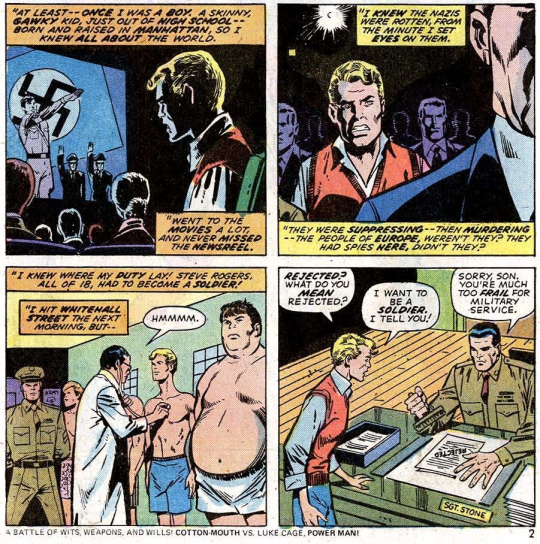
And this is what sets him apart from the deluge of patriotic superheroes from the 1940s like American Eagle, Captain Battle, Captain Comamndo, Captain Courageous, Captain Flag, Captain Freedom – no, comics have never had a problem with plagiarism, why do you ask? – the Fighting American, the Fighting Yank, and on and on. Steve Rogers had a very specific political point-of-view, one that only could have come from New York City in the 1930s, and it went way beyond a sanitized patriotism.

The specificity of Captain America’s politics is something that Marvel haven’t always been willing to talk about in recent years, but it’s what makes him genuinely interesting.  

So please, can we have a moratorium on post-Pearl Harbor origin stories? They miss the point completely.

So, thoughts on Coates’ Captain America #1?

Took a second to get my hands on it, because Comixology is bad at carrying over subscriptions when teams change, but yeah, I have some thoughts.

So far, it reminds me a lot of Brubaker’s run, that emphasis on the paranoid thriller style. 

The two main threads of the issue are:

  • Cap and Bucky working together to try to shut down “HYDRA nostalgics” while dealing with “resisters with shady pasts” who’ve got a foothold in the new government, what with Thaddeus Ross hiring Sharon Carter on the one hand, but also suggestion that Selene’s in the U.S government and Von Strucker somehow managed to get himself on the good list.
  • Bringing Russia into the HYDRA narrative with Selene (the former Black Queen of the Hellfire Club) liberating a mysterious Alexa in Russia, demonstrating how Russia reacted to HYDRA’s world conquest and their more hardcore attitude to the aftermath.

Not quite sure how they link together in the end, with the exception of Selene being both active in Russia and in the U.S government, and the way that the issue frames Steve’s street level helping ordinary people against Selene’s exemplary punishment of a HYDRA holdout. 

I’d say what I liked best in the issue is the Cap and Bucky rapport, the perspectives of the two of them as “a warrior who hates war” (which makes sense for a man who’s made a shield his signature weapon) vs. someone “who’d seen the worst of human nature” and knows how to take the shot in the meantime. 

The cyborg Nukes being used as “lone gunmen” on the National Mall are certainly a scary thought, and combined with the discussion of protesters and counter-protesters, very much getting a “ripped from the headlines” vibe out of that particular plotline.  

Why ‘Im Relieved Ta-Nehisi Coates Is Writing Captain America – Lawyers, Guns & Money

Although it’s been widely rumored for months, Marvel only lately announced that the next writer of Captain America will be Ta-Nehisi Coates. This is excellent news for a couple reasons: first, because after Nick Spencer’s disastrous run where Captain America became a Nazi, the book and the character badly need not so much a “Fresh …

Why ‘Im Relieved Ta-Nehisi Coates Is Writing Captain America – Lawyers, Guns & Money

Are there any 90s era Captain America comics or runs worth reading? Or was Captain America badly affected by the Dark Age of Comics?

So here’s the thing…one of the first superhero comics I remember reading was Captain America Vol 1 Issue 388, which started in media res with Captain America and his teammates plummeting to their deaths because MADAM (the female MODOK) has cut the parachutes attached to their ejector seats…and it was deep and unironic love at first sight:

image

So the answer to your question is that, yes, Captain America was affected by the 90s, but more in a cheesy 90s RADICAL TO THE EXTREME way than a particularly grimdark way. As a result, you did get ridiculous stuff like Capwolf:

image

And there was a brief period where a meth lab explosion caused a chemical reaction with the super-hero serum which meant that his body began to deteriorate so he needed a powered exoskeleton (because power armor was big in the 90s), or the time that Cap got “vibranium cancer” in a fight with the Beyonder and was accidentally cured by Klaw, and a bunch of other 90s cheese.

But that stuff is mere rococo ornamentation on top of Mark Gruenwald’s 137-issue run, which gave us Crossbones, the Serpent Society (a villain worker’s co-op complete with health benefits and profit-sharing), Diamondback (Cap’s ex-villain longtime girlfriend), Flag-Smasher (a bizarre anti-nationalist terrorist), Left-Winger and Right-Winger, Cap resigning over the cover-up of Nuke’s attack on New York which leads to a right-wing Captain being put in his place by the Commission on Superhuman Activities, which leads Cap to take up a new identity as “The Captain” (which is probably Cap’s laziest secret identity ever), which leads the two of them to fight and ultimately Cap helps out the right-wing Captain who’s losing his mind. 

image

As far as the rest of the 90s go, I wouldn’t bother with the Heroes Reborn arc, although Liefeld is apparently a nice guy who’s actually been working on his art in recent years and has learned to draw feet, so we shouldn’t hate on him so much.

Spoilery Thoughts on Secret Empire #2

That’s it? (warning mild spoiler, see here for more extensive spoiler) That’s the big reveal that we all had to be patient and wait for over a year for? You have got to be kidding me. EVERYONE GUESSED THAT ALMOST FROM DAY ONE. 

Hell, I came up with a better version than what you went with

But if Marvel’s going to do RedCap/Blue Cap, EvilCap/Good Cap, I demand that they also plagiarize all of the other goofy Superman event ideas: in other words, I want 90s-Teen Cap, CyborgCap, and Laser-Sunglasses Cap.

Actually, I mostly want 90s-Teen Cap, because that would be AMAZING. 

As someone who loves the MCU but is unfamiliar with comic books what makes Mad Bomber so special?

Ah, I got slightly confused there – the Mad Bomber is George

Metesky, a real-life supervillain who set off bombs across New York City for sixteen years before he was caught. 

Madbomb is special for a lot of reasons. First and foremost, it’s Jack Kirby both writing and drawing one of his signature creations, which means you get amazing visuals like this:

image

But that’s not all – you also get cameos from Henry Kissinger, a secret 200-year-old Royalist conspiracy to overthrow the U.S government and restore the British Monarchy, Captain America and Sam Wilson having very frank discussions about the linkages between American democracy and slavery, Cap and the Falcon being thrown into the plot of Rollerball (aka “Kill-Derby”), and of course a bomb that can drive people insane. 

image

In other words, it’s high-concept superhero action mixed with pop culture references and cultural anxieties of the 1970s mixed with Jack Kirby’s unique Olmec- and surrealist-inspired art. 

And I love it unreservedly. 

What do you think about Baron Zemo?

Which one?

Heinrich Zemo is an important villain in Captain America history, being the man who was responsible for Cap going into the ice (in the comics). He does have one of the most ridiculous villain origin stories ever: he hates Captain America specifically because Cap got his balaclava stuck to his face. 

image

His son, Helmut, is a bit of a basket case. He tried to kill Cap in disguise as the Phoenix – I would advise Jean Grey to sue, personally – and then managed to fall into a vat of the same adhesive that disfigured his dad, proving that idiocy runs in the family. Then he got married to a woman who claimed to be a reincarnation of his father, which is so bizarrely reverse-Freudian I can’t even.

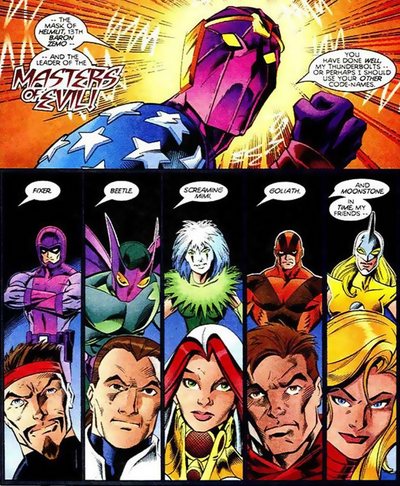
I will give Helmut one thing: he’s really good at getting people to think that his villain team is actually a superhero team – because he’s done it more than once, using the exact same superhero team name. 

image

Overall? They’re serviceable Cap villains. Not quite as classic as the Red Skull, lacking the panache of Baron Strucker, and unlike Arnim Zola they don’t have their faces on TV screens in the middle of their robot bodies. 

In the Captain America movie, is Doctor Erskine Jewish, as he is in the comics? The movie version never mentions that, even when it would naturally come up when discussing his interactions with Nazis. Does it actually work better if Erskine is non-Jewish German but still despises Nazis?

This is a tricky one, because you need to start from a place of understanding Jewish subtext in film and other media, so I’m going to do a very TLDR version of this history:

Back in the 1920s and 1930s, the Hollywood studio system was dealing with a “family values” backlash, and one of the ways in which the “family values” crowd liked to bash Hollywood was to bring up the fact that a lot of the people who ran Hollywood were Jewish immigrants and were thus alien to the values of the American heartland (which of course got revived during the Cold War with the Black List and the McCarthy hearings). 

image

One of the ways that Hollywood dealt with this, in addition to instituting the Hays Code was to really de-emphasize Jewishness in its products. Not that Hollywood didn’t continue to make products that came out of Jewish theater – the Marx brothers, for example – they just didn’t identify characters as Jewish and used circumlocution and veiled metaphor to discuss Jewish themes. Hence, even when you could fight the caution of the studio bosses to get them to greenlight an anti-Nazi picture like Casablanca (as late as 1942!), the screenwriters and directors had to smuggle in Jewishness under the radar:

So in 1941, when Jack Kirby and Joe Simon introduced us to Captain America and the name of the scientist who gave him his powers was Professor Reinstein at a time when the most famous Jewish emigre scientist in the world was Albert Einstein, the subtext was clear: Captain America’s serum is the result of Jewish emigre science, here to save us from the threat of Nazism. And while it’s changed somewhat in the last 60-70 years, the fact that the 2011 film has Doctor Abraham Erskine be both a scientist and a quasi-rabbinical figure, the subtext is still there:

You’ve talked a lot about Captain America, but what do you think of his nemesis, the Red Skull?

Good question!

Let me start by directing you to this essay here where I talk about how Jack Kirby and Stan Lee turned the Red Skull from a rather shaky pulp villain into a pretty damn good supervillain with a penchant for cigarette holders, giant Nazi robots, doomsday devices and improbable escapes.

They also gave him a rather interesting backstory in Tales of Suspense #66: Johann Schmidt was a penniless orphan, bullied and robbed because of his physical weakness, who couldn’t find regular employment (although as Steve Rogers points out, “my early years were no bed of roses, either”), who was working in a hotel when Hitler came into town, and the rest was destiny:

image

And that’s the core of the character – he is Hitler’s very own Nazi, his hand-crafted avatar of hate. But at the same time, you can see the personality defects – the self-hatred (especially centered around physical weakness), the adoration of power and strength, the “envy, the jealousy” – that would make him such an eager convert. In a way – and there’s a reason why they named him John Smith – he’s a perfect stand-in for any of “Hitler’s willing executioners.”

That’s what makes him such a good “dark mirror” for Steve Rogers – because the two of them have virtually identical backstories as poor, physically impaired orphans, but they reached such diametrically opposed ideological conclusions. Long before he volunteered for Project Rebirth, Steve Rogers had chosen the path of solidarity, and before Johann Schmidt got his mask/face, he chose the opposite. Hence why this moment works so well:

image

The Red Skull needs there to be some inherent, almost biological reason, why Steve Rogers succeeded where he failed, because otherwise he has no way of understanding his life. And it’s a big part of the reason why so many of his plans revolve around trying to break down Captain America – drive him crazy, take over his body, putting NYC in a bubble unless Cap gives in – to find that reason and overcome it. 

That being said, one major mistake I think people make with the Red Skull is that they try to make him too smart (he’s not a Batman-level strategic genius – he’s a monologuer, a gloater, a fan of the easily-escaped-death-trap and the explosion-prone-giant-robot) or too powerful (the Cosmic Cube should always be something he’s reaching for, but which always slips between his fingers).