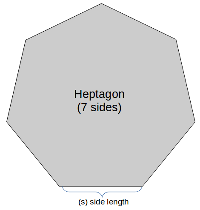
In a church that has seven sides, each of them significant, which God has to host the door to get in?

Good question!

image

My guess is that you probably have the three male gods on one side and the three female gods on the other, and the entryway is the Stranger (symbolizing the whole death and rebirth thing). 

In terms of ordering, I would guess that if the bottom side is the door/Stranger, and then going around the room on the right hand side, it probably goes Smith, Warrior, Father, Mother, Maiden, Crone. 

Thus, symbolically, the Smith and the Crone are in the back (because who cares about peasants and old women), the Warrior faces the Maiden he’s supposed to protect, and the Father and Mother are side-by-side.

Hey, so I was trying to make a political map of the North, but I am not sure about some things. Specifically,how should I map out the masterly houses like Glover and Tallhart, should I make their lands separate of House Starks, or a part of House Stark lands (masterly houses only cannot pass judgement or is there something else)? Do Stony Shore and Sea Dragon Point belong to Starks or does some vassal hold it in their name? Also, are Mountain Clan’s lands separate of Stark’s lands? Thanks!

Good question (and definitely send me a link to the map when you’re done)!

Re the Glovers and Tallharts: I would lean to separate, since they still have the right to tax and levy military support from those lands, and GRRM has talked about landed knights potentially being quite powerful. Maybe color them as alternating stripes between Stark grey and their own house color?

Re Stony Shore and Sea Dragon Point: WOIAF says that the Stony Shore was ruled by House Fisher, who became vassals of the Kings of Winter. We don’t know whether they survived the Ironborn incursions, but I would guess the lands are held by some vassal. Sea Dragon Point was once ruled by the Warg Kings before the Starks conquered them, but we don’t know who rules it now and whether they survived the Ironborn either.

Re the Mountain Clans: definitely separate. They are vassals of the Starks, but among the more independent given their distance and traditions

Hello Steven, judging from A Commentary on the True Life of the High Spider, you at least partially subscribe to the theory that the Andal invasion happened much later than at 6000 BC. Can you please provide some thoughts on how such historical discrepancy is even possible with the maesters chonicling everything?

No, I don’t even partially subscribe to the theory; I merely added some footnotes to acknowledge that there’s a debate in the fandom. And just to be clear, in footnote 1 of Part I, I was referring to the Andal Conquest not Aegon’s Conquest, although I will clear that up (along with much else) when I combine all three parts. 

The Headcanon Challenge: A Commentary on the True Life of the High Spider, Part II

The Headcanon Challenge: A Commentary on the True Life of the High Spider, Part II

image
A while back, JSLAL from Wars and Politics of ASOIAF got a really interesting question on Tumblr, asking him to come up with a character who could fill in some of the gaps in Westerosi history. I really liked his response, and so when I got the same question, I decided to see if I could do one better. (Much thanks goes out to @hiddenhistoryofwesteros and @cynicalclassicist for their assistance in…

View On WordPress

Maester Steven, may I please ask if your Economic Development Plans would be subject to alteration were they applied to now defunct polities like the Kingdom of the Storm (in its “Sea to Shining Sea” phase) or the Ironborn domains during those years of darkness when the Islanders writ ran from the Arbor to Bear Islands?

Oh definitely they would change. As with Jaehaerys and his roads, economic and infrastructure development is usually driven by the interests of the center over the periphery. 

So to take your example, I would imagine the Durrandons would discourage a Blue Fork canal in favor of a canal linking the Godseye to the Trident, as that would facilitate traffic in a southerly direction closer to the “home territories.”

As for the Ironborn at their coastal peak, well, they were rather notoriously uninterested in infrastructure that didn’t have to do with longships. Indeed, I would imagine they would ban bridge-building as a potential check on their power. But in the Hoare era of rulership over the Riverlands, I could see them favoring a Blue Fork canal to give the Iron Islands direct access to the Narrow Sea. 

The Headcanon Challenge: A Commentary on “The True Life of the High Spider,” Part 1

The Headcanon Challenge: A Commentary on “The True Life of the High Spider,” Part 1

image

So a while back, JSLAL from Wars and Politics of ASOIAF got a really interesting question on Tumblr, asking him to come up with a character who could fill in some of the gaps in Westerosi history. I really liked his response, and so when I got the same question, I decided to see if I could do one better. (Much thanks goes out to @hiddenhistoryofwesteros and @cynicalclassicist for their assistance…

View On WordPress

What does it mean “there are no children in Asshai”?

There are as many answers as you have imagination: they’re all undead, they’re all infertile due to magical radiation, they sacrifice all their children to Moloch, they eat babies, a monster comes and steals them all, etc. 

Ultimately, it comes down to that Asshai is a Thin Place more than almost anywhere else in the world:

…beyond the walls of Asshai little grows save ghost grass, whose glassy, glowing stalks are inedible. If not for the food brought in from across the sea, the Asshai’i would have starved.

The ships bring casks of freshwater too. The waters of the Ash glisten black beneath the noonday sun and glimmer with a pale green phosphorescence by night, and such fish as swim in the river are blind and twisted, so deformed and hideous to look upon that only fools and shadowbinders will eat of their flesh.

Every land beneath the sun has need of fruits and grains and vegetables, so one might ask why any mariner would sail to the ends of the earth when he might more easily sell his cargo to markets closer to home. The answer is gold. 

Beyond the walls of Asshai, food is scarce, but gold and gems are common…though some will say that the gold of the Shadow Lands is as unhealthy in its own way as the fruits that grow there…

The dark city by the Shadow is a city steeped in sorcery. Warlocks, wizards, alchemists, moonsingers, red priests, black alchemists, necromancers, aeromancers, pyromancers, bloodmages, torturers, inquisitors, poisoners, godswives, night-walkers, shapechangers, worshippers of the Black Goat and the Pale Child and the Lion of Night, all find welcome in Asshai-by-the-Shadow, where nothing is forbidden. Here they are free to practice their spells without restraint or censure, conduct their obscene rites, and fornicate with demons if that is their desire.”

This is a place where “nothing is forbidden everything is permitted.”
Isn’t it odd that Melissandre, being of Asshai, is portrayed as white? (Or in the books the only peculiarity is she has red eyes, but otherwise her ethnicity is not described which kinda implies white by default) Geographically, Asshai seems a sort of equivalent to RL India. How could people originating from Asshai A) be white and B) not have a distinctive language (I don’t buy Valyrian that far East, the books say Valyrian is already breaking down by Slaver’s bay)

This is a common misconception. Melisandre is “of” Asshai but she was not born in Asshai, because “there are no children in Asshai.” Rather, Melisandre was sold into slavery in Asshai:

“The red priestess shuddered. Blood trickled down her thigh, black and smoking. The fire was inside her, an agony, an ecstasy, filling her, searing her, transforming her. Shimmers of heat traced patterns on her skin, insistent as a lover’s hand. Strange voices called to her from days long past. “Melony,” she heard a woman cry. A man’s voice called, “Lot Seven.” She was weeping, and her tears were flame. And still she drank it in…

Dawn. Another day is given us, R’hllor be praised. The terrors of the night recede. Melisandre had spent the night in her chair by the fire, as she often did. With Stannis gone, her bed saw little use. She had no time for sleep, with the weight of the world upon her shoulders. And she feared to dream. Sleep is a little death, dreams the whisperings of the Other, who would drag us all into his eternal night. She would sooner sit bathed in the ruddy glow of her red lord’s blessed flames, her cheeks flushed by the wash of heat as if by a lover’s kisses. Some nights she drowsed, but never for more than an hour. One day, Melisandre prayed, she would not sleep at all. One day she would be free of dreams. Melony, she thought. Lot Seven.”

Moreover, we have no idea what ethnicity the Asshai are, since “those who walk the streets of Asshai are masked and veiled.” So I think people are being far too conventional by assuming that any real world ethnicity applies to the Asshai, or humanity for that matter.

Finally, why white should be assumed as the default for Melisandre, I don’t know – she was a slave in Essos, so she could be from as far west as Lys to as far east as Qarth, I suppose. We know she has pale skin, but that’s it. And she speaks with a distinctively Eastern accent, so there’s that. 

Hello! You’ve mentioned in a few places that Essos is more advanced and more urbanized than Westeros. But – though I understand it’s about relevance – 1) there are only so many cities mentioned, practically all of them save Norvos, Qohor & Vaes Dothrak are coastal. Doesn’t that leave most of the HUGE territory of Essos as just rural hinterland or waste (or ruin)? Do we know anything of it other than the disputed lands ? 2) What do we know of its scientific advancement compared w/the Citadel?

Hello!

  1. There’s also the unmentioned cities: “We speak of Nine Free Cities, though across the width of Essos one may find many other Valyrian
    towns, settlements, and outposts, some larger and more populous than Gulltown, White Harbor, or even Lannisport. The distinction that sets the Nine apart is not their size but their origins.”
    Essos is so urbanized that cities the size of Lannisport go unnmentioned as unimportant. (Must remember to double-check my Essos population estimates against this.)
  2. Well, Tyrion’s journey down the Rhoyne gave us a sense of the Volantene hinterland, and I’d imagine you’d see similar wrt to the other city-states where room applies.
  3. Here’s what we know: Myr has advanced optics, advanced crossbows (which means a good handle on levers, gears, pullys), “fine woolens, lace, glassworks and tapestries….But Qohor has metalworking on lockdown, Tyrosh has dyemaking and distillation (which suggests chemistry) and competes with Myr on armaments, Lys is a competitor in the tapestries business and has a better chemicals industry than Tyrosh, Norvos is a competitor in the tapestries business, Braavos dominates in finance and is the only place that’s figured out the assembly line and interchangeable parts.” Pretty much all high-valued added manufacturing happens in Essos, as well as a huge amount of commerce in luxury goods (spices, silks, gemstones, exotic animals/skins). Whereas Westeros exports mostly natural resources (food, timber, wool, wine, furs, stone and metal), with a smattering of finished goods (Dornish silks and satins, linen from the Reach, gold and silverware from the Westerlands). So while we don’t know about Essosi higher education (and there’s signs that it must exist), their economies and level of technology are more advanced. So maybe the Essosi go in for applied vs. academic sciences?