Anonymous asked: How long would it take to raise a city of comparable size to White Harbor and its fortifications on the river that passes through the Rills? I meant the one that leads to Torrhen’s Square, but I’m interested to know whether you think another river would be a better candidate.

Ok, now that I know what you’re getting at, I feel like I can answer that question. 

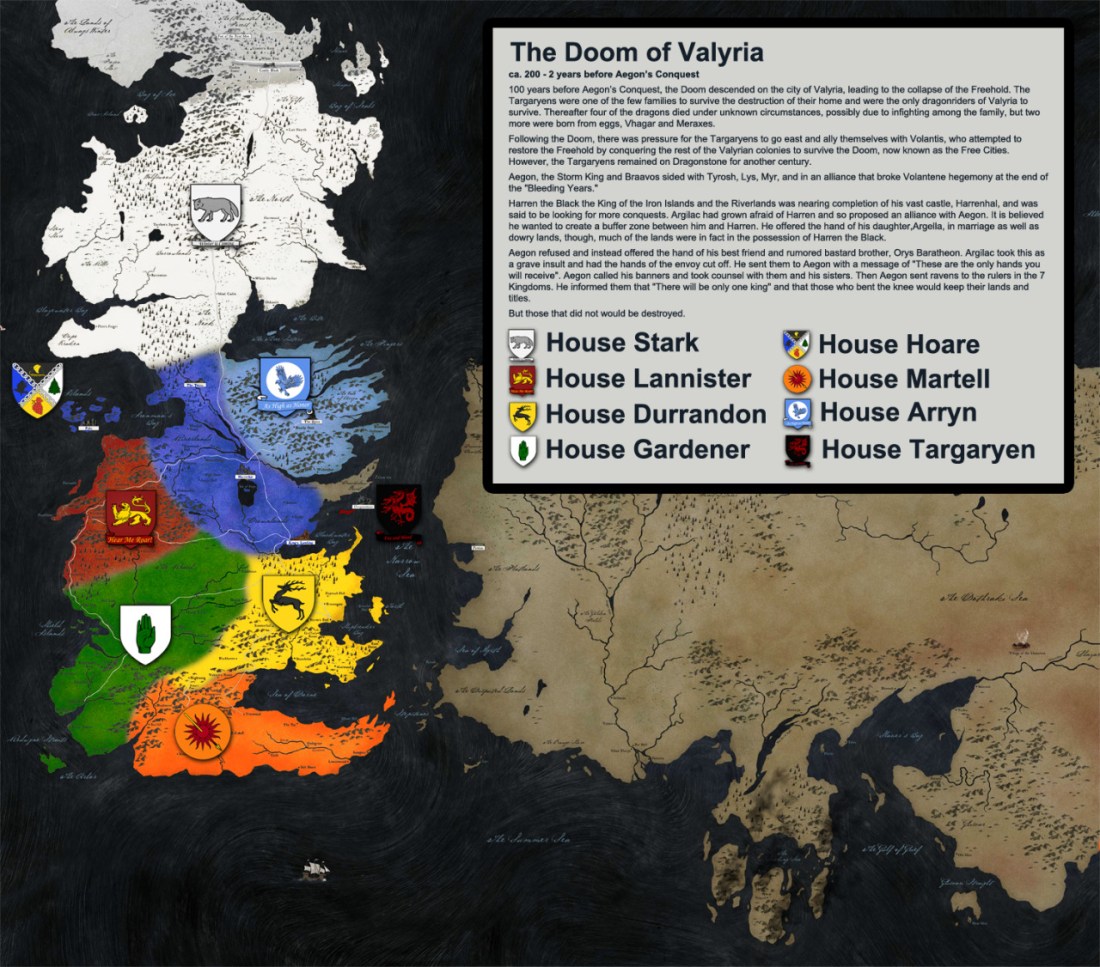
Torrhen’s Square is a good location for a city – you’re building on top of an already-existing settlement with good defenses, the lake offers quite a bit of space for docks, you’ve got direct access to the Saltspear, Blazewater Bay, and the Sunset Sea, and its location nearby to the Wolfswood gives it a natural monopoly on Northern timber exports. 

The biggest potential problem I see for Torrhen’s Square’s economic development is that it’s right by Barrowton, which is already a town with a strong economic presence (I’m pretty sure it’s a major livestock market, with sheep, cattle, and horses on offer), and has a shorter route to the Saltspear and thus foreign markets. So if the Dustins decide to make it a competition, Torrhen’s Square would be decidedly the underdog. 

As for how long…well, King’s Landing took only 25 years to go from nothing to bigger than White Harbor, so it all depends on what level of investments go into it:

  • Sawmills, timber yards, carpenters, etc. – the necessary foundation for an economy, as proximity to the wolfswood is TS’ main value added. And this is going to take some significant up-front investments, because sawmills and the like are not cheap. 
  • A Northern canal – would turbo-charge TS’ economic development, similar to how the Erie Canal changed upstate New York from a rural backwater into an industrial hotbed – depending on competition from other canals. Both Torrhen’s Square and White Harbor would grow significantly, with White Harbor gaining new western markets for its wool and its silver, and Torrhen’s Square gaining new eastern markets for its timber and woodcrafts, as well as the added revenue from providing commercial services to the passing trade. 
  • A Stark navy-yard – given the proximity to essentially unlimited timber, if the North wants a navy on its west coast again, and it desperately needs one, putting a navy-yard and naval base on Torrhen’s Square makes a ton of sense. The raw materials are right there, the lake allows you to have a lot of ships in construction or moored up in one place, the distance from the coast makes it very hard for Ironborn to burn your fleet at anchor, etc. And it would provide a baseline of demand for a shipbuilding industry to develop, and you’re going to need one of them if you want to capture the maximum value-added from Northern exports and generate additional economic growth you’ll need to pay for all of this. 
I just read that link on Henry VII and bonds, pretty interesting, thank you. Just one question, the article mentioned that Henry recieved money for knighting his son, could you please elaborate on this occurrence?

So this is an example of Henry VII looking back into the statute books to find old rights or powers that hadn’t been invoked in a while – in part because earlier kings had abused the hell out of them and in the process helped to provoke the Barons’ Revolt and the Magna Carta – and then using the hell out of them.

In this case, Henry VII was invoking the right of feudal aid. Feudal aid was a special one-time payment to be made to one’s liege lord on special occasions: when the oldest son became a knight, when the eldest daughter was to be married, when the lord was going on crusade or needed to be ransomed, etc. 

Henry VII missed few tricks, so not only did he invoke feudal aid when he knighted his eldest son Arthur, but when Arthur died and Henry became his new eldest son,  he did it again, and then again when he married his daughter to the King of Scotland. And each time, he raised the equivalent of at least £11-20 million pounds in today’s money. 

Where do you think Daeron I got his martial spirit and supreme self-confidence? Was he just a born military prodigy or do you think he had a specific tutor/master-of-arms who shaped him into a fourteen-year-old boy conqueror? His father Aegon III seems like he would have been too reserved/depressed/brooding to be a confident warrior (though Daena was said to idolize her father). Perhaps from Oakenfist or Uncle Viserys, even though they were more cautious about trying to conquer Dorne?

We don’t have much information about Daeron’s youth, so it’s hard to say. But the Oakenfist seems to have best fit the bill as a mentor figure – he was a good thirty years older than Daeron, already a storied (and daring) naval commander, and was heavily involved in Daeron’s planning for his Conquest of Dorne. 

But given his extreme youth at the time of his great victories, I think we have to assume that he was a prodigy, because an average student even of a great teacher wouldn’t have been able to do what he did in the time he had. 

Hypothetically, if Robb had won the war and married Roslin Frey, who would have been tw best internal marriage options for Edmure and Sansa to help integrate the two portions of Robb’s kingdom?

Assuming that Robb doesn’t need external alliances, it would be a good idea to marry Edmure into the Manderlys – they’re a powerful Northern House, but they’re also the most conversant with Southern culture of any of Robb’s original bannermen. Moreover, their naval and commercial presence at White Harbor would enhance North-Riverlands connections if properly exploited. 

As for Sansa, I’m not sure who I would handle. But one idea that does come to me is for Robb to settle Harrenhal on her – Harrenhal is going to be incredibly important for him holding the Riverlands from attacks from the south, so a Stark presence there will probably be necessary for making it actually perform. 

Some time ago, you theorized that Bittersteel could’ve conquered the Disputed Lands, as well as Myr, Tyrosh, and Lys. Do you think Daemon Targaryen would have been able to do that? He didn’t have a disciplined army like the Golden Company, but he had a dragon and a powerful fleet under the command of Corlys Velaryon.

Taking Myr, Tyrosh, Lys, and the Disputed Lands would be a prolonged affair – in addition to the naval campaign necessary to knock out their fleets, and the land campaign against the free companies they’re going to hire, the cities themselves will involve three major sieges, all of which are going to require siege works on land and a naval blockade to cut off the cities from resupply and reinforcement. And that’s assuming that everyone else – Braavos, Pentos, Volantis, etc. – stays out of it. 

I don’t think Daemon himself had the discipline for it – as we saw with the Stepstones, Daemon doesn’t have the patience for sticking it out for a whole campaign, and other than Corlys, didn’t seem to have anyone around him capable of leading in his absence.

So while he’d definitely enjoy some early successes, I think he’d lose interest a year in, and then the war effort would completely collapse in his absence. 

Would a hypothetical post-WftD regress back into feudal Kingdoms (divided into their historical boundaries, but leaving a wide-berth around smoking ruin KL and Oldtown respectively) affect your EDPs? Obviously some changes will have to be made, but can the Kings trade and build industry as effectively as their Lord Paramount predecessors?

The answer is, it kind of depends on what kind of damage the War for the Dawn does. If there’s a massive loss of life, you potentially can have a negative population spiral, because 90%+ of the population are also your primary food producers – lower population means lower production, which means less food available so birth-rates decline, and the spiral continues.

On the other hand, when you have a massive loss of life, you do get a huge increase in per-capita material living standards. As we saw with the Black Death, epidemic diseases kill lots of people, but they leave the land, the houses, improvements, and other non-perishable property intact, and now it’s spread over a smaller population. There’s some scholars who argue that one of the catalysts for the Industrial Revolution was the increase in surplus capital from the Black Death.  

In terms of how the political changes might change things… 

On the one hand, you now have much more flexibility within your own polity: you have your own coinage so you can set monetary policy, you have your own taxation system so you can set fiscal policy. So if there are institutional barrier at the kingdom-wide level to certain economic development, than potentially moving back to the Seven Kingdoms could ease the way for that. 

On the other hand, you now have the added difficulty of international commerce within what was once a single polity: seven kingdoms means seven currencies, which means you have foreign exchange issues; it also means that you need to work out trade deals with the other kingdoms in order to be able to sell your goods outside of your own patch. And of course, any kind of economic development that crosses borders is now made a lot more complicated. 

What would a mug of ale or a roast chicken cost in a medieval tavern/inn? How accurate is fantasy when it represents taverns? Are there examples of things like menus or prices and how would they match up to westeros?

The main inaccuracy in fantasy is A. how many of them serve food or have rooms to let and B. how many of them there are compared to places that just serve liquor. 

Historically speaking, because there was much less travel in the (especially in the early) Middle Ages than in later periods, there were far fewer establishments that catered to travelers, unless you were on a major trade route or pilgrimage or the like. So what you had was a lot of taverns that just sold alcohol and nothing else, because people were expected to eat at home, and people were expected to sleep at home, and pilgrims were expected to find lodging in monasteries. 

As we get to the High and Late Middle Ages, more and more people were traveling for business and other secular purposes, and the number of pilgrims had outstripped the supply of beds in monasteries. There was more demand for more services, so you started to see inns (as opposed to taverns) popping up that provided rooms to let, and those places tended to serve food to travelers.  

So to focus your question on prices for booze…in the 14th century, ale ran about 1 to 2 pence a gallon. Converting that to dragons works out to about 1.3 silver stags to the gallon in Westeros. 

The Westerosi seem to be both religiously conservative while also surprisingly tolerant of prostitution (brothels operate openly, pay taxes and its not even a secret that a member of the small council operates one.) Is this realistic? how freely could sex workers work in medieval/renaissance europe?

Yep, it’s pretty realistic. There’s a pretty wide literature on the history of medieval prostitution, which is very interesting if you want to know more about the history of gender, sexuality, and culture, and I haven’t read more than just the basics. 

Here’s the short and simplified version: in Medieval Europe, prostitution was seen as a necessary evil, something that would prevent adultery, rape, masturbation, and sodomy (which were seen as more important sins). The Church wasn’t super happy about it, and preachers would try to persuade prostitutes to reform, but the Church wasn’t about to ban it (especially since a lot of clergymen made use of prostitutes since they weren’t allowed to get married). 

What did happen is that prostitution was regulated: in some places, it could only be done outside the city walls; in other places, it was restricted to certain streets or neighborhoods; in some places, there were civic brothels that were given a monopoly on the trade. 

You convinced re: Maidenpool! Your ED series is brilliant, and I appreciate the discussion of the nuts and bolts of feudalism – it all adds to the feeling of a medieval world + magic. Concerning taxation: was this a means of punishing rebel lords, e.g. post Trident or Blackfyre rebellion? And would each tax rate for each lord be determined individually? The bureaucracy required for this system would have been monumental, so I presume there is another way I have not thought of. Thanks!

Thanks! 

As for taxation, it could be used to punish taxation, but it was a bit more common to simply confiscate the property of rebels or to levy a one-time fine, rather than expect compliance with taxes in the long run. Henry VII had a lot of success using bonds instead – people who chose the wrong side in the Wars of the Roses ended up having huge liens put on their estates that the King could call in at any time, which gave him a lot of control over the nobility. 

In terms of the tax rate of lords, it would be generally fixed by tradition – whether it’s a knight’s fee or the specific terms of a feudal contract – although when the king wanted to raise new revenues, it was usually by levying a flat percentage tax because that was a lot easier to do bureaucratically.