Analysis of CK2 Vassal Maps

Trying this again, because CK2 maps are tricky and change over time, which makes comparison difficult and leads people to delete their posts in frustration. This time, I have a new set of images that I am reliably informed are from 283 AC in-game, so there’s consistency there. 

So let’s compare these maps to the Imgur ones:

The North:

image

First things first: holy hell, the Rills are way too big, encompassing both the Stony Shore and Sea Dragon Point. Also, there’s an inconsistency here w/r/t the handling of “masterly houses” – the Wolfswood is separated out from the Stark domains despite the Glovers being a masterly houses, whereas Torrhen Square is not, even though the Tallharts and Glovers are of the same standing. 

Beyond that, most of the names for the hill clan areas – Arrendell, Crow’s Edge are rather spurious – and Breakstone Hill for the Flints is based on an assumption that the First Flints and the Flints of Breakstone Hill are one and the same. 

The Vale:

image

This is…interesting. Crab’s Shore doesn’t exist, neither does Darkmoore, and we don’t have any reason as to why House Templeton is that far west when the rest of the Lords Declarant are more to the east. 

Inside the Vale proper, things get weird. The Redforts have been swallowed up by Runestone, even though the Redforts are a principal House the same as the Royces; likewise, the Waynwoods have seemed to swallow up the Melcoms. The Eastweald and Northweald aren’t real names either, and the former would seem to give House Hunter a lot of territory.

Over the mountains, the Corbrays look awfully small compared to the Belmores. I like the detail of the Royces having Coldwater Burn in their affinity, but the Lynderlys of Snakewood are pretty hard to see. Crow’s Barrens doesn’t exist, nor does that hard to read area next to it. 

I will say that I think the Imgur maps do a better job with the smaller Houses, although again it’s a bit of a guess as to who’s where. 

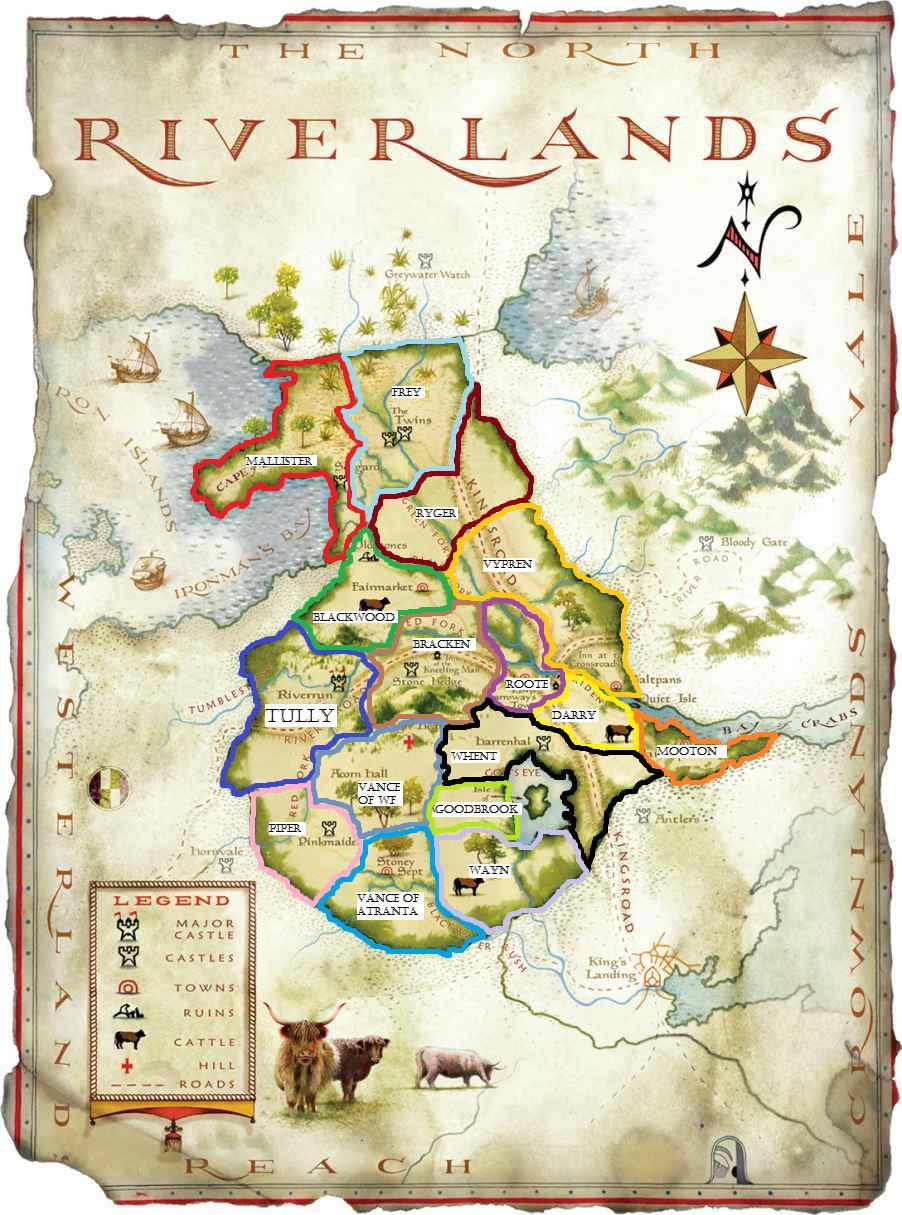
The Riverlands:

image

The Freys are way too big, even if they are a significant house, that’s more land than Harrenhal has. indeed, the lands north of the Trident are messy in general – Wycombe isn’t a real name, nor is Chiltern or Still Fenn. I also don’t think the Tullys have any land at the intersection of the Trident, as much as I think they should. My bigger problem is that we don’t see House Roote of Harroway’s Town, and I think House Darry is actually south of the Trident as per AGOT and AFFC, probably where “Deddington”(?) is on the map. 

My next problem has to do with the Vances, where I actually have a beef with both sets of maps. I agree with Ser Mountain Goat that Wayfarer’s Rest logically occupies a position on the River Road equidistant between RIverrun and the Golden Tooth: this would explain both why Karyl Vance was involved with the Mountain’s raids on the border, and why the castle that name, since it probably got its start catering to traders and travellers along the road.

I also have a problem with some of these invented names: Acorn’s Ridge doesn’t make much sense when Atranta is there to be used. Likewise, Southstone is pretty much exactly where Stone Hedge should be, so why not use that name?  

Once again, I think the Imgur does a better job reminding us of the existance of lesser Houses like the Rygers (although I would place them nearer to Riverrun given their history), the Vyprens (who are definitely near the Darrys, given the Battle of the Widow’s Ford), the Goodbrooks, the Wayns, etc.

Iron Islands:

Skipping b/c you can’t read the map.

Crownlands:

image

Let me just say how boring I find the Crownlands, and that the only reason I’m writing about them is for the sake of completeness and my undying love for you all. 

First things first, it’s a bit odd that House Wendwater isn’t on the Wendwater, and that House Fell from the Stormlands holds the Kingswood, that seemingly House Seaworth holds the Blackwater Rush, etc.

Second, there’s some missing houses here: the Buckwells of Antlers, the Brones of Brownhollow, the Rykkers of Duskendale, etc. 

Westerlands:

image

The first thing that jumps out to me is that the Gold Road is outside the borders of the Westerlands, so I don’t know what’s going on there. Next, the Lyddens of Deep Den should be in-between Silverhill and Hornvale. further south, I’m not sure why the landed knights of Greenfield are more powerful than the principal House Swyft of Cornfield, nor what Lonmount is supposed to be. Other mysteries: what Lang Tower is, or Tendring is, and why it’s where Oxcross should be. 

Sarsfield seems way too big, as does Ashemark. Tarbeck Hall can be seen, but not Castamere. The Banefort seems to have been gobbled up by the Westerlings for some unknown reason; likewise, the Kennings of Kayce seem to have absorbed the Presters of Feastfires. 

The Reach:

image

The list of non-existent names is getting too long, so I’m just going to skip them and just talk about the power dynamics. The Rowans of Goldengrove seem way too big, making the Cranes and Oldoaks seem too small. 

Blueborn and Cockleswent doesn’t exactly work very well as regions – I doubt the Meadows control all of the former, or the Ashfords the latter. Likewise, the Westmarch seems too big for the Tarlys alone to handle – where are the Peakes? Where are the Vyrwels? Inchfield doesn’t exist and wouldn’t be there if it did – Coldmoat and Standfast need to be to the west of House Rowan’s holdings, given Wilbert Osgrey’s duel with Lancel IV.

In general, probably my least favorite to date, not particularly suitable as a political map. 

The Stormlands:

image

House Wendwater is in the Crownlands, not the Stormlands, and why is it in two places? Tarth is ridiculously large, having somehow grabbed the lands of House Penrose of Parchments. House Buckler of Bronzegate also seems to have vanished. House Fellwood is north of where it should be, House Morrigen is to the east of where it should be, Stonehelm is labelled the Red Watch, and for some reason Dragonstone holds the Rainwood (is that supposed to be Davos? Even so, he’s a bit north of where he should be). 

Also not one of my favorites.

Dorne:

The penchant for HUGE fiefdoms continues apace, it seems. The Ullers are much much too big, encompassing the lands of the Qorgyles as well. The Tolands likewise seem to have gobbled up the Jordaynes and much of the Allyrions. The Fowlers and the Manwoodys look squished together. Spottswood I think is on the wrong end of Dorne, it should be much closer to the Yronwoods. 

Better than average, I guess?

Cast-amere and Cast-erly

Well… pretty much there was a theory on reddit that posited the Reynes as a bastard branch of the Casterlys, an idea whose link was included in the wonderful post of @joannalannister in her words for House Reyne. That was pretty much why I said it.

Also, when I spoke, I meant how Ellyn Reyne does resemble Barbrey Ryswell. Ellyn Reyne wanted to become a Lannister with much more intensity than anyone else recorded, like Barbrey and Theon wanted to be Starks above all.

Ah, I see. It’s a fine theory as it goes, the whole reversed arms thing, but the WOIAF I think is pretty strong evidence to the contrary. I’d also point out that we don’t know what the heraldry of the Casterlys was, and that if the connection was through the Casterlys, why would they have reversed the sigil of the Lannisters? 

I don’t know if I would agree that Ellyn wanted to become a Lannister, exactly. She “had for years anticipated one day being the Lady of Casterly Rock,” and certainly pursued Tywald and Tion and even Tytos.

But Ellyn doesn’t show any of the signs of alienation from her original family that, say, Theon did. As “the Lady of Casterly Rock in all but name,” Ellyn made damn sure that House Reyne profited from her success with Tion. Hence “her brothers Roger and Reynard were ever at her side, and offices, honors, and lands were showered upon them, and upon her uncles, cousins, and nephews and nieces as well.” Likewise, when she was finally exiled from Casterly Rock, Ellyn promoted the fortunes of Houses Tarbeck and Reyne as much as she could, shaking down Tytos for as much gold as she could get, putting it in to Tarbeck Hall and its surrounding lands. 

So I think of Ellyn as more self-possessed than Theon and less bitter than Barbrey. Which I think means that she didn’t necessarily want to be a Lannister, but rather wanted to be the Lady of Casterly Rock and the mother of the next Lord…regardless of whether this was as a Lannister or as a Reyne or as a Tarbeck. 

What if Lady Ellyn had sisters who married…

What would have happened if the Reyne-Tarbeck rebellion would have had outer support? With this I mean that the Reynes had claims to Casterly Rock older than the Lannisters themselves. Supposing than Ellyn Reyne would have had younger sisters who would have been capable of marrying one a Tyrell and another a Tully (or a Redwyne), how much would that have changed the outcome and even the beginning of the rebellion? Tywin relied on speed after all to defeat them, but supposing the Tyrells or Redwynes or Tullys would have been willing to meddle on Westerlands affairs (The Tyrells being eager with having a wide support, the Redwynes being the monopoly on the sea-trade and the Tullys still hurt for the broken betrothal of Celia) so, just speculation, really, because a web of alliances (other than the Reyne-Tarbeck themselves) may have been essential. And now that I think of it… did the Gardeners marry some Reyne to try overthrow the Lannister regime in some age before the Draconic Conquest?

Also, is Ellyn Reyne supposed to be an alter-ego of Barbrey Dustin more than one from Cersei? Both wanting to be their overlord’s family above all, but ending up hating them more than nothing in Westeros? One in the North, the other in the West

I don’t know what you mean by “claims to Casterly Rock older than the Lannisters themselves.” If you’re talking about Loreon the Lion, not only is that claim very much on the distaff side, but it doesn’t predate the Lannisters. I couldn’t find any mention of an alliance between the Reynes and Casterlys, for example. 

As for outside support during the Rains, I think a house would have had to be reckless to the point of ambitious – Aegon V had already militarily intervened twice in the Westerlands, and there’s no reason he wouldn’t have gone for a third. But yes, it would have helped. 

I don’t think Ellyn Reyne is an alter-ego of anyone. As the song goes…

Would the vassals and smallfolk under the Brackens and Blackwoods share their liege lords’ rivalry due to border raids?

Good question! If I had to guess, there’s probably two simultaneous phenomena going on. 

For the folks who are definitively on one side of the border or the other, you’re going to get mirroring of the feud, because those smallfolk see their liege lords as “their” lords, their protectors, and the other side as the thieving, murdering bastards who keep raiding their lands. Indeed, a lot of these people are going to be the folks who the lords turn to first to make up their feudal levies, they’re going to have been involved in a lot of the fighting and raiding, so there’s a strong element of selective hypocrisy here, similar to how the border reivers from the 13th through the 17th centuries had their clan feuds on both sides of the Anglo-Scottish border, despite the fact that these clans were basically indistinguishable.

image

For the folks who are in the middle, things are going to be more complicated. Since the land shifts back and forth so much between Bracken and Blackwood, you’re not going to get clear-cut divisions of loyalty. Rather, there’s likely to be a lot of mixed loyalties, both inside families and between generations. Here, I’m reminded somewhat of a lot of the German peasants during the Thirty Years War who made sure to own a picture of both the Pope and Martin Luther and then swap them on the wall depending on which marauding army was passing through. 

Where did you find the Riverlands map with the house domains? And are there other maps like it for the other regions?

the-isle-of-faces:

racefortheironthrone:

It was an imgur gallery that was deleted a while back and I had to recover it from the Wayback Machine. 

Do you want me to send you some?

Please! I’m most interested in the Vale, the North, and Dorne.

I find myself often staring at the Vale map they made for almost an hour, trying to calculate how soil fertility, coastline and fishing availability could make House Royce, with their relatively small fiefdom, into one of the Arryn’s most powerful vassals. I know they can add the Tollets and Coldwaters to their incomes, but still I feel like there’s an inconsistency here.

Ok, keeping in mind that these are all guesses that some rando came up with (and the maps themselves could be better, looking at you map of the Vale with the Mountains of the Moon on top of the damn Vale of Arryn):

Considering Renly’s Rainbow Guard, it seems to me that people like Caron are able to keep their titles so it has no impact on their property. Obviously the group were more like an association than an organization, and didn’t have the time to get off the ground, but are there any comparable real world organizations?

Well, yes. Historical royal knightly orders generally didn’t require people to take vows of poverty and chastity, in contrast to the historical monastic knightly orders. Given that important noblemen are pretty insistent about being landowners and siring an heir, it puts something of a damper on recruitment, since the religious folks are alll going to join the Templars or Hospitallers instead. 

Mostly, royal knightly orders were about symbolic politics, showing off how awesome and special the king was, and allowing the king to draw powerful and important nobility close to him by giving away shiny medals instead of land or government offices, and everyone knows that nobility love the opportunity to dress up in really stupid costumes and throw crazy parties. Viz:

image

That’s not to say there weren’t eligibility restrictions or requirements on members. For example, you had to be already a knight to be a member of the Order of the Garter and you had to be elected by the existing membership, and if you were one of the “poor knights” (impoverished veterans made additional members of the Order outside of the 24 elected members) you were required to pray daily for the elected members in exchange for your pension. Likewise, for the longest time, you had to be a Catholic to be a member of the Order of the Golden Fleece, the royal order of the Hapsburgs, which was the tradition from 1430 to 1812, when Wellington was made a member because of the whole saving Spain from Napoleon thing.

Some queries about Ser Bonnifer Hasty- 1) What do you think about his idea on crime & punishment- “Sins can be forgiven, but crimes must be punished” ? 2) How generous was his land entitlement scheme? 3) By what right was he, a mere wartime peacekeeping force commander giving away land that belonged to Harrenhal i.e House Baelish?

1.

Well, it’s a not-uncommon attitude within a medieval/early-modern religious context. One of the repercussions of an ideology that elevates the spiritual as the only important realm and the material as corrupt and sinful is a certain devaluation of the human body as a mere container for the soul. Thus, whatever you do to the body is far less important than whan what happens to the soul – this is the logic at the very heart of many different forms of religious violence, from the Massacre at Béziers during the Albigensian Crusade to the horrific reprisals of the Thirty Years War to the last days of the Spanish Inquisition.

2.

I’ve discussed this here. It’s moderately generous, but not enough to pull any of them up to the status of a knight.

3.

Baelish holds the land from the crown, and while that’s only technically true for most fiefdoms, Harrenhal is a special case because of the connection to Aegon the Conqueror.

Ser Bonifer Hasty was appointed castellan of Harrenhal by Queen Regent Cersei and thus ultimately by the authority of King Tommen, in Littlefinger’s absence.

Chapter-by-Chapter Analysis: Daenerys I, ASOS

Chapter-by-Chapter Analysis: Daenerys I, ASOS

image
“In time, the dragons would be her most formidable guardians, just as they had been for Aegon the Conqueror and his sisters three hundred years ago. Just now, though, they brought her more danger than protection. In all the world there were but three living dragons, and those were hers; they were a wonder, and a terror, and beyond price.” Synopsis: On a ship heading to Pentos, Dany talks to…

View On WordPress

“Goodman” as a Title

Is the term goodman used to refer to a member of the lower class by a noble? I recall “Goodman Willit” being rewarded after the Battle of the Blackwater. Is this accurate?

“Goodman” is a historical term, a polite way to address a respectable person who was nonetheless below the rank of gentleman. And to get even more complicated, it’s actually a term you would give to someone who was fairly lower-class, but still respectable. A “goodman,” for example, was more lowly than a “Master,” a term originally used for master craftsmen but was then extended outward to all respectable men, and then turned into “Mister.” It’s also a gendered term – “goodman” and “goodwife” (and “master” and “mistress” or “mister” and “mrs”).

“Goodman” was used in England in the late medieval and early modern period, but it eventually fell out of fashion. It stuck around longer in Scotland and especially in Puritan New England, where Governor John Withrop defined it as meaning “worth as a citizen capable of serving his community in civic matters,” although some Puritan ministers insisted that the term could only be applied to church members.