(about your latest answer to renly knowing about incest) that doesn’t make sense. Robert was pretty young, so Stannis wouldn’t be an heir for a long time with Margaery becoming new queen. This plan is so much easier than going to war. And why would Stannis hide if Cersei was executed and he didn’t need to fight for throne? Robert would have children with Margaery and Stannis would probably have to go to war with the West. Renly had no reason to hide his knowledge.

I don’t really understand what you’re saying here: you seem to be suggesting that replacing Cersei with Margaery would somehow avoid war, but would involve Stannis going to war with the Lannisters; Cersei being executed but somehow not for incest and adultery.  

Let me clarify my previous post:

Renly’s plan doesn’t work if he doesn’t know about the incest. If Cersei is a faithful wife, it doesn’t matter whether Robert sets her aside in favor of Margaery, because Cersei’s children will inherit ahead of Margaery’s children. And if Margaery’s children aren’t going to inherit, Mace Tyrell – who is consistently motivated by a desire to put a Tyrell grandchild on the Iron Throne whether the father is Renly, Joffrey, or Tommen – has no reason to go along with the plan. So Renly had to know, because the plan did go ahead, so he must have persuaded Mace to go along with it, and there’s really only trump card to play in that argument. 

To answer your specific points:

  1. While Robert is fairly young, he’s not in great health, and could die at any moment (in part because Cersei is repeatedly trying to assassinate him). But Robert living or dying is only relevant to the Tyrells if he marries Margaery and sires an heir with her. If he doesn’t marry, or marries someone else, they (and Renly) are just as out of power as they would be if he stayed married to Cersei. They only have a motive to reveal the truth if that means that Joffrey, Tommen, and Myrcella are disinherited and Margaery’s children take precedence in the succession, and that scenario requires Robert to agree to marry Margaery first. 
  2. Robert replacing Cersei with Margaery doesn’t actually prevent war, as even your scenario points out, because replacing Cersei also means replacing her kids, and Tywin will go to war to uphold their rights to the succession – and if there’s no legal justification for Cersei and her children being set aside (like say incest and adultery), a lot of other people might join Tywin, just like in the Dance of the Dragons. 
  3. Stannis left for Dragonstone when Jon Arryn died, before Renly had a chance to put his Margaery plan into effect. Hence why Renly’s only at the stage of showing Margaery’s miniature to Ned to gauge whether he can use the resemblance to Lyanna to entice Robert in Eddard VI, and talking up Margaery to Robert in Eddard VII. He hasn’t yet brought her to court so that Robert can bed her and then marry her by the time that Robert dies. So it’s not possible to “quietly kill Stannis (Tyrell style) if Robert refused to marry,” because Stannis has already taken steps to protect himself. 
Hey Dany during her wedding that that if Daario had loved her he would have taken her at sword point like Rhaegar took Lyanna. That implies that she does believe that Rhaegar kidnapped Lyanna rather than running off with her but she still seems to have a high opinion of her brother that doesn’t seem to me can you explain it?

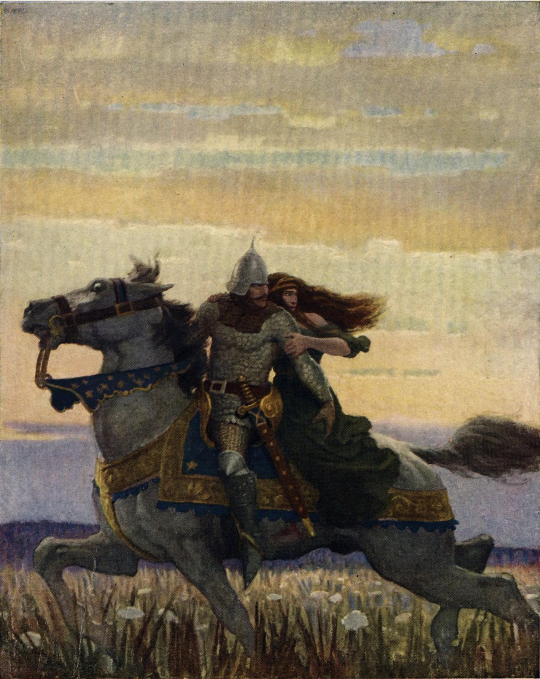
Well, this has to do with the idea of abduction as a trope in chivalric romance. In these stories, there really wasn’t a big difference between “running off with her” and “kidnapping.” Whether it’s Lancelot and Guinevere or Tristan and Iseult of chivalric romances, or the earlier Celtic sources whether Welsh or Irish (there’s a very similar story that’s part of the legend of Finn Mac Cool), the lady is married and is carried off by the knight against the wishes of her husband (hence why it’s called abduction/kidnapping and not elopment). 

Moreover, in a lot of these stories, there are very weird parallels between the very-much-married lady being kidnapped by a mysterious knight and spirited off to a strange castle in the Land of Summer or the Twisted Woods – and if all of this is starting to sound a lot like Faerie, you’re not wrong – from which she is rescued by the gallant knight (which is the spark for their falling in forbidden love) and the lady being rescued by the gallant knight from her husband’s wrath when the adultery is discovered, and spirited off to another castle, which is equally strange.

image

To bring this around to Rhaegar and Lyanna, the name of the castle that Lancelot takes Guinevere back to is Joyous Gard/Joyeuse Garde. Gard/garde means a keep, a keep is a fortified tower, and thus we get the Tower of Joy. However, Joyous Gard has a deeper significance than just the name: in the beginning of the story, it’s known as Dolorous Gard because the castle has been put under an evil enchantment; Lancelot takes the castle and breaks the spell, but finds within the castle a tomb with his name on it, and knows that he is going to be buried there one day. When Guinevere visits his castle – at a time when she’s still with Arthur and Lancelot and Guinevere are holding to a chaste romance – Lancelot changes the name of the castle to Joyous Gard in her honor. When Lancelot and Guinevere give in to their passion and their adultery is discovered, the castle becomes Dolorous Gard again, suggesting a Fisher King-like situation where the purity of chaste love has become the impurity of carnal love, dooming the land just as their adultery has caused the fall of Camelot, even as the castle becomes the refuge of the lady and her knight. 

The point is there’s a lot of doubling: the good knight and the evil knight, the lady fair and the adulterous queen, the good castle and the evil castle, and thus (to get all the way back to your ask) the kidnapper and the rescuer. 

How often did medieval commoners migrate from place to place? Like, say the North had developed booming textile and lumber industries and a commoner from a different kingdom wanted to move there for the work, how likely would it be they could do that?

Scholars seem to disagree, with some saying that most people never traveled further than ten miles from their birthplace, and other people pointing to the popularity of pilgrimage and other examples of medieval migration.

What I would say is that because most migration tended to be local and regional rather than long-distance, it would be unlikely that you’d see commoners moving to the North from Dorne. Rather, I think you’d see a lot of internal migration by Northerners and external migration from the northern Riverlands and the Vale. 

Couldn’t Robb have just sent ravens north ordering lords to gather and re-take Moat Cailin from the north? The Mandelys alone could probably have done so.

Robb could have sent the ravens, but the question is who would have gotten them? 

Winterfell had fallen, so there’s no Stark to coordinate the reconquest; the Northern lords are thoroughly distracted by the Hornwood Crisis and even when they get past that, the failed attempt to retake Winterfell further scatters the loyalist forces.

These are all dominos that have to fall for the North to fall, because as we see in ADWD, even with everything going against them, the Northmen still put Moat Cailin under siege, with the crannogmen attacking from the south and the Ryswells and Dustins from the North, and then Ramsay and Roose coordinating from north and south of the Moat. If Winterfell had not fallen or had been recaptured, Moat Cailin would no doubt have fallen faster. 

Given that a Tyroshi slaver off Bear Island would be quite far afield, do you think that, rather than Jorah selling those poachers into slavery being a one-off born of desperation, he in fact made a habit of selling slaves?

Good question!

So in AGOT, they only speak in general terms of Jorah “selling some poachers to a Tyroshi slaver” or “a few lice-ridden poachers,” although the people who talk about this are either slavers-in-all-but-name (Illyrio) or Jorah himself, who has every reason to minimize his crimes.

However, Jorah shows a surprisingly deep knowledge of the slave economy, much deeper than you’d expect to see from a Westerosi lord with only one encounter with this foreign economic system:

“I’ve told the khal he ought to make for Meereen,” Ser Jorah said. “They’ll pay a better price than he’d get from a slaving caravan. Illyrio writes that they had a plague last year, so the brothels are paying double for healthy young girls, and triple for boys under ten. If enough children survive the journey, the gold will buy us all the ships we need, and hire men to sail them.”

My thinking is that either Jorah sold slaves (more than once) in Westeros and/or he did it in Essos (or was otherwise employed in the industry as a guard or an overseer or something). I think the former case is more likely, because it seems somewhat unlikely that he got caught on his first outing. 

Quick Analysis of Fire and Blood Excerpt

Quick Analysis of Fire and Blood Excerpt

Big news for fans of ASOIAF lore: GRRM has released an excerpt from the upcoming Fire & Blood Volume I, which covers Queen Alysanne’s visit to the North.

There’s some really interesting new material here, which I think bodes well for Fire & Blood as a valuable addition to the broader corpus of lore about the world of ice and fire.

(more…)

View On WordPress

You’ve cited Edward of Lancaster before as a proto-Joffrey. May I ask why? Yes, he’s described as having been enthusiastic about war (the ‘lalks of nothing but making war’ thing), but that’s a far cry from Joffrey’s brand of indiscriminate sadism, isn’t it?

Here are the similarities:

  1. Disputed paternity: Yorkists alleged for a long time that the combination of Henry VI’s notorious piety on matters of the flesh and his repeated mental breakdowns meant that Marguerite d’Anjou had slept with one of her court favorites (either the Duke of Somerset or the Earl of Ormonde) to conceive an heir after eight years with no issue.
  2. Violent tendencies: Edward was more than a bit enthusiastic about war; in addition to talking about war, he also “talks of nothing but of cutting off heads,” and “delighted in attacking and assaulting the young companions attending him,” although it’s a bit ambiguous whether that was referring to military training. What’s not ambiguous is that, after the Second Battle of St. Albans, Edward ordered that the two Yorkist knights who had been guarding his father be decapitated, despite the fact that they had voluntarily stayed on the field to protect his father and had honorably surrendered. He was also reportedly a big fan of the decapitation and spiking of the Duke of York, his son the Earl of Rutland, and the Earl of Salisbury after Wakefield, so the beheading thing was a bit of a common thread. 
  3. Engaged to the enemy: Edward of Lancaster was married to Anne Neville, the younger daughter of the Earl of Warwick, who had been one of the chief supporters of the Yorkist cause and the opposing general at the Second Battle of Albans, for example.
  4. Similar rival: Just as Joffrey was enraged at the victories of Robb Stark the Young Wolf, Edward of Lancaster’s main opponent was the young Edward IV, who similar to Robb Stark was always victorious when he was commanding but who was undone when he broke his betrothal and made an impulsive marriage. 

In the show mance has spent 20 years to unite the free folk;in the books?

In the books, the timeline is more unclear, but it seems more recent:

  • We know that Mance was still with the Night’s Watch when LC Qorgyle visited Winterfell, and we know Qorgyle died sometime in 287/288. During the visit Jon and Robb were old enough to build a snow mountain on top of a gate as a prank, and Jon was old enough to remember Mance promising. Since Jon was born in 284 and Robb in 283, it is unlikely that it was much before 287/288, and even that’s pushing it slightly. 
  • Also, Osha says that Mance has never tasted winter, and we know that the current summer started in 288 AC, Mance had to have joined the Free Folk sometime after 287 AC. 

Chapter-by-Chapter Analysis: Jon IV, ASOS

Chapter-by-Chapter Analysis: Jon IV, ASOS

Game-of-Thrones-3x06-The-Climb

“In the Seven Kingdoms it was said that the Wall marked the end of the world. That is true for them as well. It was all in where you stood.”

Synopsis: Jon Snow and Ygritte climb the Wall.

SPOILER WARNING: This chapter analysis, and all following, will contain spoilers for all Song of Ice and Fire novels and Game of Thrones episodes. Caveat lector.

(more…)

View On WordPress

Was Randyll acting within the bounds of the law in forcing his legal heir to surrender all property rights ? Theoretically, could Sam have gone to Highgarden to seek intervention from their liege lord? Do you think there was any chance of Mace standing up for Sam against one of his principal bannerman (& most able general) ?

This is what GRRM has said on the matter:

“Well, the short answer is that the laws of inheritance in the Seven Kingdoms are modelled on those in real medieval history… which is to say, they were vague, uncodified, subject to varying interpertations, and often contradictory.

A man’s eldest son was his heir. After that the next eldest son. Then the next, etc. Daughters were not considered while there was a living son, except in Dorne, where females had equal right of inheritance according to age.

After the sons, most would say that the eldest daughter is next in line. But there might be an argument from the dead man’s brothers, say. Does a male sibling or a female child take precedence? Each side has a “claim.”

What if there are no childen, only grandchildren and great grandchildren. Is precedence or proximity the more important principle? Do bastards have any rights? What about bastards who have been legitimized, do they go in at the end after the trueborn kids, or according to birth order? What about widows? And what about the will of the deceased? Can a lord disinherit one son, and name a younger son as heir? Or even a bastard?There are no clear cut answers, either in Westeros or in real medieval history. Things were often decided on a case by case basis. A case might set a precedent for later cases… but as often as not, the precedents conflicted as much as the claims.”

Keep in mind, Randyll Tarly wasn’t proposing to write a will that bypassed Sam in favor of Dickon, or any such legal manuever. He was straight-forwardly threatening to murder Sam if he didn’t comply. 

So yes, potentially Sam could have gone to Highgarden and protested that his father was not only breaking the laws of inheritance but was an attempted kinslayer and murderer on top of that. I doubt that Mace Tyrell would have been particularly interested in championing Sam’s claims, however.