So here’s my thinking: there’s something really weird about the way that the WOIAF has the Maesters be a pre-Andal instituion but goes back and forth on the First Men having a written language.
So here’s my thinking. I think the runic writing of the First Men was quite complicated and difficult to learn, requring one to learn thousands and thousands of easy-to-confuse runes – and that the pre-Andal maesters thus relied as much more on memorizing oral traditions, similar to the traditions of the Celtic druids and bards.
And then come the Andals, but instead of overthrowing the system and burning the Citadel, they get incorporated into the power structure of the Reach and Oldtown more specifically. And so the maesters encounter these new Andal lords and knights, and there’s cultural sharing and intermingling going on.
Now, my headcanon is that the “Common
Tongue” is so named because it’s a relatively easy language to learn (atonal,
regular conjugations, no complicated system of cases and agreements,
straightforward grammar that doesn’t have the verb at the end of the sentence, etc.)
and a writing system that’s alphabetical rather than character-based, so it’s much easier to read and write and to teach people to read and write.
So early after the Andal incorporation into Oldtown, I think the maesters decided to adopt the Common Tongue and, with the help of the septons of the Faith, write down everything that had previously had been preserved orally, thus why “the tales we have now are the work of septons and maesters writing thousands of years after the fact,” and “the septons who first wrote them down took what details suited them and added others.”
Different paths of historical development, basically.
The IRL Medieval Catholic Church benefited from a number of factors:
It was the only pan-Western European (pan-European, when Rome and Constantinople could agree that I + I = δύο) institution when the Roman Empire fell and the first medieval kingdoms of the Franks, the Lombards, etc. were forming. Not only did that give it a certain amount of prestige, but it also meant that it was the only institution that could coordinate across borders, the only common authority that feuding kingdoms might appeal to.
It was the largest landowner in Europe at a time when land was the major source of political, economic, social, and military power. And because it was a corporate landowner, unlike with feudal lords, land wasn’t given away as dowries or split between sons or sold off to pay for ransoms, and there were no cases of the land falling into escheat because the only heir died intestate. The corporate entity kept growing and growing, century after century, and so the estates consolidated and could take advantage of economies of scale and do really long-range investments, making the Church a real economic engine of the Middle Ages.
It was also almost exclusively the source of literacy, learning, and communication. Churchmen were the literate class, especially early on, so in every court in Europe there were clergy serving as officials of state, bureaucrats, scribes and secretaries, as well as their religious duties. Since Church Latin was the only common tongue in Europe – the lingua franca well before diplomats started speaking French – the Church was immensely important in international communication. Up until the invention of the printing press, monks copying out manuscripts was basically the only source of books.
The Faith had none of these advantages.
When the first fair-haired Andal pirates landed on the shores of Westeros, they brought the Faith of the Seven with them, but no institutions – there was no High Septon and no council of the Most Devout to exercise managerial control, no network of septs and septries dotted across the continent for the Faith to draw revenue and manpower from. Instead, the warlords and adventurers very much followed their own truth, carving the seven-pointed star on their chests and letting the Seven speak to them (and surprisingly, the Seven told them to go forth and carve themselves kingdoms). While holy men no doubt would have influence on religious matters, as long as the Andals were smiting the heathen and cutting down their weirwoods, there’s not a lot they could say to shape the actions of the warrior caste they were dependent on.
For a brief period, the Faith could exercise some influence through the Arryn Kings’ patronage, but once the tide of Andals spilled out into the Riverlands, the petty kings and warlords and adventurers had no reason to listen to the King of the Mountains and Vale. And so the Faith would have to follow in their wake, building as they went.
And then the Andal tide broke, first on the rocks of Moat Cailin and the equally stony shores of the North, and then again on the stable, powerful, and dynamickingdoms of the West. Here were these foreign power structures, thousands of years old, who were assimilating into the Faith to be sure, but on their own terms and following their own interests, rather than the Faith’s terms and the Faith’s interests. So the Kings of the Rock and the Reach would become patrons of the Faith, but there would be no “Donation” of “Constantine”, no independent state.
Moreover, the Faith would also have to deal with competition from another pan-continental corporate institution, one which had been operating for thousands of years, which controlled access to literacy, learning, and communication, and which had advisors whispering into the ears of every lord in Westeros: the Citadel of Maesters. Now, I believe that there was a compromise between the Faith and the Citadel (incidentally, if someone could send me an ask to remind me to explain why I think the Andal language was key to this compromise…), but it was one where the Citadel’s monopolies and jurisdictions would be respected. Septons and septas could teach basic literacy and the tenets of the Faith, but the rest would be the domain of the maesters.
So when I talked about theDictatus Papae and the Walk to Canossa in previous asks, it’s actually a good example of how the two institutions were different. Here was Gregory VII, one of the most important Popes in history, laying down the law to cement the authority of the Catholic Church vis-a-vis the Holy Roman Emperor:
The Church is autonomous. Bishoprics and other offices belong to the Church alone, even if these positions had become mighty feudal states, Imperial Electors even. Only the Pope had jurisdiction over Church officials and lands, legal disputes involving the Church had to be settled by him in Rome, and so on.
The Pope is supreme over secular officials. Here Gregory really ran wild, stating that “all princes shall kiss the feet of the Pope alone,” and “it may be permitted to him to depose emperors.“ This, when Emperors had previously appointed and deposed Popes.
The Pope can dissolve the bonds of feudalism itself, through proclamations of excommunication, interdictionn, anethema, and so on. As Gregory put it, “He may absolve subjects from their fealty to wicked men.” And Gregory would do so, punishing Emperor Henry IV for attempting to assert authority over the Prince-Bishoprics of the Holy Roman Empire.
“The Roman Church has never erred. Nor will it err, to all eternity–Scripture being witness.“ That’s the origin of Papal infallibility, although less immediately relevant to the crisis.
This was somewhat controversial, to say the least. Henry IV responded by declaring Gregory “at present not pope but false monk,” calling for a new election of the Papacy, and challenging Gregory: "I, Henry, king by the grace of God, with all of my Bishops, say to you, come down, come down!” And while the Papally-sponsored rebellions in 1073-1075, and then again from 1077-1088 did force Henry IV to do penance in the snow at Canossa, in 1080 Henry IV was ready to fight back.
In 1080, Henry IV proclaimed Clement III to be the true Pope, reasserting Imperial authority to name the Pope, after Gregory had blessed Rudolf von Rheinfeld, the elected Emperor of the rebels. The next year, Henry invaded Rome and when Gregory VII called upon his Norman allies from southern Italy, they promptly sacked the city and Gregory was forced to flee when the citizens of Rome rose up against him, and died in exile.
If that’s what happened to a Catholic Church that was far more powerful than the Faith ever was, imagine what would have happened to a High Septon who tried to pull a stunt like that against the Lord of Oldtown and the King of the Reach. It wouldn’t have been the first time a High Septon was assassinated, and it wouldn’t be the last.
Synopsis: Retreating from the Battle of the Fist of the First Men, Sam Tarly slays a White Walker with the help of Small Paul and Grenn.
SPOILER WARNING: This chapter analysis, and all following, will contain spoilers for all Song of Ice and Fire novels and Game of Thrones episodes. Caveat lector.
(more…)
Well, Garth Greenhand wasn’t really a ruler per se, more of a nature/fertility god who does seem to have been venerated across the whole of the Reach. It was his eldest son Garth the Gardener who was the first King in Highgarden, and based on what we know about subsequent Gardener Kings, yes his kingdom was small by later standards (keep in mind, power is relative; if everyone else is a petty king…).
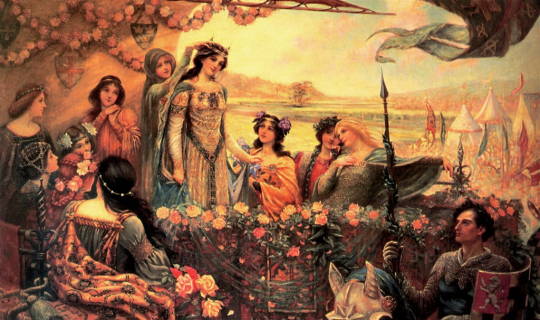
This is a tricky subject, because I think it’s an area where modern fandom and medieval literature have almost perpendicular perspectives. Let’s take the case of Lyanna and Rhaegar at the Tourney of Harrenhal, as seen below:
Oh no, wait. That’s actually a painting of Lancelot and Guinevere from 1890, a classic love story that involves adultery, murder, toxic relationship dynamics, and everyone dying horribly. And a lot of chivalric romance is like that – Tristan and Isolde, Gawain and the Green Knight, Percival and the Loathly Lady – they’re not about healthy relationships, they’re about DRAMA and TRAGEDY.
Now that doesn’t mean we can’t find something interesting/redeeming in them; a lot of feminist scholars have pointed out that the mechanics of courtly love at the heart of these chivalric romances (which often found their dramatic tension in the conflict between masculine-coded chivalry and feminine-coded courtly love) kind of results in this weird dom-sub thing where the lady is in charge of the relationship and spends a lot of time punishing the knight for not being impossibly faithful to her or thinking about anyone but her at any point.
(I mean, I can’t be the only one who sees something in all these paintings of men kneeling in front of women, right?)
But wrt to Rhaegar specifically, the knock on him is that he abandoned his wife and kids to run off with another woman in an unequal power dynamic. But if you shift the marriages around in any of these chivalric romances – so Lancelot is abandoning his wife to run off with Guinevere, or Tristan from his wife to run off with Isolde – you’d wind up with the same dynamic. Including the necessity of both of the adulterers to die in the end to restore the stability of patriarchial marriage.
And I think that’s what GRRM did, he took these stories that he’d grown up on and switched it around so that it was the prince running away from his wife instead of the queen from her king.
So does that pass muster with modern fandom’s conceptions of a healthy relationship? No. It’s not meant to (if only because unhealthy relationships are easier to mine for drama and tragedy).
A Romantic story is not the same thing as a romantic story.
““…mother of dragons…child of three…three heads has the dragon…three heads has the dragon…the ghost chorus yammered inside her skull with never a lip moving, never a breath stirring the still blue air…mother of dragons…child of storm…The whispers became a swirling song…three fires must you light…one for life and one for death and one to love…Her own heart was beating in unison to the one that floated before her, blue and corrupt…three mounts must you ride…one to bed and one to dread and one to love…The voices were growing louder, she realized, and it seemed her heart was slowing, and even her breath…three treasons will you know… once for blood and once for gold and once for love…”
And again:
“Her silver was trotting through the grass, to a darkling stream beneath a sea of stars. A corpse stood at the prow of a ship, eyes bright in his dead face, grey lips smiling sadly. A blue flower grew from a chink in a wall of ice, and filled the air with sweetness…mother of dragons, bride of fire…”
Plus all of the constant R+L=J stuff in HOTU, which suggests that Dany’s destiny is bound up with Rhaegar’s child of prophecy.
Well, just as I don’t want to yuck anyone’s yum, it’s awful hard to yum someone’s yuck, you know what I mean?
Speaking as someone who isn’t super into shipping, given how much really questionable/problematic sexuality that there is in ASOIAF,at least the relationship might be between two people of basically the same age, involve enthuastic consent, and lack the toxic dynamics that relationships founded on direct defiance of the Westermark effect seem to have.
And hey, we’ve had uncle/niece relationships in ASOIAF (looking at you, Jonnel One-Eye and your larger dynamic of trying to reconcile the competing claims of the daughters of Rickon son of Cregan by way of Arra Norrey with the sons of Cregan by Lyanara Stark), so at least there’s gender parity there. And hey, when has uncles and aunts marrying nieces and nephews ever caused a problem?
To answer your second question, I think it’s a cultural thing, a deep memory of the need to preserve the dragonrider DNA that ultimately comes from the strange blood magics that fused the ancient Valyrians to the dragons. That’s right tumblr, Dany’s a cryptid.
Ok, I’ve mentioned this in bits and pieces here and there, so I might as well do it in one place.
So, Jon’s definitely getting resurrected. Although I think it’s going to have a more profound effect on him than in the show:
Burning shafts hissed upward, trailing tongues of fire. Scarecrow brothers tumbled down, black cloaks ablaze. “Snow,” an eagle cried, as foemen scuttled up the ice like spiders. Jon was armored in black ice, but his blade burned red in his fist. As the dead men reached the top of the Wall he sent them down to die again. He slew a greybeard and a beardless boy, a giant, a gaunt man with filed teeth, a girl with thick red hair. Too late he recognized Ygritte. She was gone as quick as she’d appeared.
That screams fire wight and/or Azor Ahai to me…Anyway, once that happens, the question is, where does his story go next, what are the marks he needs to hit?
He needs to deal with the crisis at the Wall.
He needs to reunite with at least some of his family.
He needs to meet Daenerys and reunite with Tyrion.
He needs to deal with the Army of the Dead.
I’m not sure where and when and in what order that happens, but at some point the Wall is going to come down – although, like @poorquentyn I think this is going to involve Euron blowing the Horn of Winter, probably from the top of the Hightower – and the Army of the Dead will begin marching south.
At which point, we have to ask: where does Jon go when that happens? I don’t think his story is the defense of Winterfell, that’s Stannis’ story. Rather, I think Jon’s story involves going on a ranging north to the Heart of Winter where the Great Other dwells – because the “kill the one who raised them and the wights die” actually is a pretty good fantasy-style hook for a party of adventurers.
Who’s in the party, I’m not sure on. But if I’m right about the Last Hero story, having Jon go into the Heart of Winter with a group of characters we care about is an interesting parallel plus a way for GRRM to do the whole Fellowship of the Rings but no one has plot army thing. So the story is: Stannis holds the Army of the Dead at Winterfell (i.e, distracts the eye of Sauron) while Jon goes into the Heart to try to slay the Great Other and destroy the Army in one fell swoop (i.e, take the One Ring to Mount Doom).
But unlike in LOTR, I think the body count on this mission is going to be high indeed.
I see the Royces as something of the Vale’s Loyal Opposition. They’re one of the most powerful Houses in the Vale other than the Arryns, they’re older than the Arryns (and Valemen are super-snobby so this counts), and no one challenges the Arryns except for them. Hence why a Royce cadet branch ended up at the Gates of the Moon, why we see Royces as Lords Regent of the Vale, why Royces marry into House Arryn (and I would imagine vice versa), why it was the Royce of Runestone who besieged Jonos Arryn when he turned traitor, and why Bronze Yohn was one of the first to turn against Littlefinger.
I see them as somewhat assimilating and somewhat accomodating. On the one hand, the Royces have converted to the Seven and are definitely bang on side with the whole idea of knighthood and tourneys and the like. So they’ve done the big ticket things that matter. On the other hand, they’re very proud of their First Men heritage – the runic bronze armor, the marriages into House Stark, etc. – but I think in a way that works for the Vale. Being arch-traditionalists, the Vale are very into heritage, and the Royces being Seven-worshipping knights means that the First Men stuff is made “safe.”
This is historically grounded. Henry Bolingbrooke of Lancaster, Richard Duke of York, Edward of York, there was a long tradition of exiles making a landing and then claiming that they were only intent on reclaiming their family lands and bygones be bygones.
While almost always a cover for a coup, it was a good bit of political cover, because feudalism being what it was, the nobility were generally in favor of lands staying in the family and looked with deep suspicion on the monarch taking people’s lands (indeed, in the case of Henry Bolingbrooke, one of the main reasons why his coup succeeded was that the nobility really did not like Richard II seizing the Duchy of Lancaster from Henry as a matter of precedent and principle).
Thus, it made it difficult for the monarch to go all-out against the invader, in part because their vassals might be quite slow to respond to the call.




 RFTIT Tumblr Backup