You’re right about the overall meaning. More specifically, in Westeros the “right of pit” part describes the lord’s authority to imprison people, and the “right of gallows” part describes the lord’s authority to execute people.
Interestingly, there was a right of pit and gallows, or “furca and fossa” in Medieval Scotland. However, the meaning was slightly different: instead, it refered to the right of a lord to execute people for crimes, the gallows being reserved for hanging men, and the pit being used to drown women.
Even with the shutters firmly bolted against the howling winter wind, an insistent draft pushed its way through and set the candles to guttering. Munkun snatched up the fresh vellum sheet from his desk to spare the creamy white expanse from spatters of wax, and once again resented the fact that the pressures of office had forced him to confine his writing to the dark hours of…
This might be a better question for @warsofasoiaf, but I’ll try my best.
As far as swords go, we don’t have any mentions of sabres or curved swords in relation to Dorne. Curved swords do tend to be associated with Essos, so it’s possible that the Rhoynish brought that tradition to Dorne, but there’s no textual evidence for that. Where Dornish swords have been discussed – Dawn, for example – they’ve tended to be described in similar terms to the straight-bladed swords of the rest of Westeors.
The dominant weapon of Dorne is the spear, but there are a couple different variations:
Oberyn uses the long spear – “the spear was turned ash eight feet long, the shaft smooth, thick, and heavy. The last two feet of that was steel, a slender leaf-shaped spearhead narrowing to a wicked spike” – as a two-handed slashing and stabbing weapon. This seems to be a rather unusual way of fighting – probably associated with one-on-one combats – because we don’t see much in the way of Dornish fighting as pikemen.
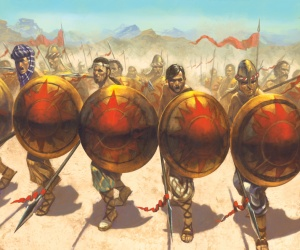
More commonly, the long spear is used in the Rhoynish fashion – “the Rhoynish warrior with his silver-scaled armor, fish-head helm, tall spear, and turtle-shell shield was esteemed and feared by all who faced in him battle” – one-handed with a round shield in close-formation, closer to the classical phalanx than the Macedonian.
However, there’s also lighter throwing spears – “the canny Dornishmen rained rocks and arrows and spears from the heights;” “many carried bundles short throwing spears” – which are used as javelins by both infantry and cavalry alike.
There are some other weapons which are also worthy of mention:
The Dornish are known for their recurve bows – “when the Dornishmen saw them coming, they spurred their own mounts, banners rippling as they rode…the double-curved Dornish bows they used so well from horseback” – which are used by infantry and cavalry alike.
As we can see from Dornish participation in various tourneys, we know that Dornish noblemen are also trained in the lance like the rest of their Westerosi peers.
In terms of armor, we have a couple different types used:
The Rhoynish smiths were especially adept at creating “suits of scale and plate.” So both heavier and lighter armors are available.
Oberyn prefers to wear lighter scale armor (“his shirt was armored with overlapping rows of copper disks that glittered like a thousand bright new pennies as he rode. His high gilded helm displayed a copper sun on its brow, and the round shield slung behind him bore the sun-and-spear of House Martell on its polished metal surface.”) in combination with some plate pieces (”The Red Viper was lightly armored; greaves, vambraces, gorget, spaulder, steel codpiece. Elsewise Oberyn was clad in supple leather and flowing silks. Over his byrnie he wore his scales of gleaming copper, but mail and scale together would not give him a quarter the protection of Gregor’s heavy plate”) to maximize his mobility.
Common Dornish soldiers are also known to wear “ring mail and crested helms.”
eidetictelekinetic said:I’m not one to miss “what if?” bait – what would have happened if Jaime had been allowed to fight at the Tourney of Harrenhal? (Great analysis of one of my favorite ASOS chapters btw!)
Okay, I’ll bite: what do you think would change from OTL if Jaime had been allowed to fight at the tourney at Harrenhal?
What would have happened if Jaime had been allowed to fight at the Tourney of Harrenhal? Hahaha hint taken
Taking the hint, what would have happened if Jaime had participated at the tourney at Harrenhal?
So what happens if Jaime is allowed to fight in the tourney of Harrenhall after being named to the Kingsguard?
indomitablerocinante said:What would have happened if Jaime had been allowed to fight at the Tourney of Harrenhal?
Aha, my scheme has worked! Answer below the cut:
So Jaime is probably right that, if he was allowed to fight at Harrenhal, he probably would have won, considering that he was one of the best tourney knights of his day and that Martin has established that being fired up by circumstances can inspire a jouster to greatness. This butterflies away the whole scene with Rhaegar crowning Lyanna the Queen of Love and Beauty, which avoids a scene but probably doesn’t prevent them running off.
However, the more interesting question is who Jaime would have named instead. See, unlike @cynicalclassicist, I’m not sure that Cersei couldn’t have been there. We know from the Knight of the Laughing Tree that Tywin didn’t go, but that “many of his bannermen and knights attended all the same,” and Cersei could have been escorted by one of them.
The trickier thing is whether Cersei would have had the opportunity, because here the text is somewhat inconsistent. In one place in Jaime II, it’s suggested that Jaime and Cersei did in fact overlap (if only briefly) at the royal court at the time that Jaime was made a knight of the Kingsguard, which was the same day as the Tourney:
Jaime’s investiture freed him from Lysa Tully. Elsewise, nothing went as planned. His father had never been more furious. He could not object openly—Cersei had judged that correctly—but he resigned the Handship on some thin pretext and returned to Casterly Rock, taking his daughter with him. Instead of being together, Cersei and Jaime just changed places, and he found himself alone at court, guarding a mad king while four lesser men took their turns dancing on knives in his father’s ill-fitting shoes.
The key thing here is that Tywin “returned to Casterly Rock,” so that he was at King’s Landing when he resigned. So if Jaime was invested at the tourney, “before the king’s pavilion, kneeling on the green grass in white armor while half the realm looked on,” how is it that Tywin (and thus Cersei) was not there if the investiture was what made him resign and take Cersei home?
So I think it’s possible that Cersei would have been able to be at the tourney, and if she had been there, absolutely Jaime would have named her Queen of Love and Beauty. As far as the outside world was concerned, Jaime would have been honoring (and promoting) his sister; as far as Jaime was concerned, it would have added the perfect tragic note to his story, giving the crown of flowers even as the sibling-lovers are parted by cruel fate.
However, if Cersei wasn’t there, I think it probable that Jaime would have named either Queen Rhaella or Princess Elia, as both would have been proper for a knight of the Kingsguard to honor House Targaryen. (Whether Aerys would have seen the latter as a Dornish plot is another question altogether.)
“They took my sword hand. Was that all I was, a sword hand?”
Synopsis: Jaime tries to die, but decides to live instead.
SPOILER WARNING: This chapter analysis, and all following, will contain spoilers for all Song of Ice and Fire novels and Game of Thrones episodes. Caveat lector.
The Dornish have certainly had maesters for some time, at least as long as the Targaryen conquest, so I doubt they’d have none.
The Iron Islands is tricky. WOIAF doesn’t say that Quellon was the first Ironborn to bring in maesters necessarily, just that he brought in dozens of them. My guess is that Harmund the Host probably was the first Ironborn to bring in maesters, but that they didn’t stick around due to the Shrike’s rebellion and the war of the Famine Winter. (Similar to how Balon banished maesters from his court.)
The North has had maesters for at least 500 years, based on the maesters’ records at White Harbor. It’s probably been longer than that, because there were maesters at the Wall since the Feast of Skane. If I had to guess, I’d say that maesters have been in the North at least since the Manderlys came from the Reach, so at least the last 1000 years.
Beyond regions, I think it comes down to the bottom reaches of the nobility, the least lords, poor landed knights, and the like, who couldn’t afford the fees.
In a recent post you mentioned lords paying for the services of a maester. Did they actually pay a stated fee, make a “not so voluntary” contribution to the citadel, or just pay for the maester’s upkeep? Did the citadel “sell” maesters with a higher ‘gpa’ for more? That quote really turned the gears in my head and got me wondering and I would love to hear a follow-up, thanks!
Lords pay for the service of the Maesters and the Citadel collects some of the revenue of Oldtown via taxes.
So the lords have to pay the Citadel to receive the service of a maester, and they also have to provide for the maester’s upkeep (I doubt that maesters have personal incomes, given their vows, but they undoubtedly have budgets to pay for necessary supplies like medicines, paper and ink, and the like). We don’t know exactly what the terms of these agreements are; however, it stands to reason that that lesser lords don’t have the same ability to pay as the Great Houses, so the fees probably aren’t uniform.
We also can tell how many areas of expertise various maesters have (and how deep their expertise goes by the number of links of each kind of metal): Luwin has a relatively short chain, but he knows history, healing, herblore, ravenry, architecture, astronomy, and the higher mysteries (which is pretty rare); Pycelle has multiple links in ten different subjects (including warcraft, mathematics, ravenry, medicine, astronomy, history, but noticeably not the higher mysteries) indicating extensive expertise in a number of areas; Aemon has multiple links in medicine and either math and economics or whatever red gold indicates, as well as warcraft, ravenry, and a number of other subjects.
Beyond that is supposition: I would assume that these additional services are more in demand by the Great Houses, since they have need of more complicated services (if you only have the one castle, you probably don’t need a maester who knows how to design castles; if you’re the lord paramount of a kingdom, you might well need a maester to design new castles for you), and they have a higher expectation for the education of their children. Moreover, since maesters with more subjects on their chain means acolytes spending more years being trained at the expense of the Citadel, I would imagine the Citadel would charge more for their services.
Are you asking if sorcery is illegal in Westeros? Then the answer is no, for the most part. There’s plenty of examples of people using the services of maegis of various stripes, from Targaryen kings down to Lannisport smallfolk.
However, it does seem as if sorcery is fairly taboo in Westeros, as we can see the Faith of the Seven being pretty consistent in their opposition to sorcery, as we can see in the case of street preachers condemning Bloodraven or the High Septon pleading with Aegon V not go through with his ritual at Summerhall, or (and this is the closest we get to illegality) Baelor I burning the writings of Septon Barth for his heretical investigations into sorcery.
I would argue that ravenry and medicine are the bare minimum for service outside the Citadel; no lord is going to pay for a maester without getting those base services. I’m sure there’s plenty of maesters who prefer an academic’s life who get by without those skills, but they can really only earn a living at the Citadel itself.
Everything beyond that is about making yourself a more attractive advisor and teacher: so it’s not that learning warfare is important because you want to advise your lord on strategy, it’s important because you can teach his sons that while you’re teaching them to read and write. Likewise, learning math and economics and/or astronomy means that you can keep the account books and tell people when it’s best to plant and when to harvest, so that you can assume the role of a steward, giving you more influence in the lord’s household. Metullurgy or history or architecture or foreign languages might not be necessary for a marcher lord, but they would be useful to a great lord.
Sure, I’d be happy to. In terms of characters, we have:
Brienne is the Knight of the Woeful Countenance. Quite literally, given what Biter does to her face. In a broader sense, she’s a knight who isn’t a knight, yet is the only one who holds to the true ideals of knighhood in a world of cynics.
Pod is Sancho Panza. The hapless yet infinitely loyal squire who follows his knight to the end, even when that takes him into hideous danger.
In terms of plot arcs, Brienne spends the whole of AFFC engaged in an impossible quest: Jaime has given her his sword and sent her forth to “make good our stupid vows to your precious dead Lady Catelyn“ – but Brienne finds herself fruitlessly chasing rumors. She tries to track down Dontos Hollard, but finds Shagwell, and she never learns that Dontos Hollard is dead and that Sansa is in the Vale. She tries to track down Sandor in the hopes of finding Arya, but she doesn’t recognize Sandor when she comes across him, and ends up finding Rorge instead, who’s been pretending to be the Hound. And even if she had found the Hound, he doesn’t have Arya anymore.
But despite her task being practically impossible, despite having every rational reason to give it up, Brienne refuses to compromise her ideals. No matter that Shagwell ambushes her three on one, no matter than Rorge shows up at the inn with “Seven, Brienne thought again, despairing. She had no chance against seven, she knew. No chance, and no choice,” she keeps fighting.




 RFTIT Tumblr Backup