Steven Xue Asks: Why didn’t the Ironborn reave an independent Dorne?

I’ve been going through the World Book and I find it strange how during the first century and a half of living under Targaryen rule when Dorne was still an independent kingdom at that time, the Ironborn didn’t take the opportunity to go there for pillage and plunder. I can understand that after submitting to Targaryen rule the Ironborn stopped raiding lands that are under the protection of the Iron Throne as they would not stand a chance against the combined might of the Seven Kingdoms (as Balon Greyjoy would later learn).

However during the time Dorne was still a sovereign country it was outside of the Crown’s jurisdiction so it wasn’t off limits. Surely Dorne should have been the perfect hub for Ironborn raids during the years before it was finally integrated into the Seven Kingdoms. It is closer to home than the lands beyond Westeros and it’s very rich. Its coastal regions especially like Planky Town which brought in a lot of trade seem like ideal targets for eager Ironborn captains as there is plenty to plunder there and they could take their chances with the Martells as there would have been no interference from the Iron Throne.

Given how tenacious the Ironborn have proven themselves to be throughout history when it came to sating their desire to pillage and plunder and attacking pretty much anywhere that’s vulnerable (eg. The North), what was stopping them from conducting full scale raids in Dorne? 

They probably did raid Dornish trade in the Narrow Sea, but the thing about Dorne’s southern coastline is that it’s really not good for sailing: “Nor is the long southern coast of Dorne more hospitable, being for the most part a snarl of reefs and rocks, with few protected anchorages. Those ships that do put ashore there, whether by choice or chance, find little to sustain them; there are no forests along the coast to provide timber for repairs, a scarcity of game, few farms, and fewer villages where provisions might be obtained. Even freshwater is hard to come by, and the seas south of Dorne are rife with whirlpools and infested with sharks and kraken.”

So the basic problem is that the Ironborn couldn’t really raid anywhere in between Skyfall and Plankytown because there aren’t really any coastal villages to raid. Also, the trip to Plankytown is a pain in the ass – if a storm blows up, you’re going to be wrecked and unable to repair your longboat or find food and water, and that’s assuming you don’t get eaten by sharks and krakens.

So my guess is that what the Ironborn would do instead is to run the gauntlet to the Narrow Sea and then prey on Dornish shipping there. 
elanabrooklyn:

elanabrooklyn:

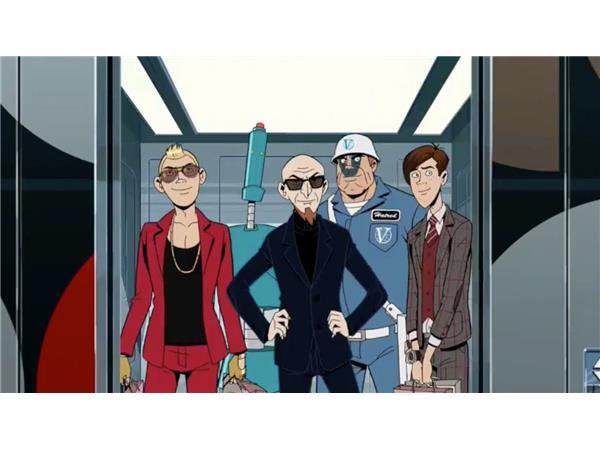
9pm on the podcast is our Venture Brothers Season 6 Premiere Special! 02/03 

Join me and @racefortheironthrone live or download it later. We’re experts. So listen!

The Venture Brothers cartoon on Adult Swim references everything from Hannah-Barbara to Marvel, Led Zeppelin to the Big Bopper, cult cinema and even Oscar Wilde. The show’s central theme is failure– the reality of life after the promises and optimism of the 60s space age have faded. But also the positive value of failure as a way to learn and grow, of making unpleasant realities better, and ultimately whether you can learn to keep the joyfulness of youth without its illusions.

In this podcast episode Elana and Steve explore the series as pop culture history geeks, talking about the episodes, drawing out themes and references.

You can download and give a listen! http://bit.ly/1X4zWzZ

and we should be on itunes by now over here:

Witness: bonuses opinions on Doctor Kilinger (who does not appear in this episode)! My theory on the Sovereign really actually being David Bowie! and more!

Were guerilla and Fabian tactics feasible in the medieval period? I know the Romans employed the concept (hence Fabian tactics), but it seems like most nobles would be a little averse to it given that it requires more decentralized leadership and a more empowered populace to maintain supplies, morale, equipment, etc.

Absolutely. 

If you look at the history of the various wars between Wales and Norman England, leading up to Edward I’s conquest, the Welsh enjoyed their biggest successes when they used guerrilla tactics against the better-equipped but slower English armies, using a combination of the longbow, hit-and-run tactics, and the Welsh mountains as secure refuges. 

Likewise, Bertrand du Guesclin, Marshal of France from 1370-1380, took over after the disasters of Crecy and Poiters, and used Fabian tactics to great effect in Brittany, Castille, and Poitiers, reversing most of the French losses from that phase of the Hundred Years War. 

This is kind of a follow up to the Aegon reforms question and I apologize if it is a bit long or boring. Do we have any information (or do you have any guesses) on how towns, cities and municipalities overall are originated and administered? Burghers were generally a separate class from manoral peasant IIRC and had unique privileges as well (though I may be wrong). Most municipalities seem to predate the Targs though so it seems a little unclear how is overseeing here. Additionally do you think

status hierarchy varies at all by region? I seem to recall from the Defiance of Duskendale section of WOIAF that Lord Darklyn was partially inspired by the fact that the Dornish lords retained their ability to autonomously administer cities (which is odd because they apparently don’t have any!). I completely understand if you want to correct me somewhere or if you think GRRM has not really developed this part of the worldbuilding.

One correction: Darklyn was primarily inspired by the Essosi paradigm (where you have full city-states), not the Dornish paradigm: “It was Lord Denys’s desire to win a charter for Duskendale that would give it more autonomy from the crown, much as had been done for Dorne many years before, that began the trouble. This did not seem to him such a vast demand; such charters were common across the narrow sea, as Lady Serala most certainly had told him.” (WOIAF, Aerys II)

The answer is we don’t know much. We know that city charters exist, we know they involve autonomy from the crown on some matters, notably “port fees and tariffs,” and that they require royal approval in the Crownlands and used to as well in the Riverlands when they were independent.

One thing we can say is that the most expansive form of rights, where cities were completely self-governing communes answerable to no one but the king, doesn’t exist in Westeros. White Harbor is ruled by the Manderlys, Oldtown by the Hightowers, Lannisport by the Lannisters, Gulltown by the Graftons.

From the little we know, city charters seem to be largely focused on taxation and other economic regulations – city charters allow cities to set their own port fees and tariff rates to some extent, allowing them to more effectively compete for trade. I say to some extent, because we know that Tywin and Aerys II fought over tariff rates and port fees at Oldtown, Lannisport, and King’s Landing, so it’s clearly not full autonomy. 

Based on historical parallels and the fact that city charters are expected to lead to expansion, my guess is that the main things that Westerosi charters involve are: 

  • the right to hold markets and fairs and regulate them.
  • the right to establish public warehouses where goods can be stored.
  • the staple right, which means foreign merchants have to unload their goods in your town and exhibit them for sale there for a given period before moving on. 
  • some sort of autonomy or revenue-sharing on port fees, tariffs, and other taxes on commerce. 

elanabrooklyn:

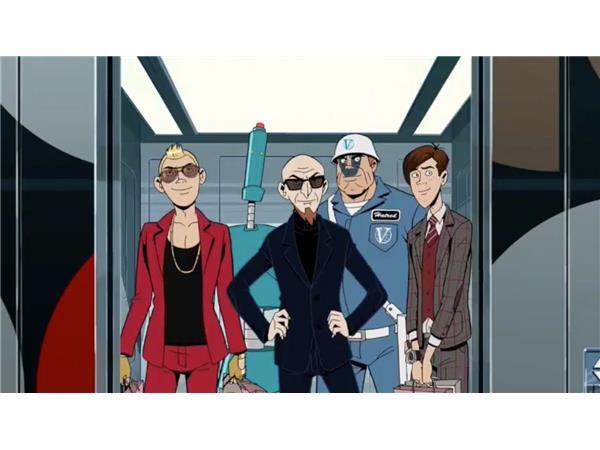
9pm on the podcast is our Venture Brothers Season 6 Premiere Special! 02/03 

Join me and @racefortheironthrone live or download it later. We’re experts. So listen!

The Venture Brothers cartoon on Adult Swim references everything from Hannah-Barbara to Marvel, Led Zeppelin to the Big Bopper, cult cinema and even Oscar Wilde. The show’s central theme is failure– the reality of life after the promises and optimism of the 60s space age have faded. But also the positive value of failure as a way to learn and grow, of making unpleasant realities better, and ultimately whether you can learn to keep the joyfulness of youth without its illusions.

In this podcast episode Elana and Steve explore the series as pop culture history geeks, talking about the episodes, drawing out themes and references.

A People’s History of the Marvel Universe, Week 2: John Byrne’s Hatred for Pierre Trudeau

Face front, true believers!

Welcome back to A People’s History of the Marvel Universe, where I explore how real-world politics (and weird bits of pop culture) was presented in some of my favorite bits of classic Marvel comics.

Today, I’ll be exploring how real-world politics intersected with Chris Claremont’s classic run on X-Men. Now, Claremont X-Men is some of the richest source material imaginable, given the way that the mutant metaphor has been used to address contemporary social issues facing different minority groups.

So what ripped-from-the-headlines issue will be looking at this week? Canadian politics from the 70s!

As many Marvel fans know, long-time X-Men artist John Byrne was a huge Wolverine fan who lobbied to keep him in the X-Men because he wanted to keep a Canadian superhero in the group, and who created Alpha Flight, Canada’s own superhero team.

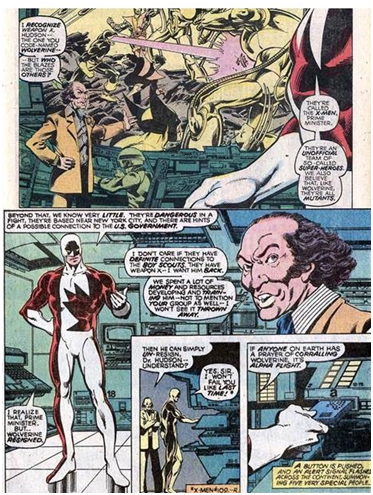
What you might not know is that John Byrne really did not like Pierre Trudeau, who served as Prime Minister of Canada from 1968-1979 and 1980-1984. Indeed, I would go as far as to say that, judging from his artwork in X-Men #120 from April of 1979, he hates the man:

Start with the visuals – from the orange leisure suit/striped open-collar shirt combination (while Mr. Trudeau was a bit more of a “swinging young bachelor” than your average Canadian prime minister, I’ve yet to find any images of him in that ugly of a suit) to the rapidly-retreating hairline to the fearsome conk, the suggestion of the buck tooth and the Hapsburgian jaw, this is less the somewhat naturalistic Marvel house style (especially when contrasted against the Marvel house styled Guardian to his left) than a political caricature.

But let’s move on to the text, where the Prime Minister of Canada, a country that abolished slavery in 1833, is arguing that (because Wolverine’s adamantium-laced skeleton was funded by the Canadian government, or the US and Canadian governments) Logan should not be allowed to resign a commission in the Canadian military (even though James MacDonald Hudson’s response suggests that he should be able to). Following his orders, Alpha Flight basically kidnaps a commercial aircraft transiting between Alaska and the continental U.S, assaults a number of foreign nationals in the middle of Calgary International Airport and downtown Calgary, all to put Wolverine into a literal cage (X-Men #120-121).

So why is Canada so evil that John Byrne depicts Canadian military backing up Alpha Flight in the same uniforms as the Death Star technicians? If I had to guess, I’d say that John Byrne was among those who objected to Pierre Trudeau’s decision to invoke the War Measures Act during the October Crisis in 1970, where Canadian military were put on the streets of Montreal and almost 500 people were arrested and held without charge.