Hi. You’ve discussed the impact of 1930s radical/political movements in New York on Steve Rogers before, but I was wondering if you could offer a similar overview on the 1920s? General perception of the 1920s is, so far as I can tell, that it was a largely conservative period, wedged between the Progressivism of the 1900s-1910s and the New Deal. Is this accurate? And, even if it is, what about the radical leftist groups that preceded the Popular Front of the 1930s?

Hey, great question!

It depends on how you look at it. Certainly, when it comes to electoral politics, the 1920s saw a hard turn against the Progressive movement in both major parties and (with the exception of Robert LaFollette in 1924) third parties as well. 

However, recent historiography has broadened our analysis to emphasize instead the 1920s as a period of conflict in American cultural politics. For the first time, the easy availability of new forms of mass media (chiefly radio and Hollywood movies) brought the culture of American cities into contact with the culture of American rural areas. (Keep in mind, the U.S had only recently crossed over from majority-rural to majority-urban in 1920, and the sides were fairly evenly matched.) 
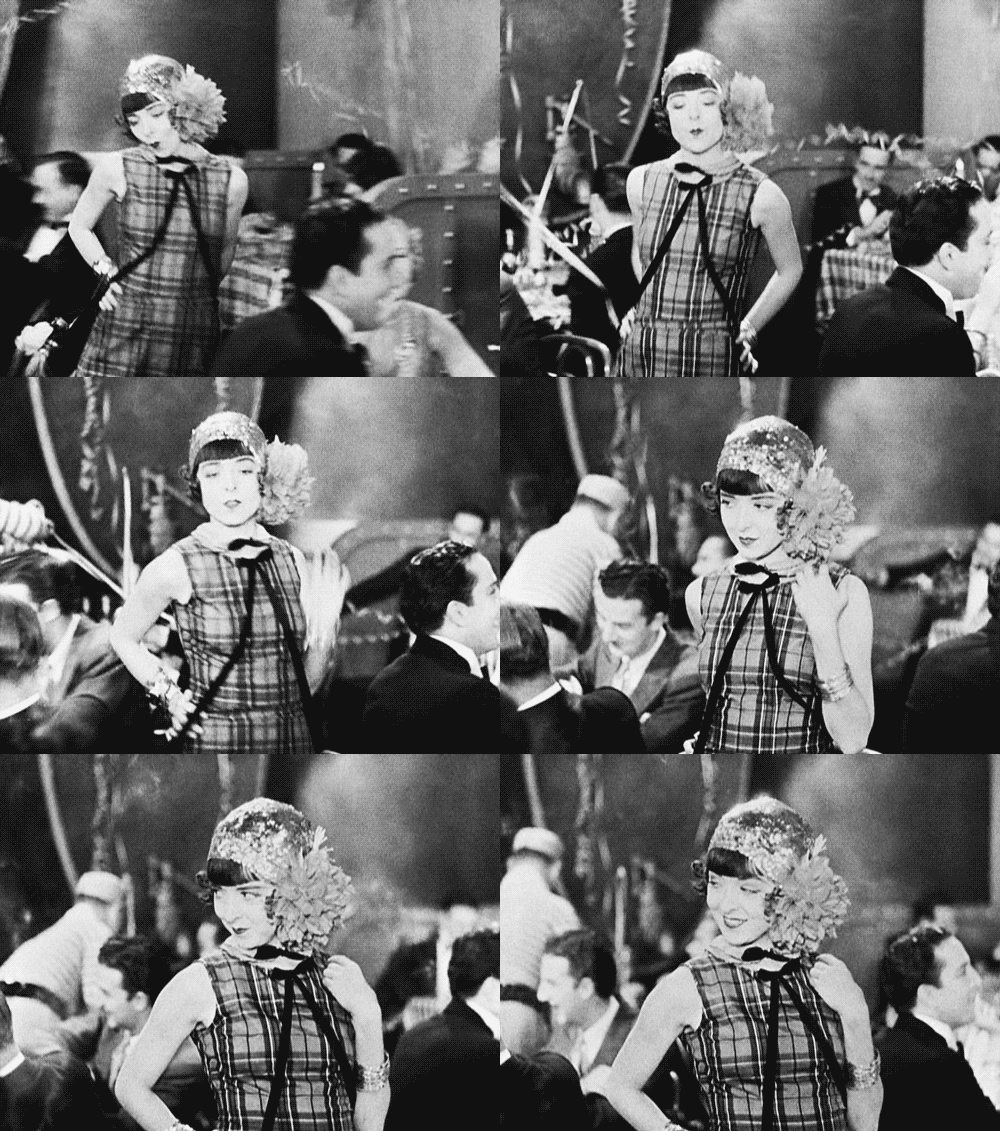
Now, it’s not like the mass media industries of the 1920s were run by radical activists – depictions of flappers and speakeasies were good business as well as challenges to traditional morality, movies that depicted frank (including non-heterosexual) sexuality and/or violence and/or crime were made for the same crass commercial reasons that rated-R movies are made today – but their ubiquity and popularity really did make them a threat to “traditional morality,” and Hollywood had good reason to fear a ginned-up moral panic, with state legislators surfing the wave of “family values” politics from the successful ratification of the 18th Amendment.

A word on that, just to finish up. One of the things that scholars have written about in really interesting ways in recent scholarship is the complicated ways that conservative movements of the 1920s interacted with modernity – whether you’re talking about fundamentalist religious movements, which couldn’t get enough of the new technology of the radio as a way to evangelize to hereto undreamt-of audiences, or the way that the “new” Klan used modern mass advertizing and fundraising methods to drive its message of traditional white anglo-saxon culture threatened by old enemies plus the new enemies of immigrants and urban modernity, etc. Which complicates the urban/rural, modernity/traditional values story a lot.

As for movements of the left…yeah, they were around. Committed activists didn’t go anywhere and there were a lot of good fights being fought throughout the 1920s. But if you were on the left in this period, you knew that you had just suffered a major defeat and were trying to hang on until the environment shifted to being more in your favor. 

In regards to the War of 5 or 4 Kings, what do you think about this legalism? Balon’s claim actually predates all of the others, by a decade & folk were aware of it (notably Robb in his offer, sent while Renly was alive) even if he hadn’t held a coronation. His argument to Robert was that he wasn’t a traitor, since his duty to the throne died with Aerys and Robert seems to have tacitly accepted that, by demanding the missing oath. Thus Balon’s reign would date from Robert’s death.

I think Balon mooted that particular claim by himself:

“Quellon Greyjoy still sat the Seastone Chair when Robert Baratheon, Eddard Stark, and Jon Arryn raised their banners in rebellion. Age had only served to deepen his cautious nature, and as the fighting swept across the green lands, his lordship resolved to take no part in the war. But his sons were relentless in their hunger for gain and glory, and his own health and strength were failing. For some time his lordship had been troubled by stomach pains, which had grown so excruciating that he took a draught of milk of the poppy every night to sleep. Even so, he resisted all entreaties until a raven came to Pyke with word of Prince Rhaegar’s death upon the Trident. These tidings united his three eldest sons: the Targaryen were done, they told him, and House Greyjoy must needs join the rebellion at once or lose any hope of sharing in the spoils of victory. (emphasis mine)

Lord Quellon gave way. It was decided that the ironborn would demonstrate their allegiance by attacking the nearest Targaryen loyalists.“

(WOIAF)

The Iron Islands could not have simultaneously been independent prior to Robert’s Rebellion (Balon’s argument following his defeat at Pyke) and have joined the rebellion prior to the Battle of the Mander (Balon’s argument in 283 AC) – because that battle post-dated the news of the Battle of the Trident, and Robert’s acclamation would have been part of that news.

And this, along with so many other reasons, is why Balon Greyjoy is utter bullshit.

Why are some lords’ titles named for their castle and others for their domain? Like Lord of Winterfell, not The North or Wintertown, but then there are the lords of White Harbor, Barrowtown, Oldtown and Duskendale, instead of New Castle or Barrow Hall or the High Tower or Dun Fort? Or Prince of Dorne, instead of Sunspear. It even confuses Emmon Frey, who conflates his title to Riverrun with the Paramount Lordship of the Riverlands.

The short answer is that GRRM is more of a gardener than an architect, and his thinking about titles has changed over time, but without retconning to make everything consistent, you get anomalies. 

However, keep in mind that lords can have more than one title. Wyman Manderly isn’t just the Lord of White Harbor, but also the Warden of the White Knife, Shield of the Faith, Defender of the Dispossessed, Lord Marshal of the Mander, Knight of the Order of the Green Hand, etc. 

So it’s quite possible that a lot of these irregularities are due to the fact that these lords have both titles – one referring to the castle and one referring to the fiefdom – but one of them is more common. 

Are people only called “subjects” in relation to their monarch, or to their liege lords as well? For instance, the villagers in The Sworn Sword – They are subjects of King Aerys, but are they also subjects of Ser Eustace? of Lord Rowan? of Lord Tyrell?

Good question!

From what I’ve read, the term “subject” can be used to describe the relation of an individual to their immediate liege lord as well as their ultimate sovereign, although it might not have been the most common term used; you might instead use the term “liege-man” or “tenant” to avoid confusion. 

Why do Americans use the term ‘socialism’ to refer to economic systems ranging from Nordic welfare capitalism to Stalinist state socialism? This seems bizarre to me.

It’s basically due to the fact that the socialist tradition in America was A. historically (mostly) confined to European immigrant enclaves in the Northeast and Midwest and then B. was viciously repressed in the first and second Red Scares, stamping out what socialist tradition had managed to form. (To give an example of the chilling effect of the first Red Scare: in 1912, Eugene V. Debs got 900,000 votes or 6% of the total in the general election as the Socialist candidate; by 1924, the Socialist candidate got less than 30,000 votes or .13% of the total.)

The result was, that unless you came from particular immigrant or ethnic backgrounds and/or were a “red diaper baby,” most Americans post-1945 especially would have no exposure whatsoever to the mainstream socialist traditions and their basic political vocabularies that would have been entirely normal to anyone who grew up in a working class European family in the same period. 

Add onto that a rich and vigorous history of various conservative forces in the U.S labeling pretty much any domestic liberal reform and more than a few soon-to-be-overthrown foreign nationalist governments as “Communistic,” and you begin to see why our grasp on the political language of socialism is so feeble.