I just read your Meereen essay. Isn’t criticizing Danys’ actions in Yunkai & Astapor what you call presentism? Her goal was not maintaining control over Astapor or forming a Slaver’s Bay Empire. At the time, she was still heading back to Westeros. She needed her troops there & more importantly, none of them WANTED to stay and rebuild the city that maimed & brutalized them. If any of them did, I really doubt Dany would given the reply her father gave about Jaime at Harrenhal.

I don’t think it’s presentism at all; indeed, I would argue my critiques would have been evident in the moment itself. 

As for Astapor, it was absolutely Dany’s goal that there be a new regime in the city. We know this, because she went to the lengths of setting up a new government, “a council of former slaves led by a healer, a scholar, and a priest.” And we know that it certainly was not her desire to see that government overthrown, because we know the dismay with which she greets the news that Cleon has overthrown her government, reintroduced slavery, or started a new war with Yunkai. 

I would argue that, at the very least, Dany’s advisers would have told her that no government can or ever has existed without a monopoly on violence, so that pulling every single trained soldier out of the city would leave the government unable to resist a coup. 

As for “needing her troops there,” she wouldn’t have needed to leave that many soldiers in Astapor. Cleon didn’t have an army backing his coup, he was just a big dude with a meat cleaver and an angry crowd; leave the council fifty or a hundred.trained soldiers, and Astapor would still be a slavery-free, unsacked city right now. 

As for “more importantly, none of them WANTED to stay” – assumes facts not in evidence. 
long ask ahead: Since the Others are like jrr Tolkien’s evil Maia in that they don’t create they just twist things and control creatures, could it be that they are created by the great other the way Melkor created orcs from elves? It’d be grrm body horror for that to be the case, human babies twisted by some huge ice slug monster until they are no more and a new, subservient (to the great other) consciousness and new body emerge. this would also give Dans Jon n Tyrion something to go down fighti

My last ask was long and got cut off, was asking about the great other and how it might create the others in a way that fits the whole “opposite of life” and thus can’t create naturally set up the others seem to be alluded to have. I’m not sure if it came through in what I submitted, but I was asking if you think this is the way grrm envisions them? Cause if so to me it’d make sense of what the three amigos will be on a mission for beyond the end of the world: torching the great other.

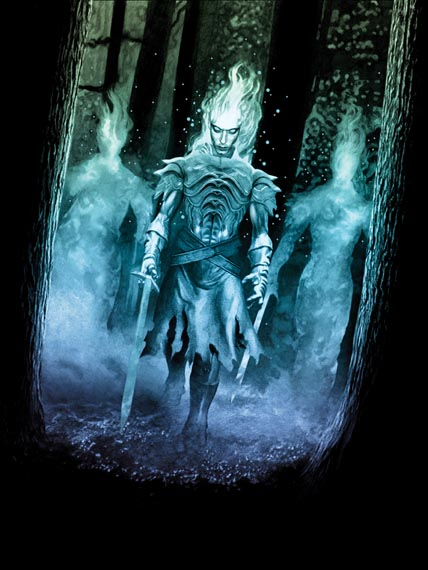
I don’t think that GRRM is particularly looking to JRR on the White Walkers. To me, the quote that’s the most important from GRRM is that he describes the White Walkers as “Sidhe made of ice, something like that.” If you’re looking for where GRRM’s getitng his inspiration, look to the Unseelie Fae, look to the folklore of the Wild Hunt – an unpredictable, irrational, malicious force that comes thundering down on humanity out of a winter’s night and then vanishes. 

image

As for creation, I don’t think that’s quite right either. Unlike on the show which has tended to blend the two, GRRM has always been quite clear that the created wights and the White Walkers are not the same thing, that the White Walkers are a non-human species. Moreover, GRRM has said that “the Others can do things with ice that we can’t imagine and make substances of it.” We’ve seen that the White Walkers have a material culture, they make swords and armor out of ice, they probably make other things we ken not of. 

As for what our heroes will find when they travel to the Heart of Winter and encounter the Great Other, I don’t know. No matter whether you travel north or west or east or south, the further away from the center of things you go, the more the map becomes hazy and indistinct, until all that’s left is “Here Be Dragons.”

Why do Americans use the term ‘socialism’ to refer to economic systems ranging from Nordic welfare capitalism to Stalinist state socialism? This seems bizarre to me.

warsofasoiaf:

racefortheironthrone:

It’s basically due to the fact that the socialist tradition in America was A. historically (mostly) confined to European immigrant enclaves in the Northeast and Midwest and then B. was viciously repressed in the first and second Red Scares, stamping out what socialist tradition had managed to form. (To give an example of the chilling effect of the first Red Scare: in 1912, Eugene V. Debs got 900,000 votes or 6% of the total in the general election as the Socialist candidate; by 1924, the Socialist candidate got less than 30,000 votes or .13% of the total.)

The result was, that unless you came from particular immigrant or ethnic backgrounds and/or were a “red diaper baby,” most Americans post-1945 especially would have no exposure whatsoever to the mainstream socialist traditions and their basic political vocabularies that would have been entirely normal to anyone who grew up in a working class European family in the same period. 

Add onto that a rich and vigorous history of various conservative forces in the U.S labeling pretty much any domestic liberal reform and more than a few soon-to-be-overthrown foreign nationalist governments as “Communistic,” and you begin to see why our grasp on the political language of socialism is so feeble. 

I’m a bit confused by this conclusion. The First Red Scare had begun in 1917 and was over by 1920. On Election Day in November 1920, Debs earned 900,000 votes, slightly more than he received in the 1912 election by raw vote totals. In the 1916 election, before the First Red Scare, Allan Benson ran as the Socialist Party’s candidate and received 3.19% of the popular vote. In the 1920 election, Eugene Debs earned about 3.41% of the popular vote, slightly higher percentage-wise than the previous election but well within standard deviations, and much higher than expected if the Red Scare was indeed suppressing the movement. If the First Red Scare was responsible, shouldn’t the drop off have happened earlier, between the 1916 and 1920 elections when it was in full swing? Certainly not in the next four year period well after the Scare was already over and discredited.

-SLAL

The First Red Scare was not over by 1920: you have the Palmer Raids in January, Sacco and Vanzetti’s arrest (their trial would run through 1921 although the cause celebre would continue through to ‘27) and the expulsion of the New York Socialist legislators in April; the May Day scare; Debs was still in prison until late December ‘21, which is the date that I’d pick as the end date, personally. 

Debs’ 1920 total was impressive given that he was running from prison, but it was definitely down from 1912 as a percentage of the vote and given the dramatic expansion of the electorate due to the passage of the 19th amendment (26.7 million in 1920 vs. 15 million in 1912). Regardless, I would argue that the before and after picture with 1924 is the more instructive. 

But pedanticism about what date from the 1920s we’re going with aside, the first Red Scare had a lasting impact on the development (or lack thereof) of an American socialist movement/tradition and (cumulatively with the second Red Scare as I mention in the OP) thus influenced how many Americans born after ‘45 would have ever been exposed to socialist ideas and concepts. 

The Venture Bros. Podcast: Season 7 Ep 2: The Rorqual Affair

graphicpolicy:

The Venture Bros. Podcast: Season 7 Ep 2: The Rorqual Affair #VentureBros #AdultSwim

Love the Venture Bros. cartoon but afraid of missing the myriad of historical references and layers of meaning behind each episode? Join pop culture and history experts Elana Levin and Steven Attewell (whose secret identity is that he’s an actual historian) for our Podcast examining each episode of Season 7 of this hit Adult Swim show.

This episode is about Season 7 Episode 2″ “The Rorqual Affair

View On WordPress

Back on the podcast grind…

What exactly is the shavepate. I never understood his character

Skahaz mo Kandaq is a former member of the Ghiscari nobility who, in order to show his devotion to the new regime and his abjuration of his former status (since the Great Masters of Meereen characteristically wear their hair in fanciful updoes), shaves his head. He is the leader of a group of ex-nobles who share both his hairstyle and his politics.

To follow along with my Reconstruction analogy: if the Unsullied represent black Union soldiers and the freedmen represent, well, the freedmen, the Shavepates represent:

“…a very specific historical counterpart, the so-called “scalawag.” Disparagingly named after a kind of runty horse, the scalawags of American Reconstruction were Southern white unionists – residents of the mountainous regions of West Virginia, East Tennessee, the western Carolinas, and Northern Alabama who had resisted secession from the outset, as well as Southerners from other regions who had turned their backs on the Confederacy during the war (through draft resistance or desertion) or after the war (most famously the former Confederate General James Longstreet, who would go on to lead African-American state militias against the paramilitary “White League” in Louisiana).”

Skahaz has something of a Longstreetish parallel, as the leader of the Brazen Beasts who combat the Sons of the Harpy – a parallel to the state militias who tried (usually unsuccessfully) to combat white terrorist organizations like the White League or the Klan. However, in his personal politics, Skahaz is more of a Robespierre stand-in, pushing Dany to adopt ever more militant policies (from torturing suspects to taking hostages to conducting reprisal killings) in response to the ongoing terrorist campaign against her new regime. 

Unlike many ASOIAF commentators, I don’t think Skahaz poisoned the locusts. At the same time, I absolutely believe that Skahaz is taking advantage of the situation to try to regain the power he lost following Hizdahr’s rise to power, and to try to complete the revolution that Dany left unfinished. To that end, I’m sure that, while Barristan (and Victarion and Tyrion) wins the Battle of Fire outside the walls of Meereen, Skahaz will solve the problem of the Sons of the Harpy and the threat of counter-revolution by putting the entirety of the Great Masters (including the child hostages) to the sword. Whether he’ll survive Ser Barristan’s reaction, I don’t know. 

As I’ve said before, the Shavepate is not a nice man, nor a good man. But he’s also not wrong about what’s going on in Meereen.