How important were crowns as a symbol of power and were they passed down through a dynasty? I’ve always thought that crowns would hold great significance to both the small folk and nobility of a monarchy, and would be held up as evidence that the current ruler has a physical link to a line of previous kings (which the Iron Throne may do for Westeros). I’ve always found it strange that Renly so willingly wore a new crown blatantly featuring the Tyrell heraldy instead of wanting to claim Robert’s.

Crowns were very important as symbols, and they often were passed down, even across dynasties. 

However, it was very rare for monarchies to only have the one crown, because the oldest crowns were usually too valuable and heavy to be worn every day.  The result is that you get multiple crowns and thus multiple symbols, which GRRM’s notes on the Amok portraits of the Targaryens does a good job of laying out for the Targaryen dynasty.

I’m sure that Renly would have loved to have Robert’s crown to use, but that was never going to happen base on how Robert’s death went down. However, I don’t find it strange at all that Renly combined the Baratheon heraldry with the Tyrell heraldry:

The slender circlet around his brows seemed to suit him well. It was soft gold, a ring of roses exquisitely wrought; at the front lifted a stag’s head of dark green jade, adorned with golden eyes and golden antlers.
The crowned stag decorated the king’s green velvet tunic as well, worked in gold thread upon his chest; the Baratheon sigil in the colors of Highgarden.

For all his faults, Renly is someone who understands political symbolism, so this isn’t an accident. Rather, it’s a bit of quid-pro-quo to reassure the Tyrells that Renly is the path to a Tyrell on the Iron Throne, and to reassure the lords of the Reach that swearing allegiance to Renly is like swearing allegiance to the Tyrells, and you’ve already done that, so everything’s copacetic. 
Steven do you still plan on reading the entire series A Song of Ice and Fire. The finale of GoT will out next year and it most likely will spoil the ending of the series. GoT has deviated from the original source material and has change the personalities of some characters, I think the ending will still be the same. I’m in the belief that when The Winds of Winter is release one could already piece the ending of Dream of Spring if you watched the final season. Your thoughts on the matter.

Yes, I do. For one thing, I don’t care about spoilers, never have and never will. 

For another, I don’t agree that the ending will be the same, given the deviations that have been introduced. 

Finally, there is such a thing as skill of execution. 

Why was the scattered land holdings system favored historically when the contiguous route seems much easier?

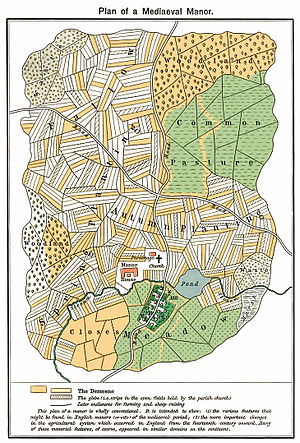
Well, it’s more efficient from a production standpoint – which is one reason why families did try to marry neighbors when possible – but it’s not necessarily easier. There’s no guarantee that neighbors will produce children at the right time and right gender sequencing for those marriages to take place, there’s always the tradeoff between marrying into a smaller neighboring landholding vs. a bigger landholding that’s not contiguous, and there’s neighbors on more than one side, and so on. 

image

However, I’d say the biggest issue is the variable quality of land.

One of the reasons why manors divvied up land in strips as opposed to any other shape or configuration is they were trying to make sure that every family got a share of “bottomland” and upland, so that you didn’t have a situation in which some families couldn’t support themselves on their assigned plots. 

Well, the same issue applies when it comes to marriages: your neighbor’s land might not be of equal quality to your land, whether that’s because it doesn’t get as much water or the soil pH is off or it’s rocky or whatever. In that case, it’s better to marry into a famiy that’s non-contiguous but has high-productivity land. 

And the same principle goes all the way up the class scale, just on different issues: your neighbors’ manors might not bring in as much of an income as manors on better land somewhere else, and so on. 

Why does Tywin make Tyrion’s trial public? It’s a huge embarassment for House Lannister, and implies that the Hand doesn’t have his own family under control.

Because Tyrion was accused, in public, by the Queen Regent, of murdering the King. That’s way too high profile a case to be handled privately; the sheer lack of information would lead to wild rumors about conspiracies and plots, and whatever the outcome, there would be people who believed the worst simply because everything was done in private. 

By contrast, while having a public trial is embarassing, it allows Tywin to get buy-in from House Tyrell and House Martell for the outcome, to shape the public’s narrative of the death of King Joffrey, to show that the government will uphold the law and punish lawbreakers, etc. 

How has the weakness of socialist movements since the red scares affected the ideology/culture within American unions? Are there any significant differences when compared to unions in nations with stronger socialist traditions?

julianlapostat:

racefortheironthrone:

That’s a tough question, because there is a long and complicated history between the socialist movement and the labor movement in America: at various times, the socialist movement has pursued a strategy of entryism (joining major labor unions in order to try to shift them left), dual unionism (forming explicitly socialist unions to compete with non-socialist labor unions). Likewise, at various times (the 1910s and 1930s especially) the labor movement has recruited socialist activists to help them organize workers and worked closely with left-wing organizations to promote pro-labor causes, and at other times (the 1920s and the late 40s-50s especially) ruthlessly purged socialists or communists from labor unions and barred them from membership. 

Indeed, the complexity of this history can be seen in the fact that John L. Lewis of the United Mine Workers pursued both, purging left-wingers in the late 20s when he viewed them as a threat to his control of the UMW and then recruiting them in the 1930s to help him build the Congress of Industrial Organizations.

Another thing that complicates this is the decentralized and indeed fragmented nature of the American labor movement, which means that various unions (and indeed, various locals within unions) have more of a history with the socialist movement than others. Historically, for example, building trades unions and the other “skilled trades” clustered in the AFL have tended to be more politically conservative and less welcoming to the left, whereas manufacturing/”industrial” unions which grew from the CIO tended to be more left-leaning, in part because CIO unions recruited radicals to help them organize, in part because their workforces were more likely to be from immigrant and ethnic communities which had their own socialist traditions, and in part because the CIO came up during the 1930s. 

However, these causal stories can get really confusing, because you have competing unions in the same industries with different political histories: the International Longshore and Warehouse Union (ILWU) on the West Coast has a long left-wing history due to their founder Harry Bridges being an open Communist, whereas the International Longeshoreman’s Association (ILA) on the East Coast was much more conservative. 

To answer your last question, I don’t have a lot of first-hand experience of European labor unions, but my impression is that U.S labor unions tend to have a lot more ideological diversity – there’s unions who are proud of being kicked out of the AFL-CIO for being too Communist back in 1947, there’s unions that were more associated with Catholic social thought, there’s unions with a long history of liberal anti-communism, etc. – whereas it’s more common for European unions to have firm institutional links to a socialist or labor party. In part because of that ideological diversity and the more complicated historical relationship between the American labor movement and American political parties, American unions have a more contingent, transactional, and pragmatic political program (especially at the local level), in contrast to European unions who either founded or were founded by a political party in their country and thus have very close relationships with that party and that party alone. 

With all that diversity, how is it that American unions are weak compared to Europe?

Well, I don’t think the ideological diversity is a strength or a weakness. 

And in terms of strength and weakness, I think that’s driven much more by different labor law on the one hand, and very different business cultures on the other. 

How well organised are mercenaries in Westeros? They’re apparently not as prevalent as in Essos, and there’s the occasional mention of “freeriders”, but are there any larger companies of specialised troops, such as crossbowmen or pikemen?

Freeriders aren’t mercenaries. 

Because the ruling class of Westeros relies more heavily on control of military manpower than the ruling class of Essos, it’s usually the case that mercenaries in Westeros are usually Essosi free companies who’ve been brought over as additional troops and/or specialized troops (Myrish crossbowmen, for example), whereas native Westerosi largely serve in the armies of their liege lords. 

However, there is a history of Westerosi mercenary companies being founded as a way to get inconvenient fighting men out of the country following a major political rupture:

  • The Company of the Rose, for example, was founded by Northerners who refused to accept Torrhen Stark’s submission to Aegon the Conqueror, and preferred exile in Essos instead. Their departure for Essos meant that Torrhen wouldn’t have to deal with a large militant faction of nationalists, who might have supported his sons’ faction in Northern politics.
  • The Stormbreakers were founded in the wake of the Dance of the Dragons, and likely absorbed a lot of the excess soldiers who had been mobilized during the Dance and now had no peacetime employment. Based on the name, I wouldn’t be surprised if the original founders were Riverlander veterans of the Battle of the Kingsroad, but I would also guess that no small amount of their number were made up of the surplus Northmen who were left behind after the “Hour of the Wolf.”
  • The Second Sons predate the Conquest, which shows how long this tradition has been going on, and were formed more for economic reasons than political ones. As WOIAF tells us, the company was “founded by twoscore younger sons of noble houses who found themselves dispossessed and without prospects.”

It is important to note, though, that all of these free companies left Westeros and worked exclusively in Essos – which was probably quid-pro-quo for allowing them to be formed in the first place.

RFTIT Tumblr Weekly(ish) Roundup (Part I)

RFTIT Tumblr Weekly(ish) Roundup (Part I)

One of the unintended consequences of taking a long time to finish an essay – the Maurice Druon essay is up to about 1000 words, btw – is that a lot of Tumblr stuff piles up in the mean time. So just eye-balling it, I’m guessing that it’s going to take more than one post to clear my backlog. Speaking of which…

ASOIAF:

View On WordPress

Godscast Issue 3 The One About the Goth

graphicpolicy:

Godscast Issue 3 The One About the Goth #comics @imagecomics @kierongillen @McKelvie

Hosted by Steven Attewell and Chris Holcomb, Godscast takes you issues by issue through the hit comic series The Wicked + The Divine by Kieron Gillen and Jamie McKelvie.

Every ninety years, twelve gods incarnate as humans. They are loved. They are hated. In two years, they are dead. Welcome to The Wicked + The Divine, where gods are the ultimate pop stars. But remember: just because you’re…

View On WordPress

Back on the podcast grind!