Other than the kid dying, no she doesn’t.
Category: Uncategorized
How different do you think the WOT5K would have gone if Shireen was a healthy boy of the same age? Or if Sweetrobin was a healthy girl?
I think it would change things mostly in the margins. If Shireen is a boy, then Stannis’ dynastic line looks healthier, so he might get a bit more support from the outset.
But Sweetrobin being a girl I don’t think changes much, except adding a competition for her hand that’s more intense than that for her mother.
I’ve seen you say in a few places that the ideal strategy for Edmure Tully to defend the Riverlands during the Wot5K would be to cede ground for time and use the Trident as a defensive multiplier. I don’t disagree with you at all, but was wondering to what extent his promise of protection as liege lord to his vassals would allow him to write the Vances’ and others’ lands off in the short-term without repercussions.
I think it depends on the cultural assumptions of war in that region. Consider that the Martells’ grip on their bannermen didn’t slip an inch when Aegon was burning down every single castle in Dorne except Sunspear, for example.
In the case of the Riverlands, if you look back into their history, defense in depth and guerrilla warfare is how they win wars, whether you’re talking about the Dance of the Dragons or the revolt against the Stormlanders. So I think Edmure’s bannermen would understand the necessities of war, especially if its keeping the majority safe behind watery walls of the Riverlands.

As with the argument about the Battle of the Fords, I think people have this in reverse. As we can see from this map, the vast, vast majority of the Riverlands is either east of the Red Fork and/or north of the Tumblestone. That tiny triangle of land in the middle – which probably is just House Vance of Wayfarer’s Rest, since Pinkmaiden (the castle of the Pipers) on the eastern bank of the Red Fork – is not going to have the political influence to outweigh the rest.
Chapter-by-Chapter Analysis: Davos I, ASOS
Chapter-by-Chapter Analysis: Davos I, ASOS

“He watched the sail grow for a long time, trying to decide whether he would sooner live or die.”
Synopsis: Davos may never die, but rises again, harder and stronger.
SPOILER WARNING: This chapter analysis, and all following, will contain spoilers for all Song of Ice and Fire novels and Game of Thrones episodes. Caveat lector.
(more…)
When justifying the Red Wedding, Tywin mentioned killing a “dozen” at dinner. How many people were actually killed in the RW? The army outside in the tents were killed, so it has to be a significant amount, no?
Thousands. In addition to the men murdered in the tents at the same time that Robb and Co. were being murdered inside the hall, you also have to include the thousands of men who died at Duskendale and the Ruby Ford due to Roose’s betrayal and Tywin’s connivance, without whose deaths Roose and Walder wouldn’t have had the manpower advantage necessary to get them to sign off on the massacre.
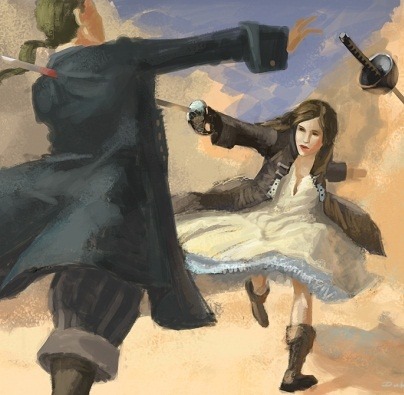
Julie D’Aubigny was a 17th-century bisexual French opera singer and fencing master who killed or wounded at least ten men in life-or-death duels, performed nightly shows on the biggest and most highly-respected opera stage in the world, and once took the Holy Orders just so that she could sneak into a convent and shag a nun.
(via Feminism)
bisexual opera singer who killed ten men and snuck into a convent to shag a nun.
Just so y’all know, she later set that convent on fire so she and that nun could sneak out. And she seduced one of the men she’d dueled.
Mademoiselle de Maupin (Julie d’Aubigny) has always been one of my role models. I’m so glad this post exists so more people can learn about her. The more you know, the more there’s to love. Let’s see:
- Around 1678 (she was like fourteen or fifteen), she was making a living in Marseilles by doing fencing exhibitions, dressed in male clothes, with her boyfriend who was on the run because he killed a guy in an illegal duel in Paris.
- Then she joined an opera company and fell in love with a young woman, but the woman’s parents decided to put her in a convent to, you know, protect her honor and all that…
- …so yeah, that’s when the whole “sneaking into a convent to help a nun sneak out and also putting the room on fire” thing happened.
- She wounded a guy through the shoulder with a sword in a duel because he had made fun of her clothes. They became friends after she came back a few days later to ask if he was okay.
- She beat a singer who was quite famous at the time because he was being a jerk to some women from her new opera troupe in Paris.
- She kissed a young woman in front of everyone at a society ball, and that angered three noblemen who were there, so she beat them all in duel and fled to Brussels. Then she resumed her opera career there.
- Then she returned to the Paris opera and had yet more problems with the law because she beat up her landlord.
- She retired to a convent after the death of her love Madame la Marquise de Florensac, and died at only 33 years old.
- The legend says that she never got arrested for all her deeds because king Louis XIV thought she was way too entertaining to deserve death. I have no idea if that’s true. But she did sing in Versailles for the Court, so there’s that.
She’s back on my dash!
The woman who is, no word of a lie, MY PERSONAL HERO 😀
How badass can you be to basically get a lifetime pardon from the king?!
Julie D’aubigny: It’s okay I have a note from the king
“Julie can do what she wants – King Louis XIV”
Feels like she could’ve been in the Baroque Cycle. Timeline seems to work.
True story: in the brief period of my life where I was almost going to work for a Hollywood producer, I pitched La Maupin.
Why does the kingmaker gets al the bad rap? Alicent’s role is just as big if not more, and we don’t hear about her until the historical novels. Btw, i just love your blog!
Thanks!
Alicent at least tried for a diplomatic solution. Criston Cole started slitting throats and then died like a chump.
Since recently someone (else) asked why medieval Europe is the standard fantasy setting, I was wondering: Are there (or do you know, anyways) fantasy books based on, say ancient Rome. It’s a reasonably well-known era, after all. Or what about ancient China, or India? I don’t really know much about them, but there’s probably lots of possibilities there, too. Or maybe even ancient Egypt?
Ancient Rome – there’s Jim Butcher’s Codex Alera series, Thomas Harlan’s Oath of Empire series, and many more.
Ancient China/India – Years of Salt and Rice is an interesting alternate history focusing on India and China with some fantasy elements. Grace of Kings by Ken Liu is a great fantasy take on the Romance of the Three Kingdoms. Here are some suggestions about fantasy novels set in India, although I should mention that there’s apparently a very lively fantasy scene in India if you can read Hindi or Urdu, etc.
Ancient Egypt – try some of these?
If oathbreaking is so reviled than why aren’t people like Cole and Daemon Blackfyre hated more? But made holy oaths to their kings and then betrayed without a justification. Aerys murdered people.
Criston Cole is despised.
But Daemon Blackfyre is different – firstly, he had public justifications for his actions – justifications that half of Westeros agreed with. Secondly, he conducted himself impeccably according to the canons of knighthood and died gloriously, whereas Cole went out like a chump. Thirdly, Daemon wasn’t a member of the Kingsguard.

Kickstarter Fulfillment Update!
Hey folks! As you probably have already seen by now if you’re checking your email, Kickstarter backers just got sent two bonus essays – including the now-complete Politics of the North essay, which weighs in at a whopping 15,000 words.
 RFTIT Tumblr Backup