It’s hard to say how much they kick up – you could use the 10% rule, I suppose.
I did do some previous estimates about royal incomes here, but those were based only on debt rather than on GDI calculations.
Just a backup in advance of the detumblring
It’s hard to say how much they kick up – you could use the 10% rule, I suppose.
I did do some previous estimates about royal incomes here, but those were based only on debt rather than on GDI calculations.
X-Posted from Tumblr: Estimates of Great House Incomes

After I did this post, @joannalannister asked if I could do a similar set of estimates for the other Great Houses, so I figured I might as well knock them out.
So what are the incomes of the .01% of Westeros?
(more…)
After I did this post, @joannalannister asked if I could do a similar set of estimates for the other Great Houses, so I figured I might as well knock them out.
So what are the incomes of the .01% of Westeros?

House Lannister
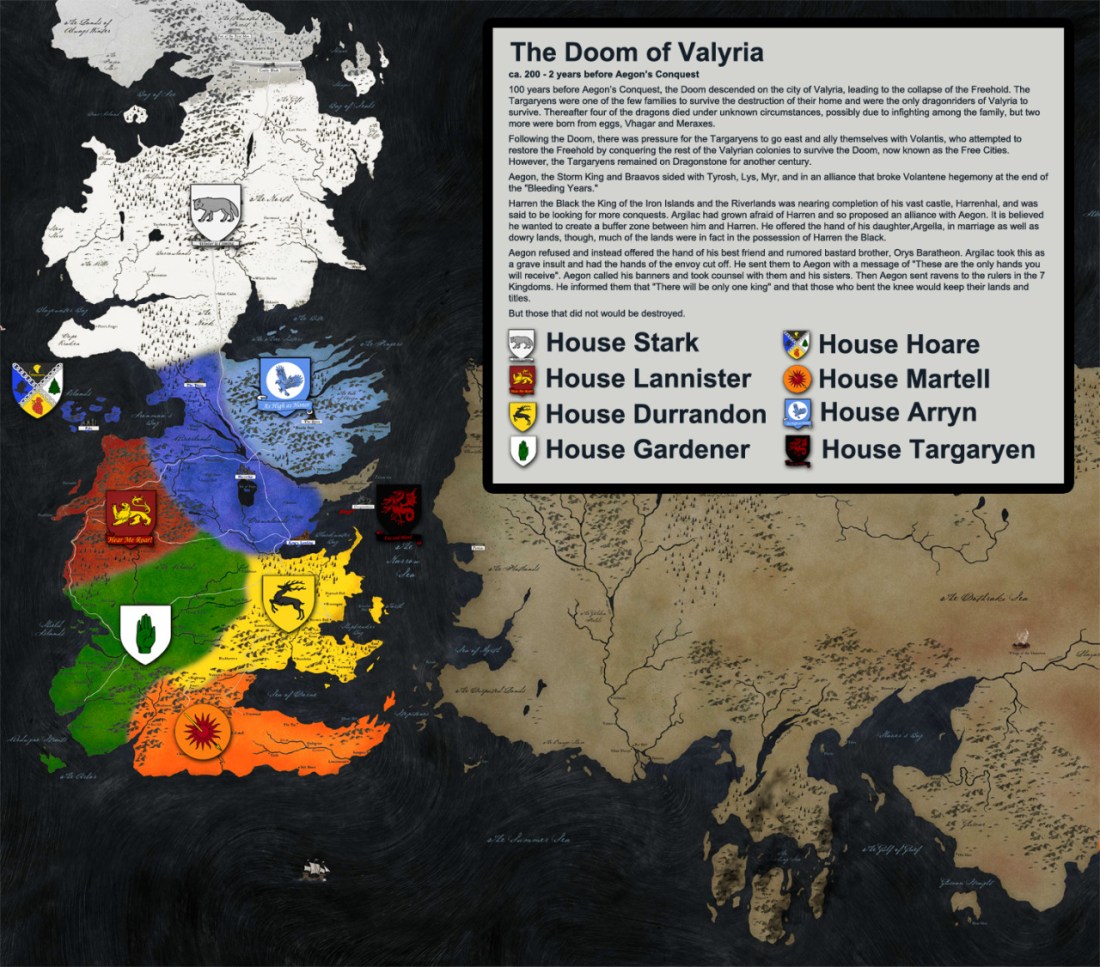
Now, this is the one where I have to admit I may have under-estimated in the past. I had previously estimated that the Lannisters earn at least a million a year based on their lending to the Crown, but my population-based methodology put the Starks easily at or above that level, so I definitely need to do a rethink.
Given that the Westerlands have a population of around 4.5-5.5 million (depending on which estimate you use), the GDI of the Westerlands would be around 13.5-27.5 million dragons a year if we use the average peasant income. (Which would suggest a Lannister income from taxes alone of 1.3-2.75 million a year…)
However, we know from the text that the Westerlands have an unusually high GDI per-capita due to their vast mineral resources, high levels of urbanization, and high levels of human capital in their skilled artisans. So I would start at the upper range and add on perhaps another third to half, suggesting that their GDI is somewhere around 35-41 million dragons.
This would place House Lannister’s revenue at 3.5 to 4.1 million dragons a year, more than three times as much as House Stark – which would fit the Lannisters’ reputation for ostentatious luxury and the Starks’ reputation for spartan austerity.

House Arryn
I’m actually working on my essay on the politics of the Vale right now, but all evidence points to the Arryns being on the high side of average: we hear that “The Vale of Arryn—a long, wide, fertile valley entirely ringed by the great grey-green peaks of the mighty Mountains of the Moon—is as rich as it is beautiful,” and that “though the Vale itself is famously fertile, it is small compared to the domains of other kings (and even some great lords)…Trade is therefore of paramount importance to the rulers of the Vale.”
So I would put their per-capita income on the high-side of average, but this is offset by their lower population. Given a population of 3-3.5 million, the GDI of the Vale is probably around 15 to 17.5 million a year. This would bring in 1.5-1.75 million a year, but Gulltown’s port incomes probably brings it up to 2-odd million a year – substantially higher than the Starks despite having a roughly equivalent population, but significantly below that of the Lannisters due to their low population.
But as I’m sure the Arryns would be the first to tell you, money can’t buy good manners…

House Tully
House Tully is a fascinating case in how failed governance can waste the advantages of nature. Given that the Riverlands are “rich and fertile…the waters of the Trident make the lands ripe for settlement, farming, and conquest, whilst the river’s three branches stimulate trade and travel during peacetime,” the region’s 4 million inhabitants should produce a GDI of around 20 million dragons a year (taking the high average of peasant income), producing tax revenue of around 2 million dragons a year.
However, whether it’s due to underdevelopment or the weak grasp of the Tullys on their subjects, their actual army size compared to their potential army size suggests that they only have an income of 1 million dragons a year. Obviously in comparison to ordinary smallfolk, this is a staggering sum, but in comparison to their neighbors to the west and to the east, you can see why the Riverlands have struggled to maintain their independence.

House Greyjoy
These estimates are all rather crude, but this is especially true for the Ironborn, since so little of their income is generated by the Iron Islands themselves, and so much of their income is generated from reaving, which makes it very very “off the books.”
However, based on their poor soil and downright Dickensian levels of squalor, I would say that the Iron Islands population produces perhaps 4.5 million dragons a year in GDI, which means the Greyjoys earn only 450,000 dragons a year in “legitimate income.” No wonder they turn to piracy to make up the difference.

House Tyrell
As has been said repeatedly, House Tyrell’s incomes likely fluctuate depending on the price of foodstuffs, given that the Reach is the breadbasket of Westeros. It’s also home to one of the oldest and largest cities in Westeros, and more towns and villages per capita than any other kingdom in Westeros, so you have to add that into the equation. As a result, it’s also the most populous region in all of Westeros.
Add all of these factors together, and you should adjust upwards from the initial projection of 60 million dragons a year in GDI. For consistency’s sake, let’s take the lower bound of the Lannister adjustment, and say that the Reach produces 78 million dragons a year in GDI.
This would suggest that the Tyrells have a yearly tax revenue of around 7.8 million dragons, almost twice what the Lannisters do. However, a few factors probably reduce that somewhat – first, the Tyrell revenues are probably less liquid than those of House Lannister, with much and more being held “in kind” as grain; second, the Tyrells don’t have additional income from Casterly Rock, which is no small factor.
All the same, no wonder they can afford a political strategy of bread and circuses for the people of King’s Landing…

House Baratheon
Given that the Stormlands are notoriously “thinly-peopled,” subject to poor weather for growing cereal grains, and rather under-urbanized compared to other regions, I would peg the Stormlands at the lower end of Westerosi per-capita incomes. This in turn suggests a GDI of around 7.5 million dragons a year, which is only a little bit above that of the North – which makes sense when you consider that the North has about 10,000 more men under arms despite the Stormlands having much better weather (relatively speaking).
This would put House Baratheon’s incomes at only 750,000 dragons a year, making them among the poorer Great Houses of Westeros. And that’s a hell of a step down from where they used to be, consider that the Stormlands once owned the Crownlands and the Riverlands, which would have made them richer by many times over.
How the mighty have fallen.

House Martell
House Martell is a difficult calculation indeed – Dorne is also thinly peopled, and much of its land is not arable. On the other hand, Dorne also has an unusual level of manufacturing and many high-valuable export commodities, which compensate for its desert climate.
Adding those two factors together, I’d put them around the middle for per-capita income, which suggests a GDI of around 10 million dragons a year – richer than the Stormlands largely due to trade and manufacturing, substanially poorer than the Vale despite roughly equal populations due to the Vale’s legendary fertilty, and way below the Reach or the Westerlands.
This is turn makes for an tax revenue of around 1 million a year, putting them roughly in the middle of the pack.
I’m glad you liked it, but why does the Stark political philosophy suggest that Ned is the rule?
Guest Post at Tower of the Hand: Politics of the Seven Kingdoms (The North)
The long-anticipated installment of my new Politics of the Seven Kingdoms series is up at Tower of the Hand…
I doubt that the Manderlys are richer than the Starks, since the Starks get income from the entire North in addition to from the Manderlys, so they’re taxing 3.5-4 million people rather than a hundred thousand or so. And even though the per-capita income of the Manderly’s subjects is way higher than the rest of the North, it’s not enough to outweigh the Stark’s manpower advantage.
I did a rough estimate of Great House incomes here, but let’s try to do some calculations based on the ones I did for the Seven Kingdoms as a whole. The North has 3.5 to 4 million people, and assuming that 90% of them earn around 3-5 dragons a year, we’re talking 10.5-20 million gold a year as the rough GDI of the North.
Now, medieval taxation thankfully was generally simple (because medieval states lacked the bureaucracy to get fancy) so we’ll be using the English “tenth” (i.e, a 10% tax on moveable property and income) as our model. That would suggest that the North generates 1-2 million in tax revenue. Now, a good part of that goes to the King, but the Starks probably keep the bulk of it.
Now, the North is considerably less fertile and prosperous than the rest of Westeros, so we might want to start with the low range for peasant income and then adjust further. So if the North is half as prosperous as the average, then the North has a GDI of 5.25 million and produces 525,000 gold in tax revenue. If we say it’s two-thirds, then we’re talking a GDI of 7 million and 700,000 in tax revenue.
The Manderly’s income is a bit harder to figure out, because we don’t have a firm number on their total population – we know that White Harbor has 50,000 people living in it, but we also know that the Manderlys control a broad swathe of territory beyond just the city and have a higher per capita GDI than the rest of the North between their silver and their artisans. I would say that at a minimum, the population of White Harbor brings in 15,000 golden dragons to the Manderlys just on the regular tenth, not counting taxes and fees coming in from the port.

Hey folks, thanks for all of your great suggestions about podcast topics. Before I get to the Tumblrs, a few announcements: The Politics of the Seven Kingdoms – the North essay should be going up at Tower of the Hand and here early this week, probably Tuesday. It’s a biggun, some 25 pages of analysis. I’ll also be posting a link to the History of Westeros Podcast’s upcoming episodes on…
Ah ok. Well, if Stark is the only prisoner, a couple things happen:
1. Ned’s not confessing. He only did that to save his kids. Now, he’s not in good shape atm, so it’s still possible he dies in his cell, but that probably butterflys away his death at Joffrey’s order.
2. There will be a strong push to trade Ned for Jaime, and that push will have support from Robb’s bannermen: trading the Kingslayer for the Lord Paramount of the North is an equal trade at worst, and arguably a trade-up for the North.
3. It’s highly unlikely Robb becomes King in the North. An alive Eddard is going to reveal his investigation and push for the North and the Riverlands to back Stannis as the rightful King.
4. This in turn changes Stannis’ strategy in both political and military terms. On a political level, with two kingdoms behind him, Stannis doesn’t seem like a no-hoper, and with the Hand of the King and Protector of the Realm legitimating his open letter, you’re going to get people who were on the fence shifting to Stannis’ side. On a military level, Stannis can take his men up to Maidenpool, unite with the Starks and Tullys, and make a hard push on King’s Landing from the land, negating most of Tyrion’s strategems, before Renly is anywhere near the capitol.
Absolutely.
In many premodern cultures, guest right was considered sacred and breaking it was right up there with matricide or patricide in terms of crimes against the natural order set down by the gods. In Greco-Roman culture, for example, the right of xenia or hospitium was enforced by Zeus/Jupiter in his role as Zeus Xenios. Zeus would enforce this by disguising himself as a beggar (sometimes Hermes/Mercury would hang out with him, as he was the patron god of travelers) and then showing up to people’s houses, punishing people who turned him away and rewarding the generous.

Ovid formalized this tale in his Metamorphoses, where he tells the story of Baucis and Philemon, who take in Jupiter and Mercury and treat them generously while their rich neighbors bar their doors. In return for their generosity, Jupiter and Mercury spare them from a flood that wipes out the entire town for failing their duty of xenia.
Likewise, a lot of Greek tragedies have their roots in breaches of hospitality. The fall of the House of Atreus is littered with murdered guests and guests being unwittingly offered human flesh, the Acheans during the Trojan War have the support of Zeus because Paris abducted Helen while a guest under Menelaus’ roof, Penelope’s suitors in the Oddessy die because they have abused the right of hospitality.
And you see this in other cultures too – in Norse mythology, Odin/Woden frequently disguises himself as a traveller and shows up at the front door of King Geirodd to test him. Geirodd, being a sadistic bastard, has his guest chained between the two fires of his hearth to torture him and refuses him food or drink. Geirodd’s son takes pity on the traveler and gives him food and drink. Odin reveals himself, slays the wicked king, and elevates the son in his place.
(btw, Tolkein totally stole his look for Gandalf)

You can find very similar stories in Celtic myths, and in the Upanishads of Hinduism, where the maxim “Atithi Devo Bhava” means “the guest is god.”
Guest-right is not GRRM’s invention.
What’s your opinion of the thoery that Aegon has some descent from Aerion as well as Daemon Blackfyre?
Personally, I think it is convoluting.
I’ve never been that much of a fan of the Brightfyre theory, and I think the WOIAF definitely makes it less likely. Given that Aerion’s exile was temporary rather than permanent and that Aerion fought against the Blackfyres in the 3rd Rebellion and did something really infamous that most likely is murdering Haegon after Haegon had surrendered, I don’t think any Golden Company loyalist would lift a finger to put his spawn on the Iron Throne.
 RFTIT Tumblr Backup