No, I think he knew the prophecy from childhood onwards.
Category: Uncategorized
Most important battle of Wo5K so far?
Blackwater.
Maester Steven, Love the blog! You have been given the opportunity to interview and write the official authoritative biography on any ASOIAF universe character which includes interviewing the subject and many of the people they know. Who do you choose?
Septon Barth.
I Love Captain America: Civil War, But…

http://io9.gizmodo.com/before-civil-war-the-third-captain-america-movie-was-a-1785754186
This news fills me with a strange combination of retroactive regret, anger, wistfulness, and bewilderment, because as much as I love Captain America: Civil War, Jack Kirby’s MADBOMB is one of the greatest Captain America stories ever written and drawn and it kills me that we might have gotten to see the Russo Brothers attempt it on the big screen but it never happened.
I need a german compound word to express how I feel right now.

Given your feeling on the comic version of civil war and Ultimates Captain America I take you are not a fan of Mark Miller?
Yeah, you could say that.
My thing with Mark Millar is that I think he’s a better concept/pitchman (What if superheroes were real? What if Superman had landed in Russia?) than he is at executing his own ideas (there’s a reason why a lot of his comics get turned into movies, and that those movies tend to do well but tend to involve the director making some significant changes to the plot, characters, tone, etc.).
When Millar executes his own ideas, not only do they often end up lacking in depth, but you also get some really icky stuff creeping in: leaving aside Wanted’s misanthropic hatred of its own audience, the treatment of black women especially is really grotesque; the graphic novel of Kick-Ass likewise has some weird stuff around both gender and sexuality and race. Throughout a lot of it runs the worst part of 90s comics – the idea that violence, sex, sexual violence, and characters acting like assholes makes something edgy, mature, and art.
His runs on the Ultimates (my beef with him started with his decision to make Captain America a jingoistic conservative, but I wasn’t a huge fan of having Bruce Banner’s rage powered by his sexual failures wrt to Betsy Ross, or re-enacting Ant-Man’s domestic violence, etc. etc.), Ultimate X-Men, etc. have a somewhat more sanitized version of the same thing.
So yes, the MCU borrowed from some of his setups and visual motifs, it’s highly noticeable that they jettisoned his characterization and themes in favor of their winning strategy of making their hero characters likeable, good people who (mostly) get along with one another, and who we enjoy watching being together. This is why this moment was so important:

Now, I have heard that Millar has matured somewhat recently and his recent works are a lot better on this front – less misanthropy, less crude deconstructionism for its own sake – so I don’t want to write him off entirely. But he was a big part of what burned me out on superhero comics in the early 00s, so I’m just going to let it pass me by.
How common do you think the marriage of second sons and daughters to the small coterie of the Westerosi urban merchant class is? How about to to Essosi nobles? It seems like there would be significant financial advantages in wedding into prosperity, rather than two noble yet relatively poor houses from the same region marrying children off to one another, notwithstanding the political alliances these nuptials can bolster. .
It seems to be uncommon but not unknown. It’s uncommon because there’s a social prejudice against it – merchants are commoners, so you’re marrying below your social status, and merchants are “in trade,” which nobles consider to be greedy, unproductive money-grubbing as opposed to being an absentee landowner who can afford to follow an honor code and not think in a profit-maximizing way (except when you relabel “profit” as “glory”).
The Essosi are kind of a mixed bag. On the one hand, you definitely see that Tywin looks down on the Essosi as “spice soldiers and cheese lords,” who “Lord Tywin had always held…in contempt. They fight with coins instead of swords, he used to say. Gold has its uses, but wars are won with iron.” In other words, the Essosi are seen as somewhat cowardly and merchantlike, not really nobles. Beyond mere prejudice, you definitely get the sense that there’s a rather signifiant culture clash that makes Westerosi see these marriages as inviting trouble: there’s a significant number of divorces/separations (Larra Rogare, Mellario of Norvos), there’s the cautionary tale of Serala of Myr who brought her expectations of Essosi free cities to Westeros, etc.
On the other hand, at least since the Targaryens, the Westerosi do see marriage into Essos as potentially bringing in political benefits (Rohanne of Tyrosh, Kiera of Tyrosh) or bringing in the Valyrian “look” which is prized aesthetically.
In either case, I think the likelihood of these marriages depend on the needs of the House in question. If the House is prosperous, it’s probably not going to bother – not when marriage alliances to other nobles can give them land (the former of which you can’t get from marrying into money) and military power. If the House is poor, it’s not necessarily a slamdunk – marrying into the Spicers didn’t exactly elevate the Westerlings, but Lyonel got the heir he wanted and a lot of money – but it can be the shot in the arm you need.
As a historian, what’s your take on Polyani’s ‘great transformation’ and ‘double movement’? I’m drawing on the historical sociological school for my Master’s thesis on welfare provision and was wondering if you had any other suggestions to read.
I’m a huge fan of Polayni, his Great Transformation remains one of the most important books I’ve ever read. I would recommend reading Marc Blyth’s Great Transformations for a more recent interpretation of Polayni that seeks to explain why the drive for social protection that Polayni described/predicted went into reverse in the 1970s and 1980s.
You know, I have always wondered why the Children of the Forest were unable to prevent the First Men invasion. Was there really nothing they could do as a pre-emptive measure? I mean, an event of that scale must have been foreseen by their greenseers long before it actually happened…?
The Breaking of the Arm and the Hammer of the Waters are pretty significant efforts to prevent the invasion.
Why did the movie Civil War turn out so much better than the comics Civil War? Were the comic writers trying too hard to be edgy, does the basic idea fit a movie better than comic books, or were the movie writers just better writers?
A bit of 1 and a bit of 3.
Melisandre’s thoughts on the wildlings
Melisandre nodded solemnly, as if she had taken his words to heart, but this Weeper did not matter. None of his free folk mattered. They were a lost people, a doomed people, destined to vanish from the earth, as the children of the forest had vanished.
Do those thoughts seem disturbing given she is essentially saying regarding the wildlings that their lives don’t matter?
I think there’s two ways to interpret this passage.
The first way starts with the fact that Melisandre’s brand of religious devotion is intensely Millennialist and prophetic in nature – as far as she’s concerned, the Final Battle between Azor Ahai Reborn and the Great Other is at hand as the prophecies have foretold, and the entire world faces apocalypse unless it unites behind her god and his chosen champion. This is part of the reason why Melisandre is the most misunderstood character in ASOIAF – she doesn’t sacrifice people or burn weirwoods because she’s actively malicious, she genuinely thinks that what she is doing is necessary for the salvation of humanity, and like Varys she’s a hardcore consequentialist. A truly just woman is no less to be feared than her male counterpart.
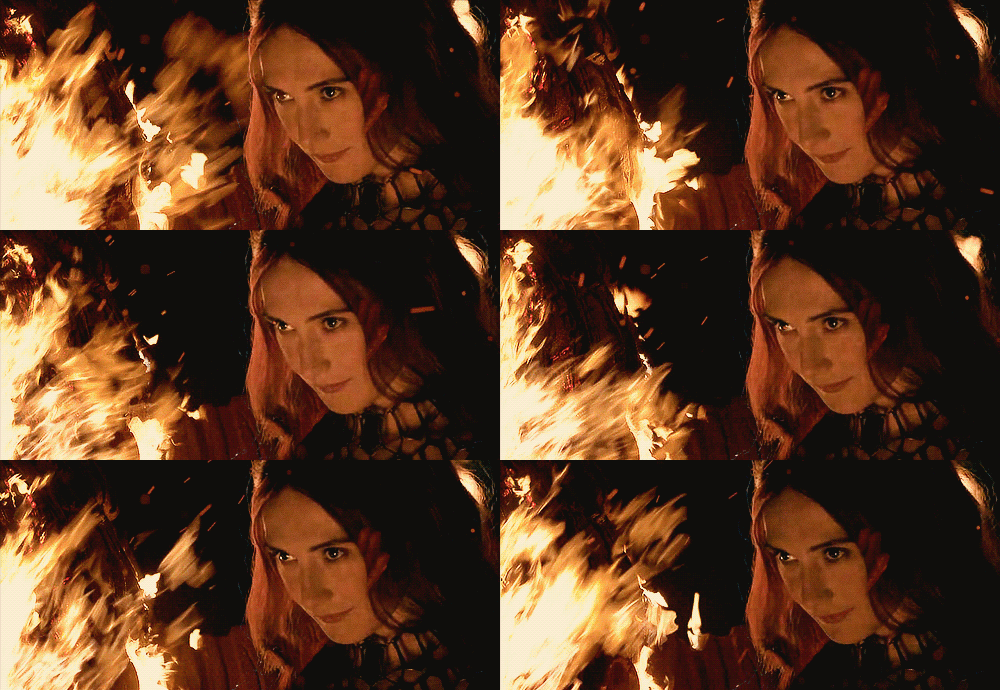
In this reading, Melisandre views the wildlings as doomed by fate to be casualties in the coming war – these dead-ender wildlings who insist on staying north of the Wall have placed themselves right in the path of the Army of the Dead. And her view is helped by the fact that these wildlings have rejected both the true god and his champion, who are the only path to salvation.
The second way of reading has to do with her attitude of cultural superiority. Remember, Essosi consider Westerosi to be barbarians only recently raised to semi-civilization by the last remnants of the Valyrian Empire. Melisandre, as someone raised in one of the most ancient cities of Essos, probably shares this view, given that she is also a missionary bringing the true religion to the heathen.
Now think what someone like that would think of a people that even Westerosi consider barbarians and savages. One of the things I actually really like about ASOIAF is that GRRM shows his main POV characters reacting to the widllings or the mountain clans as people from their backgrounds would react: Tyrion considers the mountain clans’ devotion to democracy and gender equality to be signs of backwardness and part of his plan for using them to take the Vale is to educate them in civilized ways, like obedience to a king. Jon Snow comes to empathize with the wildlings’ desire for freedom and their attachment to their cultural heritage, but he also thinks that these same qualities will doom them on the battlefield.

In this reading, Melisandre is expressing the softer side of Manifest Destiny doctrine – as opposed to the harsher side, which presented native peoples as dangerous threats, this view said that native peoples were “destined to vanish from the earth” as the progress of Western Civilization eventually overtook them. Indeed, the very trope of the Noble Savage was premised on the idea that this fate was inevitable, but now interpreted as a tragedy that could be safely lamented. So in Melisandre’s eyes, the wildlings have rejected enlightenment in favor of clinging to superstion and will thus be swept away by the force of history.
So which is it? Take your pick.
 RFTIT Tumblr Backup