The Venture Bros. Podcast: Season 7 Ep 4: The High Cost of Loathing

graphicpolicy:

The Venture Bros. #Podcast: Season 7 Ep 4: The High Cost of Loathing #VentureBros #AdultSwim

Love The Venture Bros cartoon but afraid of missing the plethora of historical references and layers of meaning behind each episode? Join pop culture and history experts Elana Levin and Steven Attewell for our Podcast examining each episode of this hit Adult Swim show.

This podcast is about Season 7 Episode 4: The High Cost of Loathing

Professor Attewell puts his campus teaching experience to use…

View On WordPress

Back on the podcast grind. 

How does Drogo benefit from the deal with Viserys? Is Daenerys really that valuable as a wife, if the Targaryens’ status is so uncertain?

opinions-about-tiaras:

Ennnhhh… I’m not sure about this, Steven. In fact I’m willing to say its actually wrong.

The Dothraki I don’t think ever had direct contact with the Freehold, and were certainly never engaged in direct military conflict with it. They were kept penned into the far eastern grasslands by three world powers, none of them Valyrian; the Ghiscari city-states, the Qaathi city-states, and the Kingdoms of the Sarnor. The Dothraki existed well outside the Freeholds direct sphere of influence, not even bordering any of their directly conquered lands, and if the Valyrians ever flew dragons against them it isn’t recorded in any source I know about. (Willing to be wrong here!)

Indeed, the Dothraki were such a nonentity that the Sarnori explicitly regarded them, according to WOIAF, as “little more than a nuisance.” They did not rise to prominence until well after all the Valyrian dragons were dead, throwing the Sarnori down when they unified under the first khal of khals.

I don’t think one can reasonably make the case that it was the Valyrians holding the Dothraki back. Other world powers, sure, but not the Valyrians.

Point of order, the Sarnori did not entirely separate the Dothraki from the Valyrians:

“In short, the names and numbers of the peoples who fell to Valyria are unknown to us today…A few, such as the Rhoynar, lasted against the tide for centuries, or even millennia. The Rhoynar, who founded great cities along the Rhoyne, were said to be the first to learn the art of iron-making.
Also, the confederation of cities later called the Kingdom of Sarnor survived the Valyrian expansion thanks to the great plain that separated one from the other … only for that plain and the people who occupied it—the Dothraki horselords—to be the source of Sarnor’s downfall after the Doom.”

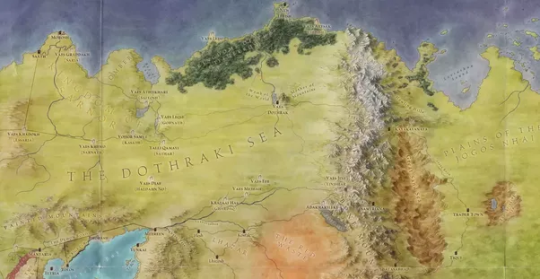
You can see this on the map:

While much of the Dothraki Sea is to the east of the Sarnori cities, it does stretch south and west to the Painted Mountains of northern Valyria. And of course, when the Valyrians had conquered the Ghiscari Empire to their east, they would have had the Dothraki to their nrothern border there too.

As for the Dothraki and dragons, it is noticeable that they never attacked either the Ghiscari, the Qatheen, or the Free Cities until after the dragons were gone. And then there’s this:

racefortheironthrone:

The one thing the Dothraki fear are dragons, the one thing that held them back from their manifest destiny for thousands of years was the white-haired, purple-eyed dragonriders. 

It’s not about power politics for Drogo, it’s about symbolism. 

“And now the stone was gone and she flew across the Dothraki sea, high and higher, the green rippling beneath, and all that lived and breathed fled in terror from the shadow of her wings.“ (Dany IX, AGOT)

Do pyromancers do anything other than make and store wildfire? If the monarch is not interested in burning people, or has a dragon for that, what else can they do?

Well, they’re alchemists, so I would imagine they’d be working on transmuting base metals into gold and silver or finding the universal solvent , trying to find the elixir of youth or the panacea, and other such worthy endeavors. 

If they’re anything like historical alchemists, however, I’m guessing their practical utility would be in proto-chemistry. 

About Pycelle and Varys. How is it that Jaime and the Pyromancers knew about the Wildfire under KL but Pycelle and Varys didn’t? Pycelle obviously didn’t know since he wanted to let Tywin through the gates and he wouldn’t consciously endanger him. Varys doesn’t seem to know either. Why did Aerys hide the plot from them? If he didn’t trust them about the Wildfire, why did he turn to them for counsel when Tywin knocked on the door, and then deferred to Pycelle anyway?

opinions-about-tiaras:

racefortheironthrone:

“Three can keep a secret if two are dead.”

Here’s who Aerys told about the wildfire: the three pyromancers Rossart, Garigus, and Belis. That’s it. (Jaime Lannister was the only other person in the room when this happened, and he killed the other four people involved.) The Lord Hand Chelsted “became suspicious” when he saw “Rossart, Belis, and Garigus coming and going night and day,” but when he confronted Aerys, he was immediately burned alive and couldn’t share what he knew. 

So Pycelle didn’t know because Aerys kept his Small Council ignorant of his plans, because he didn’t want anyone trying to stop him. 

As for why Varys didn’t know, even the best spymaster needs time to develop sources, collect information, and then correctly analyze this information. The problem is that the wildfire plot only included a few people, who maintained a high degree of operational security:

“Everything was done in the utmost secrecy by a handful of master pyromancers. They did not even trust their own acolytes to help.” 

(Jaime V, ASOS)

As for why Aerys didn’t trust them on the plot but trusted them on other things, this was a fairly consistent pattern of his paranoia, where he was simultaneously afraid of the same people he was deeply dependent on, and refused to remove people who he thought was trying to kill or replace him:

“By this time, King Aerys had become aware of the widespread belief that he himself was but a hollow figurehead and Tywin Lannister the true master of the Seven Kingdoms. These sentiments greatly angered the king, and His Grace became determined to disprove them and to humble his “overmighty servant” and “put him back into his place.”
…Tywin Lannister attempted to return his chain of office the next morning, but the king refused to accept his resignation.
Aerys II could, of course, have dismissed Tywin Lannister at any time and named his own man as Hand of the King, but instead, for whatever reason, the king chose to keep his boyhood friend close by him, laboring on his behalf, even as he began to undermine him in ways both great and small.”

(WOIAF)

Aerys’ weird mind-game with Tywin lasted for a decade, and then the moment it ended, he started a new one with Jaime Lannister. As Jaime puts it, “Aerys liked to keep me close. I was my father’s son, so he did not trust me.” So it’s entirely consistent that Aerys would feel the same way about Pycelle and Varys.

Is it wrong that I find it slightly dubious that those four guys by themselves managed to undertake such a wide-ranging plot?

They had to cook up a ton of wildfire, and then transport it and hide it throughout the whole city. People are still finding large amounts of it in weird, dangerous places decades later. And like… who let the pyromancers into these places? ESPECIALLY the Great Sept. “Open up in the name of the king” will get a lot of cooperation… but a collection of weird-ass master pyromancers knocking on your door in the kings name with a big wagon full of dubious stuff they want to move into your place? Or ordering you to clear out for hours at a time while they go about their work?

You’d think people would have started asking questions.

The cooking up the wildfire I don’t think is an issue – that’s what pyromancers do, after all, and they’d been doing it for Aerys in large quantities for years. (Think about how much wildfire was required for his bizarre ritual to ward off the winter of 282, for example.) 

The transportation involves moving carts full of small pottery jars – that’s not particularly suspicious in and of itself, and the pyromancers are used to moving the stuff around the city by night anyway, so that helps. 

The more difficult aspect, as you point out, is the stashing of the stuff. But remember, they’re not putting it IN the Great Sept, or the Dragonpit, or under the City Gates, or the Red Keep…they’re putting it UNDER those locations. Which, to me, suggests tunnels, basements, and other hidden and forgotten places. 

About Pycelle and Varys. How is it that Jaime and the Pyromancers knew about the Wildfire under KL but Pycelle and Varys didn’t? Pycelle obviously didn’t know since he wanted to let Tywin through the gates and he wouldn’t consciously endanger him. Varys doesn’t seem to know either. Why did Aerys hide the plot from them? If he didn’t trust them about the Wildfire, why did he turn to them for counsel when Tywin knocked on the door, and then deferred to Pycelle anyway?

“Three can keep a secret if two are dead.”

Here’s who Aerys told about the wildfire: the three pyromancers Rossart, Garigus, and Belis. That’s it. (Jaime Lannister was the only other person in the room when this happened, and he killed the other four people involved.) The Lord Hand Chelsted “became suspicious” when he saw “Rossart, Belis, and Garigus coming and going night and day,” but when he confronted Aerys, he was immediately burned alive and couldn’t share what he knew. 

So Pycelle didn’t know because Aerys kept his Small Council ignorant of his plans, because he didn’t want anyone trying to stop him. 

As for why Varys didn’t know, even the best spymaster needs time to develop sources, collect information, and then correctly analyze this information. The problem is that the wildfire plot only included a few people, who maintained a high degree of operational security:

“Everything was done in the utmost secrecy by a handful of master pyromancers. They did not even trust their own acolytes to help.” 

(Jaime V, ASOS)

As for why Aerys didn’t trust them on the plot but trusted them on other things, this was a fairly consistent pattern of his paranoia, where he was simultaneously afraid of the same people he was deeply dependent on, and refused to remove people who he thought was trying to kill or replace him:

“By this time, King Aerys had become aware of the widespread belief that he himself was but a hollow figurehead and Tywin Lannister the true master of the Seven Kingdoms. These sentiments greatly angered the king, and His Grace became determined to disprove them and to humble his “overmighty servant” and “put him back into his place.”
…Tywin Lannister attempted to return his chain of office the next morning, but the king refused to accept his resignation.
Aerys II could, of course, have dismissed Tywin Lannister at any time and named his own man as Hand of the King, but instead, for whatever reason, the king chose to keep his boyhood friend close by him, laboring on his behalf, even as he began to undermine him in ways both great and small.”

(WOIAF)

Aerys’ weird mind-game with Tywin lasted for a decade, and then the moment it ended, he started a new one with Jaime Lannister. As Jaime puts it, “Aerys liked to keep me close. I was my father’s son, so he did not trust me.” So it’s entirely consistent that Aerys would feel the same way about Pycelle and Varys.

RFTIT Tumblr Weekly(ish) Roundup (Part II)

RFTIT Tumblr Weekly(ish) Roundup (Part II)

The Maurice Druon essay is up to 1800 words, so let’s get back to the Tumblrs!

ASOIAF:

View On WordPress

I’m not sure what to make of the Ashford tourney. In The Hedge Knight, Prince Valarr is only challenged by “old men and upjumped squires,” and “lords of high birth and low skill.” What was going on? Was this a case where the competition was somehow fixed, in the same way as Daemon II’s tourney competition was set up? If it was fixed, are there any clues who was behind it? Or was this a case where people figured Valarr would be king one day, so it’s better not to embarrass him?

I don’t think it’s deliberately fixed, per se. Rather, I think there’s an informal understanding that it’s better to make Valarr look good – who knows, you might even gain favor with him, a la Kyle the Cat – rather than make him look bad. To quote Hilary Mantel:

“Father, I hope I am not drawn against the king…not that I fear him. But it will be hard work, trying to remember it is him, and also trying to forget it is him, trying your best to get a touch but please God no more than a touch. Suppose I should have the bad lukc to unhorse him? Can you imagine if he came down, and to a novice like me?” (Bring Up the Bodies)

It’s also a metatexual commentary by GRRM on the difference between Valarr and his father, who took on all comers on the lists, who remembers every man he ever crossed lances with no matter how lowly, who truly walks the walk on the code of chivalry. Whereas Valarr is all style and no substance, a bit too privileged and not enough noblesse oblige. And he’s the one who’s remembered as the Young Prince, the hope of the realm after his father’s death…

Suggests a bit of hollowness at the heart of the post-Redgrass Daeron regime, no?