Why were the Royces so steadfast in wanting to declare for Robb ? Being “near on the verge of open revolt” over the fate of Great House of a different realm seems to be indicate a very deep rooted sense of loyalty/camaraderie with the Starks, which I find surprising.

They’re kinsmen, for one thing – due to the marriage of Beron Stark and Larra Royce, all Starks today have Royce blood. And the families have kept pretty close connections in recent years – as Kyle Royce was one of Brandon Stark’s companions, it’s likely that Kyle was fostered at Barrowton with Brandon. 

Kyle’s death at the hands of Aerys II would have made House Royce one of the leading rebels in the Vale, making Bronze Yohn one of Ned’s war buddies – hence why Bronze Yohn got such a warm reception at Winterfell when he brought his son up to join the Night’s Watch. 

elanabrooklyn:

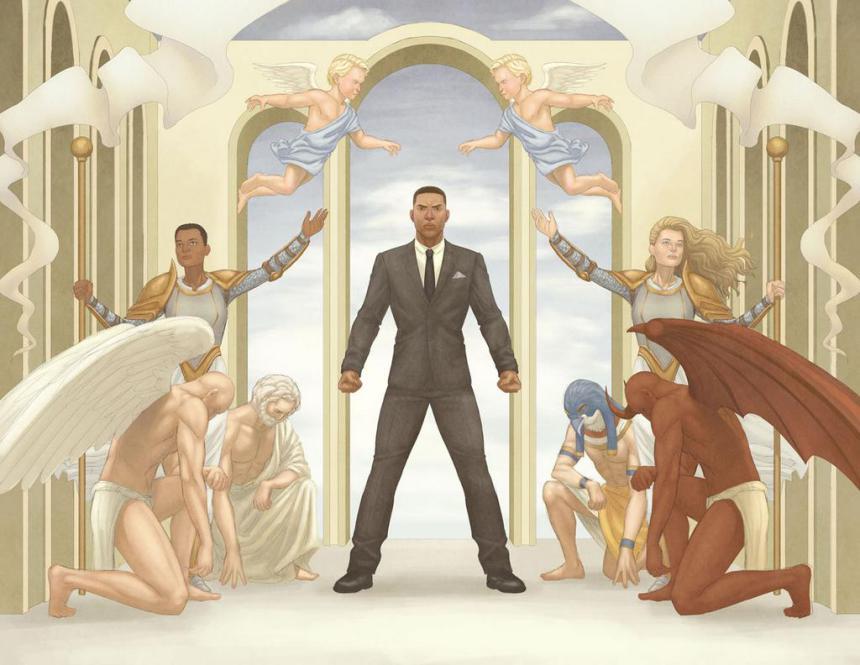
The Wicked + The Divine: Depiction of Baal in Majesty, AD 2014

Baal’s atrium in Wotan’s Valhalla features a gigantic mural of Baal dressed in an understated black suit and tie. His suit is the only thing understated about his portrait, and I love him for that. The mural is a fresco, pigment painted onto a wet plaster wall. It reaches from vaulted ceiling to floor on a Heroic scale. Baal is the central figure, positioned like a god—which of course he is—attended by archangels and cherubs. At his feet and supplicant are the devil, the Egyptian god Horus, Zeus and another angel. That bearded figure might be “God the Father” but it’s probably Zeus, a lightning god.

Why does it matter that we read the fresco as a painting executed on wet plaster? Because Baal’s wall isn’t decorated by poster art, or by airbrush or any modern technique– it’s Renaissance Art. Baal is positioning himself in a European pantheon. He is showing the lineage between himself and eurocentric culture and he is dominant over it.

He is Baal Haddad, a Canaanite god but painted like this he could also be Zeus or Jesus. Or Yeezus (aka Kanye).

Visit Graphic Policy to read my whole piece about the symbolism of @mckelvie ‘s use of Renaissance Art & comparisons to the contemporary paintings of Kehinde Wiley. 

It’s my nerdiest and most art history driven writing yet. @kierongillen​ seems to agree this is a reasonable use of my time. His work demands this attention so I can’t say no.

I want to thank @gothshostakovich​ for inspiring me to finally write this. Her post about the 1831 special is essential reading. 

PS: Here’s one of Wiley’s masterpiece’s “Napoleon Leading the Army Over the Alps”. I’m pretty sure Baal owns it.

image

Very cool. 

Hi! I was reading about the Wars of the Roses and I’m a little confused. Who actually had the better claim, Lancaster, York, or Tudor?

I don’t know if there’s a right answer to this per se, other than “not Tudor.”

Lancaster held the throne at the outset of the Wars of the Roses, so they could argue that, A. Henry had been anointed by God at his coronation, where he had taken the coronation oath and had been acclaimed and done homage, B. he was the rightful king by inheritance from Henry V and Henry IV before him, and C. Henry had a legitimate male heir. 

On the other hand, the Yorkists could claim that A. Henry’s inheritance was based on the usurpation of Richard II by Henry Bolingbroke and was thus in violation of the laws of succession, and that B. because Richard Plantagent was descended from Lionel of Antwerp the second son of Edward III (albeit on the female side through Anne Mortimer, although he was descended from Edmund of Langley, the fourth son of Edward III, on the male side), his claim super-seded that of Henry IV who was the son of John of Gaunt the third son of Edward IV, and C. that Parliament had passed the Act of Accord naming Richard Plantagent (and his sons) heir to the throne after Henry’s death. 

Whereas all the Tudors had was that the Beauforts were legitimized bastards of John of Gaunt, and that the Tudors had married Henry V’s widow. Oh, and that they claimed descent from Cadwaladr ap Cadwallon, King of Gwynedd, who Geoffrey of Monmouth had named as the last King of Britain, but at that point you’re basically using fanfic as evidence. 
I was looking at your theory on the prologue of TWOW, so I’m curious: Why would Stoneheart and the BwB hang Jeyne? As far as I can see, Catelyn had a rather amicable relationship with her good-daughter, why kill her?

poorquentyn:

warsofasoiaf:

Because it’s not Catelyn anymore, it’s Lady Stoneheart. She’s a revenant, and she’s fighting for vengeance not with a scalpel, but with an axe. Catelyn wouldn’t have hanged Brienne either, but it’s Stoneheart.

Thanks for the question, Anon.

SomethingLikeALawyer, Hand of the King

Indeed. And specifically, Stoneheart’s got a spy in Riverrun (Tom o’ Sevens), which means she may well know about Sybell’s deal with Tywin. If so, Stoneheart will probably assume that Jeyne was in on it. 

Or just blame her for Robb’s death because of her marriage to Robb regardless of how little sense that makes. 

As SLAL pointed out, “it’s not Catelyn anymore, it’s Lady Stoneheart.” And what Lady Stoneheart is is Nemesis, and Nemesis is the primordial, implacable spirit of resentment against perceived injustice. Nothing rational or fair about it.

If Varys truly wants the best for the kingdom and is a Targayren loyalist and a consequentialist, as you claim, why did he inform Aerys of the council Rheagar was attempting to create at the tourney to retire Aerys. Surely he did not think Aerys was more suited toward the throne than Rheagar

Varys is a consequentialist and a utilitarian, but he’s not a Targaryen loyalist in the normal sense – he thinks that the Targaryen name and legend are useful, but only in so far as they are useful in producing and legitimizing his ideal enlightened despot.

As far as Varys was concerned, Rhaegar wasn’t suitable to play that role because he had been “taught that kingship is his right” rather than his duty, and had never gone through Varys’ carefully-designed curriculum for training the perfect prince. 

Moreover, Rhaegar had quite a few signs of being the wrong kind of Targaryen – he was melancholy and unpredictable, fixated on the tragedy of Summerhall, and was obsessed about prophecy and his role as the messiah. With a bit of stress and a bit of a push, one could easily see him following his grandfather’s path to wrack and ruin.