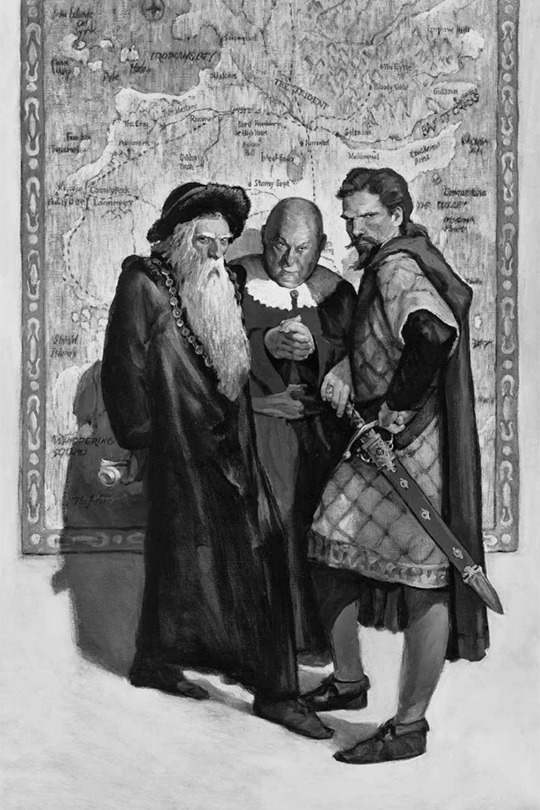
A Game of Thrones: The Illustrated Edition: “Maester Pycelle, Lord Varys & Petyr Baelish” by Gary Gianni
I kind of love/hate this. On the one hand, Pycelle as EvilGandalf is amazing and Varys looks like Sydney Greenstreet, which I love. On the other hand, Littlefinger doesn’t carry a sword at his hip, ever.
True. But there’s a distinction between Ghiscari Valyrian and High Valyrian, or for that matter between Tyroshi Valyrian and High Valyrian – the term “High” standing in juxtaposition to the “low” Valyrian of the dialects.
Sure it is. Let’s leave out the fact that we see plenty of people using gold dragons – Dunk, for example. Let’s just do a thought experiment.
A load of bread costs around three coppers. Assume that everyone in King’s Landing eats a loaf a day – which is pretty close to the statistics we have of ancien regime France, for example – that’s 1.5 million coppers that bakers are getting, which works out to about five thousand pounds of metal, on a daily basis. Trying to store that much metal is a giant pain, but it gets a lot easier when you can turn that 1.5 million coppers into 26,785 stags or 127 gold. I guess the point I’m getting at is that when you’re thinking about currency, in addition to thinking about different economic classes, you also need to think about different economic scales – even if most people aren’t throwing around gold on a regular basis, there’s a lot of economic activity in aggregate and having different denominations makes that easier.
Now, as for why those denominations are metallic rather than paper…well, let me recommend Extra History’s series on the history of paper money:
The quick version of a very long and complicated history is that it depends on social and economic organization and levels of trust. With regards to the former, it comes down to this: how many people are there for whom this given note is going to be useful? Yes, merchants and nobles might be doing enough business that they’d be able to use a letter of credit from a given merchant, but what happens if that merchant or noble needs to buy a horse from a farmer who’s never been to King’s Landing, let along Braavos?
With regards to the latter, before governments get into the business of printing money, you’re basically taking it on trust that the particular bank’s or merchant’s or nobleman’s notes are worth what they claim to be, and you run the risk that a bank failure or a bankruptcy or fraud (because the potential for fraud with letters of credit and other notes is huge) leaves you with nothing.
And it gets even more complicated, because there’s no standardization, and so you have to discount the value of the notes of this merchant or this bank, which makes valuing the notes or making change or basic stuff like that really complicated. When I was in high school, my family sometimes went on trips to Old Sturbridge Village, a living recreation of an 1830s New England village. One of the places you could visit in the village was their bank, and I remember being shown these massive ledgers where bankers would record the different bank notes they have seen and what they think the notes were worth, and it’s a huge undertaking.
Whereas gold coins have the advantage that they can be weighed and assayed to figure out how much the coin is worth, so you don’t have to do any of that. And as MMT theorists have pointed out, there was another advantage to coins: they had the government’s stamp on them saying what the coin was supposed to be worth, and they had a relatively steady value based on what the government would pay for goods and services, and how many coins they would accept as payment for taxes.
That being said, the gold standard is insane, fiat money is a huge advance in human civilization, but it took a lot of work to make it possible.
Got it in one: they think Dany doesn’t speak Valyrian (which is partly why the Astapori think of her as a barbarian, because anyone who’s civilized speaks it), so Missandei is there to translate.
High Valyrian is pretty clearly modelled on previous international languages, but in slightly weird ways. On the one hand, because it’s the language of classical scholarship, it’s taught in the Citadel, and educated highborn people like Tyrion learn it as part of being cultured, it’s a lot like how Latin was the international language of the literate in Medieval and Early Modern Europe.
And it’s also got that root-language thing; in the same way that Latin gave rise to the Romance languages, High Valyrian has given rise to the dialects of the Free Cities. Thus, Kraznys doesn’t speak particularly good Valyrian, “twisted and thickened by the characteristic growl of Ghis, and flavored here and there with words of slaver argot.” Grazdan is probably better-educated than Kraznys; hence being able to speak Westerosi (although not well), so his Valyrian is better.
On the other hand, trade languages aren’t usually the grammatically complex, sophisticated languages of scholarship. They tend to be simplified pidgins, because they’re being used in inter-cultural communication and you’re primarily interested in buying and selling and things like complex declensions and cases and tenses just get in the way of business. So for example, the original linga franca which emerged in the Mediterranean in the medieval period, used a simplified Italian as its base because of the prominence of Italian merchants, and then added on large numbers of loan words from almost every language group a merchant might encounter in the Mediterranean, from Spanish and French to Turkish.
Captain America was around for the protests of the 1960s, and sided with the protesters when it came to radical occupations of univerisites, so he’s absolutely going to back someone in a peaceful symbolic protest. In fact, he’s explicitly made the same kind of arguments that Colin Kaepernick is making:
And as I’ll discuss in a forthcoming People’s History of the Marvel Universe, Captain America has specifically dealt with issues of police brutality before. Starting in Captain America #139 (1968), Steve Rogers joined the NYPD, where he championed community policing, fought police corruption, ended urban riots peacefully, and brought down the Cowled Commander, a supervillain cop working to fight reform of the NYPD.
So there is no doubt whatsoever in my mind of which side Cap would be on.
What do you think Tatters is going to do when he takes Pentos, gather the current Prince and all the magisters and spear their heads to the gates of the prince’s palace a la Francesco Sforza?
My guess is abolish the Council of Magisters and declare himself King of Pentos, amidst a spree of proscriptions, executions, and confiscations that would make Sulla blush.
there’s someone on my friends list who is also a comic nerd but like…right now he’s sharing a meme about how captain america would be disgraced at americans kneeling for national anthem
& like i really wanna come at him with receipts about how he’s fucking wrong as fuck
like…did you not pay attention during civil war????? at all???
DUDE.
“I remember the first time I really understood what it was to be an American…what it was to be a patriot. I was just a kid…a million years ago, it sometimes seems, maybe twelve. I was reading Mark Twain. And he wrote something that struck me right down to my core…something so powerful, so true, that it changed my life. I memorized it, so I could repeat it to myself, over and over across the years. He wrote – In a Republic, who is ‘The Country?’ Is it the government which is for the moment in the saddle? Why, the government is merely a temporary servant; it cannot be its prerogative to determine what is right and what is wrong, and decide who is a patriot and who isn’t. Its function is to obey orders, not originate them. Who, then, is ‘the country?’ Is it the newspaper? Is it the pulpit? Why, those are mere parts of the country, not the whole of it. They have not command, they have only their little share in the command.”
“In a monarchy, the king and his family are the country; in a republic, it is the common voice of the people. Each of you, for himself, by himself and on his own responsibility, must speak. It is a solemn and weighty responsibility and not lightly to be flung aside at the bullying of pulpit, press, government, or the empty catchphrases of politicians. Each must for himself alone decide what is right and what is wrong, and which course is patriotic and which isn’t. You cannot shirk this and be a man. To decide against your convictions is to be an unqualified and inexcusable traitor, both to yourself and to your country, let men label you as they may. If you alone of all the nation shall decide one way, and that way be the right way according to your convictions of the right, you have done your duty by yourself and by your country. Hold up your head, you have nothing to be ashamed of.”
“Doesn’t matter what the press says, doesn’t matter what the politicians or the mobs say. Doesn’t matter if the whole country decides that something wrong is something right. This nation was founded on one principle above all else: The requirement that we stand up for what we believe, no matter the odds or the consequence. When the mob and the press and the whole world tell you to move, your job is to plant yourself like a tree beside the river of truth, and tell the whole world – no, you move.”
“There’s a difference between fighting against evil and fighting for the common good. I’m not always able to choose my battles… but effective immediately, I’m going to make an effort to choose the battles that matter. Battles against injustice, against cynicism, against intolerance. I will still serve with the Avengers. I will continue to defend this nation from any and all threats it may face. But as of today, I am not a “super hero.” Now and forevermore, I am a man of the people. Together, you and I will identify and confront America’s problems. Together, we will figure out what we are and what we can be. Together, we will define the American Dream and make it an American reality.”
-Captain America, vol. 4 #7
“Listen to me – all of you out there! You were told by this man – your hero – that America is the greatest country in the world!He told you that Americans were the greatest people – that America could be refined like silver, could have the impurities hammered out of it, and shine more brightly! He went on about how precious America was – how you needed to make sure it remained great! And he told you anything was justified to preserve that great treasure, that pearl of great price that is America! Well, I say America is nothing!! Without its ideals – its commitment to the freedom of all men, America is a piece of trash! A nation is nothing! A flag is a piece of cloth! I fought Adolf Hitler not because America was great, but because it was fragile! I knew that liberty could be snuffed out here as in Nazi Germany! As a people, we were no different than them!When I returned, I saw that you nearly did turn American into nothing! And the only reason you’re not less then nothing —- is that it’s still possible for you to bring freedom back to America!”
There is a long silence, then…
“Th-that is him!! That’s the real Captain America!”


 RFTIT Tumblr Backup