Do you prefer the symbiote as it is from OTL or in Ultimate universe, synthetic?

kwaj:

racefortheironthrone:

OTL. Although, TBH, I’m not really into the whole symbiote planet thing. 

Is it because of Conservation of Ninjutsu? One symbiote is an enigmatic and interesting threat. An entire planet’s worth is just a bunch of disposable goons.

It was always a rather wonky retcon – why did this machine on Battleworld use it to make clothing, exactly – but yeah, the planet thing is largely out of a desire by Marvel to make Venom more of a franchise than the idea can hold. Hence – deep breath – Carnage, Toxin, Anti-Venom, Scream, Hybrid, Riot, Phage, Agony, Lasher, Scorn, Mania, the Poisons, Payback, ZZXX, Marcus, Karl Malus, the Agents of the Cosmos, Raza, All-Black, Grendel, Sleeper, and the symbiote versions of the O5 X-Men, and on and on.

In the same way that photocopies of photocopies gradually lose fidelity, each iteration on the original is less novel and less interesting than the one before it, and keep in mind the original was a pretty meh Nineties Edgelord to begin with.

Not every concept has the load-bearing capacity to support a franchise. 

Even before Joffrey’s murder, do you think Tywin was looking for a way to rid of Tyrion? Cersei’s accusation gave him pretext, but it seems to me that if he wanted to keep Tyrion around, it wouldn’t have been that hard for him to say something like “the Queen is sick with grief,” asked the nearest Kingsguard to escort her to her chambers, and shipped her back Casterly Rock as soon as possible when she made her accusation.

He wanted to send Tyrion to Winterfell…

Who would consider Spiderman’s all time arch nemesis? Goblin, Ock or Venom?

Venom I’ve already said my piece about. 

Picking between the Green Goblin and Doc Ock is real hard. 

The Green Goblin works really well as Peter’s opposite: poor vs. rich, accidental power vs. sought-after power, altruistic vs. selfish. Plus, you add all the Shakespearean drama of Harry torn between Peter’s friend and Norman’s son, the death of Gwen Stacey, and of course the death of Norman. 

Doc Ock is the dark mirror version of Peter, far more than Venom ever was. They’re both science nerds who gain powers in an accident, but Peter ultimately learns a positive lesson from his accident – power, responsibility, et al. – but Doc Ock becomes bitter and selfish. And he’s got some really weird connections with the Parker family, what with trying to marry Aunt May. 

Could part of Valyria’s drive to enslave more and more people have had something to do with feeding an enormous population of dragons? I know it’s never mentioned as such, but I always thought that feeding – for example – the 300 dragons during Garin’s last stand must have been a hell of a logistical problem.

No, it was to feed the mines

While I’m sure slaves were sometimes fed to dragons, I’m pretty sure that would have been to terrify and intimidate the slaves into compliance, rather than as a primary foodsource. 

Thoughts on J. Jonah Jameson as a character?

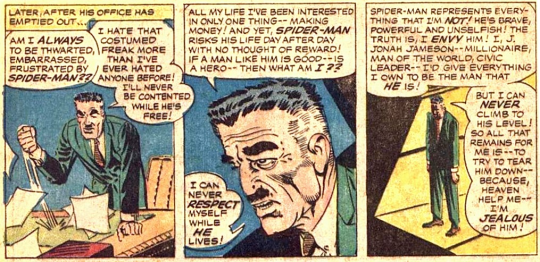
J. Jonah Jameson is a great character, who somehow is both absolutely classic – you could do a silhouette carictature of the toothbrush moustache, the flattop haircut, and the stogie and I think you could get most people on the street to guess his identity – but also incredibly mutable. He can be Spider-Man’s most enduring hater or his biggest ally; an amoral scandal-monger who cares about selling papers not the truth or a tough-but-fair newspaperman of the old school who won’t tolerate spin and who will back good investigative reporting to his last breath; the Mayor of New York City or a conspiracy theory podcaster. 

image

Jameson’s original version of him is a Steve Ditko original, steeped in Ditko’s own brand of Objectivist philosophy, a tormented, small man hiding behind bluster and bravado, consumed by ressentiment towards those who stand above the crowd, who fans the flames of the mob’s hatred in order to salve his own ego. But somehow this jacket couldn’t quite stick; Jameson has too much roaring energy, too much snappy cigar-chewing banter, too rich of a Falstaffian mix of hypocritical humor and human frailty, to go down as a Randian cardboard cutout. 

https://youtu.be/mhDBWiTfNCU

So over the years, writers have looked for a deeper and more sympathetic motivation for Jameson, and his character changed as a result. I would call him Spider-Man’s Loyal Opposition, undoubtedly an irritant and an obstacle, but one whose constant pressure pushes Spider-Man to be a more selfless, more “responsible” hero, if only to get one over on the old man. 

in the show it’s revelead that the Iron Bank invested in the slave trade of Essos. Would that be something that could happen in Book!Braavos?

Not directly, no. The First Law of Braavos forbids slavery, and that law is enforced:

“I know why the Sealord seized the Goodheart. She was carrying slaves. Hundreds of slaves, women and children, roped together in her hold.” Braavos had been founded by escaped slaves, and the slave trade was forbidden here.

“I know where the slaves came from. They were wildlings from Westeros, from a place called Hardhome. An old ruined place, accursed.” Old Nan had told her tales of Hardhome, back at Winterfell when she had still been Arya Stark. “After the big battle where the King-Beyond-the-Wall was killed, the wildlings ran away, and this woods witch said that if they went to Hardhome, ships would come and carry them away to someplace warm. But no ships came, except these two Lyseni pirates, Goodheart and Elephant, that had been driven north by a storm. They dropped anchor off Hardhome to make repairs, and saw the wildlings, but there were thousands and they didn’t have room for all of them, so they said they’d just take the women and the children. The wildlings had nothing to eat, so the men sent out their wives and daughters, but as soon as the ships were out to sea, the Lyseni drove them below and roped them up. They meant to sell them all in Lys. Only then they ran into another storm and the ships were parted. The Goodheart was so damaged her captain had no choice but to put in here…” (AFFC, The Blind Girl)

And that’s just domestically – internationally, Braavos has fought six wars with Pentos over the issue of slavery, and forced Pentos to abolish slavery and the slave trade. 

On the other hand, the Iron Bank of Braavos is quite active in lending to “Kings, princes, archons, triarchs, and merchants beyond count,” and they in turn likely buy and sell slaves (although I doubt that the Iron Bank would approve a business loan specifically to buy slaves as opposed to a general line of credit). 

However, we’ve had quite a few chapters set in Braavos, between Arya and Sam, and GRRM has not been sparing in the gossip, letting us know about merchants and nobles, courtesans and bravos, and that the Sealord is ailing and there will be a “choosing” soon, and we even know the name of one of the leading candidates. At no point in time have we heard anything about the Iron Bank supporting Volantis against Daenerys for interfering with the slave trade. 

My belief is that the slave trade nonsense was cooked up by Benioff and Weiss to give the Iron Bank a motivation to back Cersei against Daenerys because they’ve essentially given Aegon’s plot to Cersei (hence giving her the Golden Company) in order to give Lena Headey something to do. 
Never heard of the Accursed Kings before , but your write-up has piqued my interest. Would you recommend it ? Are all the books good, or just the first few ? Also are the books enjoyable as standalone works, or do you need to read the full series to really savor them ?

To take the questions in reverse order: no, you really should read the books in order; I find the quality drops a bit towards the end of the series, but at least the first three are worth reading. 

I’m curious about where the idea for a system of canals in your Westerosi economic development plans came from. The only IRL historical example of such a system that I can think of was in China, and that one kinda broke down in government corruption and general infrastructure decay after a thousand years or so. I guess I’m curious about how you would manage the upkeep of these canals, and also how you would counteract corruption in trading ports and port cities in general.

Great question!

image

You’re not the first person to bring this up, but no, the Grand Canal of China is not the only example of premodern canal-building as an economic development strategy, only the biggest and most extravagant example.

Indeed, the reason why I put canals at the center of my Economic Development plans is that canal-building was a quite common part of Early Modern European economic development, as the Commercial Revolution offered enormous advantages to European states that could move goods faster than their competitors:

  • In France, canal-building was a major part of the economic policy of more than a few monarchs and finance ministers: you had the Briare Canal (35 miles long) built to link the Loire to the Seine, and most impressively you had the Canal des Deux Mers which connected the Atlantic to the Medittarnean (270 miles long). 
  • In Germany, the Prussians were absolutely mad for canals, so you had a series of canals built by zarious Hohenzollerns to link the Elbe to the Oder to the Weser.
  • Due to the nature of their geography, the Dutch and the Belgians were huge innovators in canals going back to the 13th century, building canals to protect their cities from armies and floods but also to encourage water-based commerce, and to connect Amsterdam to Haarlem, Haarlem to Leiden, and so on and so forth.
  • While most English canals were built during the “canal mania” of the 18th and early 19th centuries, there are quite a few canals built during the Early Modern period (the Exeter Canal in 1566, the Oxford-Burcot improvements to the Thames between 1605-1635, the River Wey improvements in 1653, the Stamford Canal in 1670, etc.)

In general, I opted for canals because you can build them with existing technology (they mostly involve a lot of manual labor, and various forms of simple locks were well within the technological capacity of Medieval Europeans) which means that the plan doesn’t rely on the discovery of new technology, they have a broad economic impact across a wide area by reducing transportation costs and lowering the price of bulk goods, and because Westeros has a lot of major river systems that almost, but don’t quite, connect so that relatively short canals can have an outsized impact on travel.